10 Google Ads Mistakes That Waste Your Budget
Google Ads can bring qualified traffic, leads, and sales quickly, but poor campaign decisions can drain money just as fast. Many advertisers do not lose budget because the platform is ineffective; they lose it because of avoidable setup, targeting, tracking, and optimization errors. Understanding the most common Google Ads Mistakes can help you spend more efficiently and improve return on ad spend.
Identifying Google Ads Mistakes early helps protect your budget. The following ten issues are common reasons businesses pay for clicks that do not produce meaningful results.
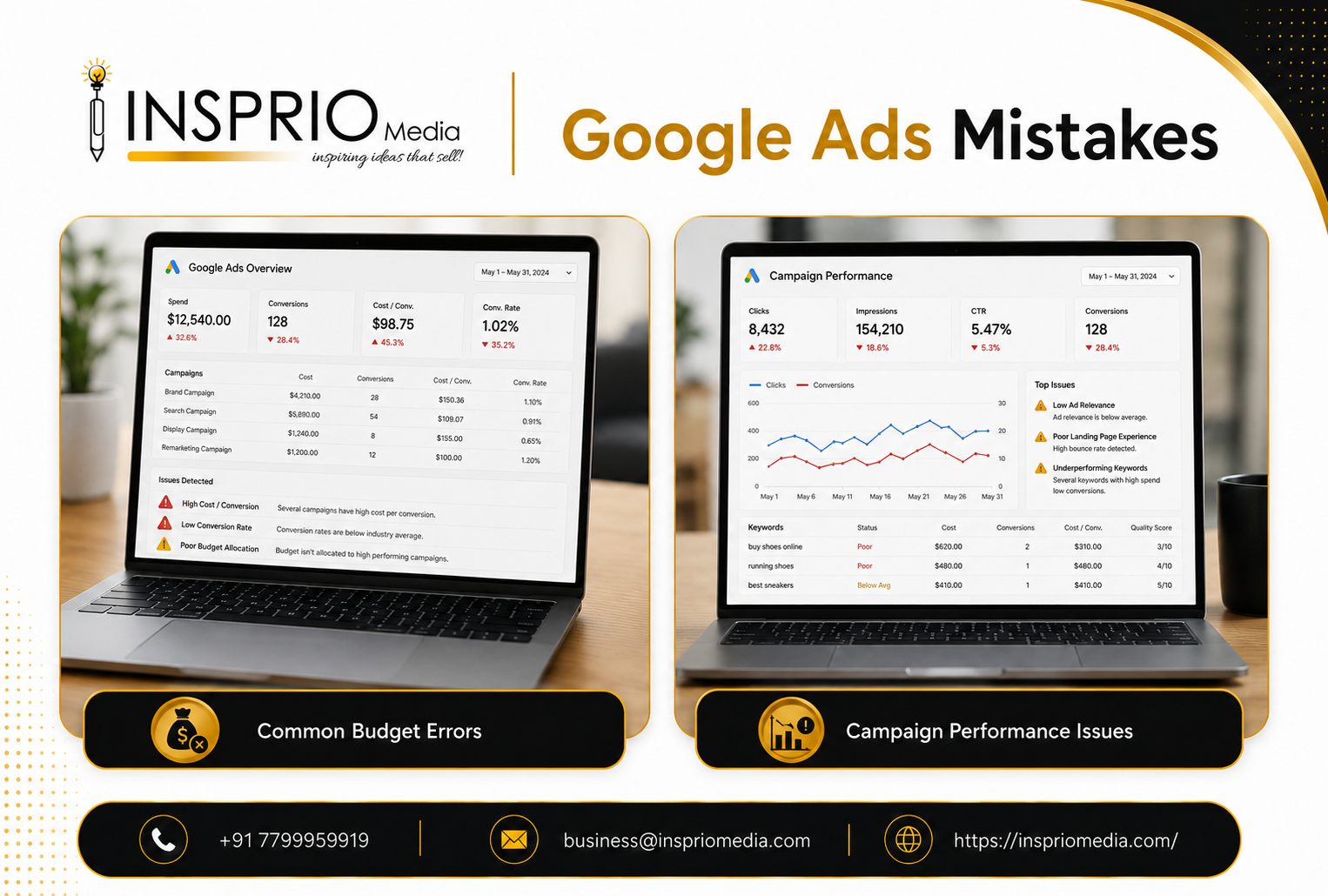
1. Using Broad Keywords Without Enough Control
One of the biggest Google Ads Mistakes is using broad keywords without carefully reviewing search terms. Broad match can discover new opportunities, but it may also trigger ads for searches that are only loosely related to your offer.
Review the Search Terms report frequently and add negative keywords for irrelevant traffic. If you sell premium business software, for example, searches containing words such as “free,” “jobs,” or “course” may not match your commercial intent. Preventing these Google Ads Mistakes helps focus spend on people more likely to convert.
2. Ignoring Negative Keywords
Failing to build a negative keyword list is another expensive example of Google Ads Mistakes. Negative keywords tell Google when not to show your ad, which can reduce wasted clicks and improve traffic quality.
Build negative keyword lists for irrelevant services, locations, informational searches, and low-value terms. This can eliminate many Google Ads Mistakes before they consume your monthly budget.
3. Sending Every Ad to the Homepage
Among the most damaging Google Ads Mistakes is directing every visitor to a generic homepage. Someone searching for a specific product or service expects a page that directly addresses that need.
Use dedicated landing pages with relevant headlines, benefits, trust signals, and a strong call to action. Avoiding these Google Ads Mistakes creates a smoother path from keyword to ad to conversion.
4. Running Campaigns Without Reliable Conversion Tracking
Running ads without accurate conversion tracking is one of the most serious Google Ads Mistakes. If you cannot measure calls, form submissions, purchases, bookings, or other valuable actions, you cannot confidently judge campaign performance.
Set up and test conversion actions before making major budget decisions. See Google's conversion tracking documentation for official guidance.
5. Setting the Same Budget for Every Campaign
Treating every campaign equally is another common form of Google Ads Mistakes. Different products, services, locations, and audiences often have different conversion rates and profit margins.
Allocate more budget to campaigns producing profitable results and limit campaigns that still need testing. Use performance data rather than assumptions.
6. Writing Generic Ads With No Clear Benefit
Weak ad copy can create Google Ads Mistakes even when targeting is accurate. Generic messages such as “Best Service” or “Contact Us Today” may not explain why a searcher should choose your business.
Use headlines that match intent and emphasize specific value such as speed, expertise, availability, or a strong offer. See Google's responsive search ads guidance .
7. Not Reviewing Search Terms Regularly
Search behavior changes, so ignoring the Search Terms report can create ongoing Google Ads Mistakes. New irrelevant queries may appear as Google expands matching based on intent.
Review search terms weekly. Add valuable queries as targeted keywords and exclude poor-fit queries. Google explains matching in its keyword match types documentation .
8. Targeting Locations Too Broadly
Location targeting is often overlooked, yet it can cause costly Google Ads Mistakes. A local company may accidentally pay for traffic from people outside its service area or from users who only show interest in the location.
Check your geographic settings, location reports, and presence options. Google's location targeting guide explains how geographic targeting works.
9. Making Too Many Changes Too Quickly
Constantly changing bids, budgets, keywords, ads, and targeting can create confusing Google Ads Mistakes. Automated bidding systems often need enough conversion data and time to learn.
Make changes based on a clear hypothesis and allow time to evaluate results. For automated bidding, review Google's automated bidding information .
10. Focusing Only on Clicks Instead of Business Results
High click volume can look impressive, but it can hide serious Google Ads Mistakes. A campaign with thousands of clicks may still be unprofitable if leads are poor quality or cost per acquisition is too high.
Track qualified leads, sales, revenue, cost per acquisition, conversion value, and return on ad spend. The Google Ads Help Center provides official measurement guidance.
How Better Campaign Strategy Prevents Wasted Spend
Fixing Google Ads Mistakes is not about finding one secret setting. It requires a connected strategy that includes keyword intent, account structure, compelling ad copy, relevant landing pages, accurate tracking, disciplined budget allocation, and continuous optimization.
For businesses that want to improve campaign profitability, it is useful to connect paid advertising with broader digital growth activities. Explore Insprio Media's performance marketing insights , social media management guide , GMB SEO services article , and website SEO services guide .
You can also learn how stronger creative and brand assets support campaign performance through 3D design services , graphic design services , offline marketing services , branding services , web development services , and digital marketing services . You can also visit the Insprio Media homepage to explore its broader marketing solutions.
Another way to reduce Google Ads Mistakes is to review campaign data in context rather than judging one metric alone. A lower click-through rate is not automatically bad if the campaign produces highly qualified leads, and a cheaper click is not automatically good if users never convert.
Google's Skillshop training platform is another authoritative resource for learning Google Ads fundamentals and certifications.
FAQs About Google Ads Mistakes
What are the most common Google Ads Mistakes?
The most common Google Ads Mistakes include poor keyword targeting, missing negative keywords, weak conversion tracking, broad location settings, generic ad copy, and sending traffic to irrelevant landing pages.
How often should I review my Google Ads campaigns?
For active campaigns, review key performance data at least weekly. Larger accounts may need more frequent checks. Regular reviews help identify Google Ads Mistakes such as sudden cost increases, irrelevant search terms, or declining conversion rates.
Can a small budget still work in Google Ads?
Yes. A small budget can perform well when it is tightly focused on high-intent keywords, strong locations, and clear conversion goals. Avoiding Google Ads Mistakes becomes especially important when every click represents a meaningful share of the budget.
Why am I getting clicks but no leads?
This can happen because of poor targeting, weak landing pages, unclear offers, inaccurate tracking, or low-quality traffic. These are all common Google Ads Mistakes that should be investigated through search-term, landing-page, and conversion data.
Do negative keywords really save money?
Yes. Negative keywords can prevent ads from showing for irrelevant queries, reducing wasted clicks. Ignoring them is one of the easiest Google Ads Mistakes to correct.
Should I use automated bidding?
Automated bidding can be effective when conversion tracking is accurate and the campaign has enough data. Using automation without trustworthy measurement can create additional Google Ads Mistakes, so tracking should be validated first.
Conclusion
Google Ads can be highly profitable when campaigns are structured around real customer intent and measurable business goals. The biggest opportunity is often not spending more, but removing waste. By correcting these Google Ads Mistakes, advertisers can improve traffic quality, reduce unnecessary spend, and make better decisions about where to scale.