Performance Marketing Funnel: From Clicks to Customers
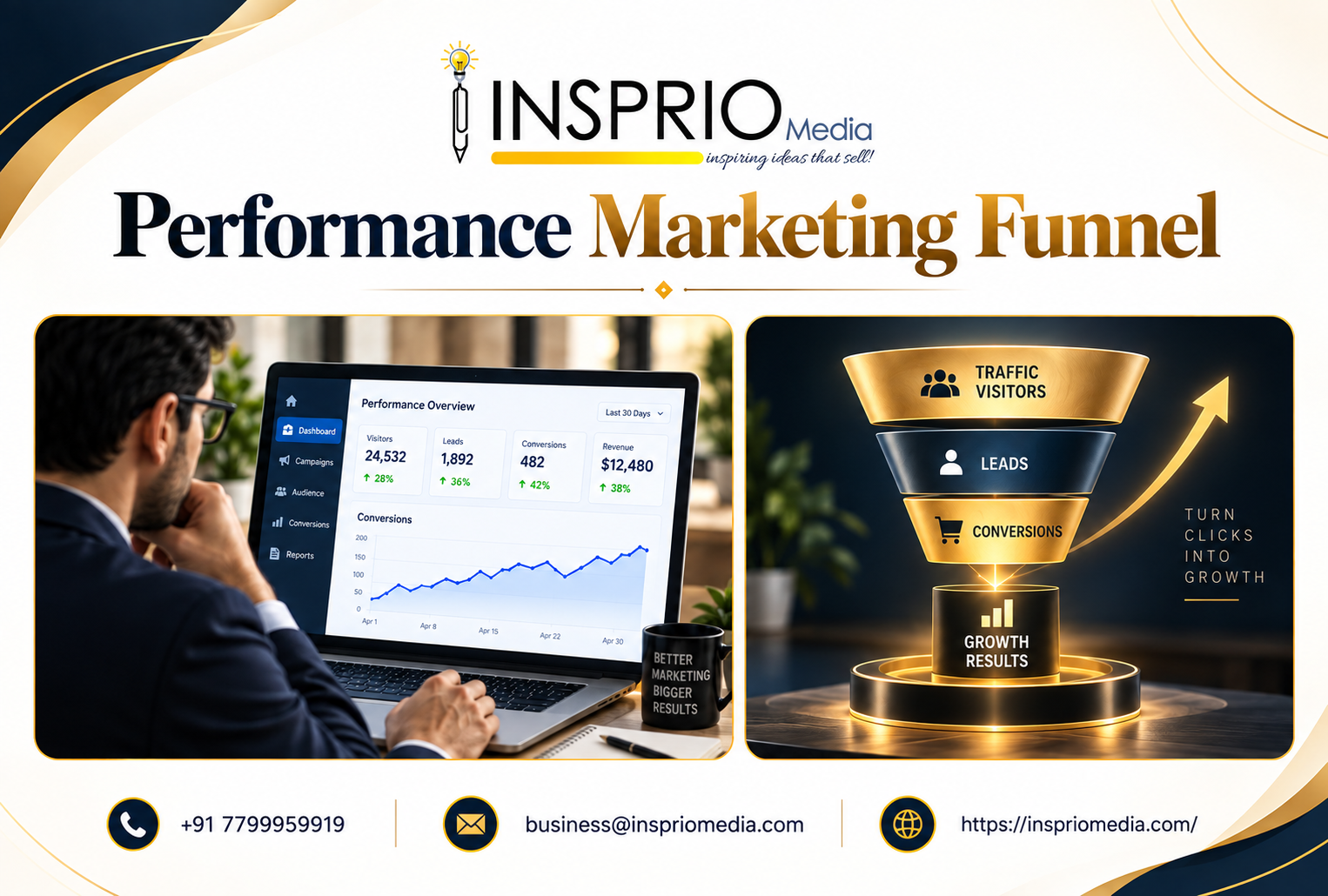
A successful digital campaign is not simply about generating more traffic or collecting inexpensive clicks. Businesses need a structured path that turns attention into measurable commercial outcomes, and a Performance Marketing Funnel provides that structure. It connects advertising, content, landing pages, audience targeting, lead nurturing, remarketing, conversion tracking, and sales activity into one measurable customer journey. Instead of treating every campaign as an isolated advertisement, businesses can understand what prospects need at each stage and build campaigns around those needs. When a Performance Marketing Funnel is planned correctly, the focus moves away from vanity metrics toward qualified leads, completed purchases, booked appointments, customer acquisition cost, revenue, and long-term profitability.
Modern buyers rarely see one advertisement and purchase immediately. They may discover a company through Instagram, search for its services on Google, read educational content, compare competitors, leave the website, encounter a remarketing advertisement, return through branded search, and finally complete an enquiry. A Performance Marketing Funnel helps marketers understand this multi-touch behaviour rather than giving all importance to one isolated click. The objective is to create a connected experience in which every interaction has a purpose. By analysing how audiences enter, move through, and exit the Performance Marketing Funnel, marketers can identify friction, improve messaging, strengthen conversion pathways, and invest advertising budgets where they are most likely to generate meaningful business results.
This approach is particularly valuable because digital advertising has become more competitive. Businesses cannot afford to continuously increase spending while ignoring landing-page quality, audience intent, sales follow-up, tracking accuracy, and customer value. A Performance Marketing Funnel allows these components to work as one growth system. At Insprio Media, performance-driven campaigns can be supported by search marketing, social media, SEO, web development, branding, graphic design, and other digital capabilities that strengthen different stages of the journey. The goal of a Performance Marketing Funnel is therefore bigger than generating clicks: it is to create a repeatable acquisition process that can be measured, improved, and scaled as reliable performance data becomes available.
1. Build the Funnel Around Business Outcomes
The first step is defining what a successful customer action actually means. An ecommerce business may optimise for completed purchases, while a real estate company may prioritise qualified enquiries, scheduled site visits, and closed transactions. A healthcare provider may measure appointment bookings, and a B2B company may focus on demo requests or sales-qualified leads. A Performance Marketing Funnel should therefore begin with revenue objectives rather than advertising platforms. Choosing Google Ads or Meta Ads before defining the commercial objective can result in disconnected campaigns. A strong Performance Marketing Funnel works backwards from the desired business result and determines which audience, offer, channel, message, landing page, conversion event, and follow-up process is required to achieve that result efficiently.
Clear goals also make campaign measurement much more useful. Instead of reporting that an advertisement generated thousands of impressions, marketers can connect spending to enquiries, opportunities, transactions, or customer lifetime value. The Performance Marketing Funnel should include primary conversions and supporting micro-conversions such as video engagement, product views, form starts, pricing-page visits, WhatsApp clicks, downloads, or repeat sessions. These actions show whether potential customers are progressing toward a final decision. Businesses interested in a broader measurable growth approach can explore Insprio Media's guide to performance marketing and ROI. Connecting commercial objectives to the Performance Marketing Funnel makes optimisation more meaningful because teams understand exactly which behaviour they are trying to increase.
Another important requirement is agreement between marketing and sales. Marketing teams sometimes celebrate lead volume while sales teams complain that the leads are not qualified. This usually indicates that success criteria were never aligned. A Performance Marketing Funnel should establish what constitutes an enquiry, qualified lead, sales opportunity, customer, and repeat customer. It should also define how quickly sales representatives should respond and what information should be recorded. Without these definitions, advertising platforms may optimise toward easy but low-value conversions. When marketing and sales share one Performance Marketing Funnel, campaign decisions can be based on downstream quality rather than simply the number of form submissions generated.
Finally, businesses should establish realistic benchmark metrics before scaling. These can include click-through rate, landing-page conversion rate, cost per lead, lead-to-opportunity rate, sales conversion rate, average order value, customer acquisition cost, and return on advertising spend. The Performance Marketing Funnel gives context to each number because no single metric tells the full story. A campaign may have an expensive cost per lead but generate customers with substantially higher purchase values. Another campaign may produce inexpensive leads that rarely convert. Evaluating the complete Performance Marketing Funnel prevents teams from scaling activity simply because an early-stage number looks attractive while the final commercial results remain weak.
2. Awareness: Attract the Right Attention
The widest stage of customer acquisition is awareness, where potential buyers discover a brand or realise that a solution exists for their problem. At this point, expecting every visitor to buy immediately is unrealistic. A Performance Marketing Funnel uses awareness campaigns to introduce useful ideas, demonstrate expertise, communicate a clear brand position, and begin collecting behavioural signals. Search advertisements, educational videos, social media campaigns, SEO content, display advertising, and high-quality creative can all contribute. The purpose of the Performance Marketing Funnel at this stage is not simply maximum reach; it is relevant reach among people who could realistically progress into customers as their interest and purchase intent develop.
Creative quality matters significantly during awareness. Users scrolling quickly through social feeds decide within seconds whether a message deserves attention. Clear visuals, strong hooks, customer pain points, demonstrations, before-and-after examples, useful statistics, and concise benefit-driven messaging can increase engagement. A Performance Marketing Funnel should test multiple creative concepts instead of relying on one advertisement indefinitely. Different prospects respond to different problems and motivations, so creative testing generates information that can improve later stages. Insprio Media's article about graphic design and brand identity explains the wider importance of visual communication. Strong creative gives the Performance Marketing Funnel more qualified attention to work with.
Organic social activity can also strengthen paid acquisition because prospective customers often examine a company's profile before contacting it. An advertisement may introduce the company, but recent posts, reviews, educational content, comments, and consistent branding can influence whether the visitor develops trust. A Performance Marketing Funnel should account for these supporting touchpoints rather than assuming the advertisement operates alone. Businesses can learn more through this guide to social media management for business growth. When organic and paid channels communicate a consistent message, the Performance Marketing Funnel becomes more persuasive because potential customers repeatedly encounter evidence that the company is active, credible, and relevant.
SEO plays a similar role by capturing people who are actively searching for information. Educational articles can introduce a brand before the visitor is ready to purchase, while commercial pages can attract users with stronger intent. A Performance Marketing Funnel becomes more efficient when paid and organic acquisition work together because prospects can encounter the business through multiple credible touchpoints. Insprio Media's guide to website SEO services and sustainable rankings provides additional context. Search visibility can lower dependence on continuous paid reach while giving the Performance Marketing Funnel a steady stream of potential buyers at different levels of intent.
3. Consideration: Turn Attention Into Genuine Interest
Once prospects understand their problem, they begin comparing possible solutions. This is where educational depth, proof, differentiation, pricing clarity, demonstrations, and customer trust become especially important. A Performance Marketing Funnel must anticipate the questions potential buyers ask before contacting sales. Service pages, comparison content, case studies, FAQs, testimonials, product demonstrations, downloadable guides, video explanations, calculators, and consultation offers can help prospects evaluate the business. At this stage, the Performance Marketing Funnel should reduce uncertainty instead of aggressively pushing every visitor toward an immediate transaction. Buyers who receive useful answers are more likely to progress naturally toward a commercial conversation.
Trust is one of the most valuable assets during consideration. Customers may ask whether the business is experienced, whether the product will solve their problem, whether the company is legitimate, and whether competitors offer better value. A Performance Marketing Funnel should provide evidence rather than relying on promotional claims alone. Customer reviews, project examples, credentials, transparent processes, team expertise, warranties, clear policies, and genuine case studies can all reduce perceived risk. Local companies can also strengthen discovery and credibility with Google Business Profile optimisation, supported by Insprio Media's guide to GMB SEO and Google Maps visibility. These trust signals make the Performance Marketing Funnel more effective before direct sales conversations begin.
Brand consistency becomes increasingly important as prospects move between advertisements, websites, social profiles, landing pages, email, and offline interactions. If every channel looks and sounds unrelated, customers may question whether they are dealing with the same organisation. A Performance Marketing Funnel should maintain consistent visual identity, positioning, tone, offers, and value propositions while adapting the message to each stage. Insprio Media's resource on branding services and business identity highlights why cohesive presentation matters. Consistency reduces cognitive friction and gives the Performance Marketing Funnel a recognisable identity that becomes stronger with repeated exposure.
Consideration campaigns should also segment visitors according to behaviour. Someone who watched twenty seconds of a video has demonstrated less intent than a visitor who repeatedly viewed pricing information or added a product to a cart. A Performance Marketing Funnel can separate these audiences and deliver different messages according to their level of engagement. Educational retargeting might suit early-stage visitors, while testimonials, demonstrations, limited-time incentives, or consultation prompts may suit high-intent prospects. Segmenting the Performance Marketing Funnel avoids showing identical advertisements to everyone and helps the business use advertising budget more intelligently.
4. Conversion: Make the Next Step Simple
The conversion stage is where attention and consideration become a measurable business action. The user may purchase, submit an enquiry, schedule a consultation, request a quotation, register for a trial, or call the company. A Performance Marketing Funnel should remove unnecessary barriers from this decision. Complex forms, unclear pricing, slow pages, confusing navigation, weak calls to action, hidden contact information, and inconsistent messaging can reduce conversions even when advertising performs well. The Performance Marketing Funnel therefore treats website usability and landing-page design as important performance variables rather than separate design considerations.
A strong call to action should clearly explain what happens after the user responds. “Request a Free Consultation,” “Get a Custom Quote,” “Book Your Demo,” or “Check Availability” often provides more context than generic buttons. A Performance Marketing Funnel can test different calls to action, form lengths, layouts, offers, headlines, social proof, and mobile experiences. Small improvements can become financially significant when campaigns operate at scale. Website infrastructure is equally important, which is why businesses may benefit from Insprio Media's guide to fast, secure and SEO-friendly web development. A technically reliable website gives the Performance Marketing Funnel a stronger environment for converting paid and organic traffic.
Mobile experience deserves special attention because many advertising interactions begin on smartphones. Forms need appropriately sized fields, buttons must be easy to tap, page elements should load quickly, and essential information should appear without excessive scrolling. A Performance Marketing Funnel can lose high-intent prospects if mobile users encounter friction at the final stage. Businesses should test landing pages on real devices rather than relying only on desktop previews. Telephone buttons, WhatsApp links, map directions, autofill support, simplified checkout processes, and concise forms can improve accessibility. Optimising the Performance Marketing Funnel for mobile behaviour is especially important when social media, local search, and mobile search campaigns generate a large percentage of traffic.
Sales response speed also influences final performance. An advertising campaign can generate excellent leads, but commercial value is lost when enquiries remain unanswered for hours or days. A Performance Marketing Funnel should include the operational process that begins after a conversion. Automatic confirmations can reassure prospects that their request was received, while CRM alerts can notify sales teams immediately. Lead information should help representatives understand the source, service interest, campaign, and actions completed before enquiry. When the Performance Marketing Funnel includes both acquisition and follow-up, management can evaluate the entire path from advertising spend to customer revenue instead of blaming marketing for weaknesses in the sales process or vice versa.
5. Landing Pages and Conversion Experience
Landing pages should be designed around one audience, one problem, and one primary action wherever possible. Sending every advertising campaign to a general homepage can force users to search for information they expected to see immediately. A Performance Marketing Funnel improves relevance by matching advertisement intent with landing-page content. The headline should reflect the campaign message, supporting copy should explain value clearly, and visual elements should reinforce the promised outcome. The Performance Marketing Funnel becomes stronger when the journey from advertisement to landing page feels continuous rather than like two unrelated experiences.
Good landing pages answer the most important questions before asking visitors to commit. What is being offered? Who is it for? What problem does it solve? Why should the visitor trust the company? What should they do next? A Performance Marketing Funnel uses content hierarchy to answer these questions quickly. Important benefits, evidence, process information, testimonials, frequently asked questions, and contact options should be easy to find. Visual content can also make complex services easier to understand, especially when businesses use animation, product visualisation, or interactive assets. Insprio Media's article about 3D design and visual experiences demonstrates how richer creative presentation can support the Performance Marketing Funnel.
Conversion optimisation should be treated as structured experimentation rather than random design changes. The Performance Marketing Funnel benefits when marketers create hypotheses based on evidence. If users frequently start a form but do not finish it, the team might test fewer required fields. If visitors leave before reaching testimonials, the social proof could be moved higher. If users repeatedly view pricing without enquiring, more clarity around packages may help. Every test should address a specific weakness in the Performance Marketing Funnel and should be measured against an appropriate conversion goal rather than judged primarily by visual preference.
Technical performance deserves equal attention. Large images, unnecessary scripts, broken tracking, intrusive pop-ups, layout shifts, security warnings, or slow server response can damage conversion rates. A Performance Marketing Funnel relies on an environment where visitors can complete actions without technical interruption. Page speed should be monitored alongside campaign metrics because poor experience can make strong traffic sources appear ineffective. Analytics can reveal unusually high abandonment by device, browser, geography, or landing page. Continuous technical monitoring ensures the Performance Marketing Funnel does not lose revenue simply because a website problem remained unnoticed.
6. Retargeting and Re-Engagement
Many qualified visitors will not convert during their first session, making re-engagement a central part of performance marketing. A Performance Marketing Funnel can create audiences based on website visits, product views, content engagement, video activity, cart actions, or lead interactions where privacy rules and platform capabilities permit. These segments make it possible to continue the conversation after the initial visit. Instead of repeatedly showing the same generic advertisement, the Performance Marketing Funnel should deliver messages related to the prospect's previous behaviour and likely objections.
For example, a visitor who viewed a service page could receive a customer case study, while someone who started checkout may respond better to reassurance about delivery, returns, payment security, or availability. A Performance Marketing Funnel can also exclude recent customers from acquisition campaigns where continued advertising would waste budget. Frequency should be monitored carefully because excessive retargeting can create irritation rather than persuasion. Well-designed sequences make the Performance Marketing Funnel feel helpful and relevant by gradually introducing stronger proof and clearer calls to action instead of simply following visitors around the internet.
Retargeting is also valuable across channels. Someone may first discover a business through social advertising and later convert through Google Search because the first campaign created awareness. A Performance Marketing Funnel recognises that marketing channels often assist one another. This is why last-click reporting alone can provide an incomplete picture of customer acquisition. Marketers should evaluate assisted interactions, branded search growth, returning users, audience engagement, and attribution reports where appropriate. Looking at the complete Performance Marketing Funnel helps businesses avoid eliminating an awareness channel simply because another platform receives the final recorded conversion.
Re-engagement does not have to rely exclusively on paid advertising. Email sequences, SMS where permission has been granted, WhatsApp communication, organic social content, sales follow-ups, webinars, and useful resources can bring prospects back. A Performance Marketing Funnel works best when different channels reinforce each other according to customer preference and intent. Businesses should avoid overwhelming prospects with repetitive communication and instead focus on relevance. When every follow-up adds information, reduces uncertainty, or offers a useful next step, the Performance Marketing Funnel can recover opportunities that would otherwise disappear after a single website visit.
7. Measurement, Attribution and Tracking
Reliable measurement is the foundation of performance-driven decision-making. A Performance Marketing Funnel should track events that correspond with real customer behaviour, including important page views, form submissions, calls, checkout activity, purchases, downloads, and other valuable actions. Google Analytics explains attribution as assigning credit to the advertising interactions and other touchpoints that contribute to meaningful actions. Businesses can review Google's official Analytics attribution guidance when developing their measurement approach. Accurate tracking allows the Performance Marketing Funnel to show where users are progressing and where they are abandoning the journey.
Campaign tracking should use consistent naming conventions for traffic sources, campaigns, creative variations, audiences, and offers. Without disciplined structure, reports quickly become difficult to interpret. A Performance Marketing Funnel needs clean data so marketers can compare performance across channels and time periods. Conversion tracking in advertising platforms should also be configured around meaningful actions rather than every minor interaction. Google's official Google Ads Help resources provide detailed documentation covering campaign and conversion measurement. Better data makes the Performance Marketing Funnel easier to optimise because decisions are based on consistent evidence rather than assumptions.
Attribution requires thoughtful interpretation because real customer journeys are rarely linear. A prospect may interact with several advertisements and organic touchpoints before converting. The Performance Marketing Funnel can use attribution reports to understand these paths while recognising that no model perfectly represents every buyer's psychology. Marketers should compare platform-reported data with analytics, CRM information, and actual sales outcomes. HubSpot's marketing funnel resource also explains how customer journeys can be structured into measurable stages. Combining quantitative and qualitative evidence helps the Performance Marketing Funnel produce more reliable strategic conclusions.
Offline conversions should be connected where possible, especially for businesses whose final transactions happen by telephone, in stores, through sales teams, or after consultations. A Performance Marketing Funnel becomes much more useful when marketers know which campaigns generate actual customers rather than merely enquiries. CRM integrations, unique lead identifiers, call tracking, transaction data, and structured sales updates can close the measurement gap. Privacy, consent, and platform requirements must always be respected when transferring customer information. When compliant systems connect advertising activity with downstream revenue, the Performance Marketing Funnel can optimise toward business value instead of stopping measurement at the first form submission.
8. Understand Acquisition Economics
Performance marketing becomes sustainable when businesses understand the economics behind each customer. A Performance Marketing Funnel should consider customer acquisition cost, gross margin, average transaction value, repeat purchase rate, refund rate, sales costs, and customer lifetime value. A high return on advertising spend can still be unprofitable if margins are extremely low or fulfilment costs are ignored. Likewise, a campaign with modest immediate returns could be valuable when customers purchase repeatedly. Connecting financial information to the Performance Marketing Funnel helps management establish realistic targets for bidding, lead generation, discounts, and scaling.
Cost per lead should therefore never be evaluated in isolation. Suppose Campaign A generates 100 leads at a low cost but only two become customers, while Campaign B generates 40 more expensive leads and ten become customers. The Performance Marketing Funnel would reveal that Campaign B may have significantly better acquisition economics despite its higher initial lead cost. Optimisation should reward quality and commercial outcomes rather than simply chasing cheaper numbers. When CRM and revenue data are connected, the Performance Marketing Funnel can identify which audiences, keywords, campaigns, locations, offers, and creatives consistently generate stronger customers.
Budget allocation should follow evidence while preserving room for experimentation. Businesses sometimes move all spending toward the current winning campaign and stop exploring new audiences or channels. A Performance Marketing Funnel can separate core budget from testing budget so reliable campaigns continue operating while new opportunities are evaluated systematically. Tests might include new creatives, search themes, landing pages, audience segments, offers, or platforms. Broader digital capabilities can be explored in Insprio Media's overview of digital marketing services for business growth. Continuous testing keeps the Performance Marketing Funnel adaptable as markets and customer behaviour change.
Scaling should occur gradually because campaign performance can change as audiences expand. A profitable advertisement shown to a small high-intent group may perform differently when spending increases dramatically. A Performance Marketing Funnel should monitor marginal acquisition cost rather than assuming yesterday's efficiency will remain constant at every budget level. Teams should watch conversion quality, lead capacity, creative fatigue, sales response times, fulfilment constraints, and profitability as volume increases. Scaling the Performance Marketing Funnel responsibly means increasing investment while protecting the economics that made the campaign attractive in the first place.
9. Creative, Channels and Continuous Optimisation
Creative testing should be systematic because advertising platforms can only distribute the assets they are given. A Performance Marketing Funnel benefits from testing different hooks, pain points, visual formats, demonstrations, testimonials, offers, headlines, lengths, and calls to action. Each variation should represent a meaningful strategic difference instead of minor cosmetic changes. Meta provides businesses with advertising and measurement resources through the Meta for Business platform. As creative performance data accumulates, the Performance Marketing Funnel can reveal which messages attract attention and which messages generate qualified commercial outcomes.
Google Search is often particularly useful for capturing existing demand because people express intent directly through search queries. Social advertising can be effective for creating demand, visual storytelling, audience discovery, and retargeting. SEO, email, local search, video, and offline promotion may support additional stages. A Performance Marketing Funnel does not require every business to use every channel. Instead, channels should be selected according to customer behaviour and economics. Google's Think with Google resources offer research and marketing insights that can support planning. The best channel combination is the one that strengthens the Performance Marketing Funnel for the specific business model.
Offline marketing can also complement measurable digital campaigns, particularly for local businesses, property companies, healthcare providers, retailers, events, and regional services. Billboards, printed materials, signage, exhibitions, QR codes, local partnerships, and direct response promotions can create awareness that later appears as branded search or direct website traffic. A Performance Marketing Funnel should consider these interactions when evaluating demand. Insprio Media's overview of offline marketing and local brand visibility demonstrates how physical promotion can support wider brand activity. Connecting offline and online touchpoints creates a more complete Performance Marketing Funnel.
The optimisation cycle should be continuous: collect data, diagnose the largest constraint, develop a hypothesis, launch an improvement, measure results, and repeat. A Performance Marketing Funnel is never truly finished because customer preferences, competitor behaviour, advertising costs, platforms, products, and market conditions continue changing. Teams should schedule regular reviews at campaign, funnel, and revenue levels. These reviews can identify where additional creative, technical work, content, sales support, or budget is required. Continuous improvement transforms the Performance Marketing Funnel from a static diagram into an operational growth system.
Funnel Metrics by Customer Stage
| Stage | Main Objective | Useful Channels | Important Metrics | Optimisation Focus |
|---|---|---|---|---|
| Awareness | Reach relevant prospects and introduce the problem or solution. | Paid social, video, SEO, display, organic content. | Reach, impressions, CTR, engaged sessions, video engagement. | Audience relevance, creative hooks, messaging and positioning. |
| Consideration | Educate prospects and strengthen confidence. | SEO content, remarketing, email, social media, case studies. | Return visits, content engagement, pricing views, lead magnet activity. | Trust signals, proof, objections and educational depth. |
| Conversion | Generate enquiries, bookings, purchases or qualified leads. | Search ads, remarketing, landing pages, sales outreach. | Conversion rate, cost per conversion, qualified lead rate. | Landing-page experience, offers, forms and calls to action. |
| Sales | Turn qualified demand into revenue. | CRM, telephone, email, WhatsApp, consultations. | Response time, lead-to-sale rate, revenue and acquisition cost. | Lead qualification, follow-up quality and sales process. |
| Retention | Create repeat purchases and additional customer value. | Email, CRM, loyalty programmes, customer service. | Repeat rate, lifetime value, retention and referrals. | Customer experience, personalisation and re-engagement. |
Common Funnel Problems Businesses Should Fix
One common mistake is optimising for traffic rather than meaningful outcomes. Cheap clicks can look impressive in a dashboard while generating little commercial value. A Performance Marketing Funnel forces marketers to examine what happens after the click. If visitors do not engage, pages are irrelevant, leads are unqualified, or sales conversion is poor, increasing traffic usually magnifies the underlying problem. Teams should identify the weakest stage before increasing spending. Diagnosing the Performance Marketing Funnel may reveal that better targeting, stronger creative, improved landing pages, clearer offers, or faster sales follow-up will deliver more growth than simply purchasing additional traffic.
Another mistake is changing too many variables simultaneously. If a business changes the campaign audience, creative, landing page, offer, bidding strategy, and budget at once, determining which change produced the result becomes difficult. A Performance Marketing Funnel should use controlled experimentation whenever practical. Prioritise changes according to potential impact and gather enough information to form useful conclusions. This does not mean companies should move slowly when serious problems exist; it means testing should remain interpretable. A disciplined Performance Marketing Funnel creates organisational learning because successful experiments can be documented and applied across future campaigns.
A third problem occurs when brand-building and performance activity are treated as enemies. Short-term conversion campaigns can capture existing demand, but businesses also need future customers to know and trust the brand. A Performance Marketing Funnel connects both objectives. Awareness activity can introduce the business while lower-funnel campaigns convert people who are ready to act. Brand consistency, creative quality, educational content, search visibility, customer reviews, and remarketing support measurable acquisition rather than competing with it. A balanced Performance Marketing Funnel creates both immediate opportunities and a larger pool of informed prospects who may convert later.
Finally, companies often overlook retention after investing heavily in customer acquisition. Existing customers may be more receptive to complementary services, upgrades, renewals, referrals, or repeat purchases than completely new audiences. A Performance Marketing Funnel should continue after the first transaction. Post-purchase communication, onboarding, customer support, loyalty programmes, review requests, personalised recommendations, and reactivation campaigns can improve customer value. When retention data feeds back into acquisition decisions, the Performance Marketing Funnel can prioritise campaigns that generate customers with stronger long-term economics instead of focusing only on first-purchase revenue.
How to Build a Full-Funnel Campaign Step by Step
Start by mapping the customer journey from first discovery through purchase and retention. Identify the questions, concerns, channels, information requirements, and actions associated with each stage. The Performance Marketing Funnel should then assign appropriate content and campaign objectives to those stages. Awareness may require educational creative, consideration may require comparisons and case studies, and conversion may require strong offers and simple landing pages. Avoid creating unnecessary complexity at the beginning. A practical Performance Marketing Funnel with clear stages and accurate measurement is usually more useful than a complicated framework that teams cannot maintain consistently.
Next, implement reliable tracking and establish a baseline before aggressively optimising. Confirm that conversions fire correctly, traffic sources are labelled consistently, forms work across devices, telephone and messaging actions are measurable where appropriate, and CRM teams can identify lead sources. A Performance Marketing Funnel becomes difficult to manage when analytics and sales systems report contradictory information. Google's documentation for Google Tag Manager and analytics tools can support structured implementation. Once measurement is dependable, the Performance Marketing Funnel can be reviewed using both advertising metrics and actual commercial results.
Then develop campaign assets around specific audience problems rather than generic company descriptions. Good advertisements explain why someone should care, while good landing pages prove the promise and make the next action easy. A Performance Marketing Funnel should contain several creative angles because different motivations may lead customers toward the same service. Businesses should also consider whether visual presentation, website quality, social proof, local visibility, content depth, or brand credibility needs improvement before scaling media spending. Strengthening these supporting elements increases the efficiency of the Performance Marketing Funnel because paid campaigns send users into an environment designed to build confidence.
Finally, create a recurring optimisation process involving marketing, sales, and decision-makers. Review which campaigns attract qualified prospects, which landing pages convert, which lead sources close, and which customer segments generate the strongest value. A Performance Marketing Funnel becomes powerful when these observations are transformed into action. Budgets can be reallocated, weak messaging can be replaced, successful creative can be expanded, landing-page barriers can be removed, and sales processes can be improved. Businesses seeking integrated execution can visit Insprio Media to explore digital marketing solutions. Over time, a data-informed Performance Marketing Funnel can become a repeatable engine for customer acquisition and sustainable growth.
Frequently Asked Questions
1. What is a full-funnel performance marketing system?
A Performance Marketing Funnel is a structured customer acquisition framework that connects marketing activities from initial awareness through conversion, sales, and retention. Instead of judging campaigns only by clicks or impressions, businesses measure how prospects move through each stage and where commercial value is created. The approach combines audience targeting, creative, content, search visibility, landing pages, analytics, remarketing, CRM information, and sales outcomes. A strong Performance Marketing Funnel also helps teams recognise that customers may interact with a brand several times before purchasing, so optimisation can consider the complete journey rather than giving all importance to a single advertisement or traffic source.
2. How is it different from a traditional marketing funnel?
A traditional funnel often describes customer stages conceptually, while a Performance Marketing Funnel places greater emphasis on measurable actions, acquisition economics, experimentation, attribution, and optimisation. Each stage is connected with metrics that can help businesses understand whether prospects are progressing toward revenue. Paid advertising data may be combined with website analytics, CRM outcomes, sales performance, and customer value. The practical advantage of a Performance Marketing Funnel is that teams can continuously test audiences, advertisements, offers, landing pages, and follow-up processes rather than treating the customer journey as a static diagram used only for planning.
3. Which stages should businesses include?
Most companies can begin with awareness, consideration, conversion, sales, and retention, although the exact structure depends on the business model. A Performance Marketing Funnel for ecommerce may include product view, add-to-cart, checkout, purchase, and repeat purchase events, while a service company may use visitor, enquiry, qualified lead, consultation, proposal, and customer stages. The most important principle is that the Performance Marketing Funnel should reflect genuine customer behaviour and commercial milestones rather than adding stages simply to make the framework appear more sophisticated.
4. Which metrics matter most?
The right metrics depend on the stage being measured. Awareness campaigns may examine reach, engagement, video activity, and click-through rate, while conversion campaigns may focus on conversion rate and cost per acquisition. A Performance Marketing Funnel should ultimately connect these early indicators with qualified leads, sales, revenue, margin, customer acquisition cost, and lifetime value. Businesses should avoid selecting one universal metric for every campaign. The purpose of the Performance Marketing Funnel is to determine whether activity at one stage contributes to progress at the next stage and ultimately produces economically valuable customers.
5. How long does optimisation take?
There is no fixed optimisation period because results depend on traffic volume, budget, conversion frequency, sales cycles, market size, and the type of campaign being tested. A Performance Marketing Funnel with high conversion volume can generate useful patterns relatively quickly, while businesses with long B2B sales cycles may require significantly more time to connect leads with revenue. Teams should avoid making major decisions from extremely small samples. The Performance Marketing Funnel should be improved continuously as meaningful data accumulates, with urgent technical or customer-experience problems fixed immediately and strategic experiments evaluated using appropriate evidence.
6. Do small businesses need a complete funnel?
Small businesses can benefit greatly from a Performance Marketing Funnel, but they do not need dozens of campaigns or complicated automation systems. A simple structure containing discovery, consideration, enquiry, sale, and retention may be sufficient initially. What matters is understanding where enquiries originate, which campaigns produce qualified opportunities, how quickly prospects receive follow-up, and whether acquisition is profitable. As the company grows, the Performance Marketing Funnel can become more sophisticated through audience segmentation, CRM integration, remarketing, content nurturing, and deeper attribution analysis.
7. Why are landing pages so important?
Advertising can generate attention, but the landing page usually determines whether that attention turns into action. A Performance Marketing Funnel needs landing pages that match user intent, explain the offer clearly, answer important objections, demonstrate trust, load properly on mobile devices, and provide an obvious next step. Sending visitors to confusing or irrelevant pages can waste even well-targeted advertising traffic. Improving landing-page relevance and usability strengthens the Performance Marketing Funnel because a larger percentage of existing visitors can become enquiries or customers without necessarily increasing advertising expenditure.
8. Is retargeting necessary for every campaign?
Retargeting is useful for many businesses because a large percentage of visitors will not convert during their first interaction, but implementation depends on audience size, privacy requirements, platform capabilities, and buying behaviour. A Performance Marketing Funnel can use re-engagement to provide additional proof, answer objections, remind prospects about products, or encourage incomplete actions to be finished. However, excessive frequency and repetitive advertisements can damage customer perception. Effective retargeting supports the Performance Marketing Funnel by providing relevant communication based on previous behaviour rather than repeatedly displaying the same promotional message.
9. How does SEO support paid performance campaigns?
SEO can attract customers who are actively researching problems, products, services, and providers, making it a useful acquisition and consideration channel. A Performance Marketing Funnel can use SEO content to answer educational queries while paid search captures high-intent commercial demand. Organic rankings can also strengthen credibility when customers search for a brand after seeing advertisements. When SEO insights reveal valuable queries and topics, they can inform advertising creative and landing-page content. Integrating these channels enables the Performance Marketing Funnel to capture demand through multiple entry points instead of depending exclusively on paid traffic.
10. How can Insprio Media help businesses improve results?
Insprio Media can support businesses by connecting digital marketing activities such as paid campaigns, search visibility, social media, branding, creative design, website development, and measurement into a more coherent customer acquisition system. A Performance Marketing Funnel is most effective when the advertisement, message, landing-page experience, tracking setup, and business objective work together. Instead of evaluating isolated marketing tasks, teams can identify where prospects are being lost and prioritise improvements accordingly. Building and continuously refining the Performance Marketing Funnel gives businesses a clearer path from digital attention to qualified leads, customers, revenue, and longer-term growth.
Final Thoughts: Turn Marketing Activity Into Measurable Growth
Digital marketing becomes more valuable when every campaign has a clearly defined role in the customer journey. Businesses do not simply need more website visitors; they need the right people discovering the brand, understanding its value, developing trust, taking action, receiving effective follow-up, and eventually becoming profitable customers. That is the purpose of a Performance Marketing Funnel. It creates a measurable connection between advertising activity and commercial outcomes while revealing where customer acquisition is working and where opportunities are being lost. By combining creative strategy, analytics, conversion optimisation, sales alignment, and continuous testing, a Performance Marketing Funnel can transform disconnected campaigns into a structured system for scalable business growth.
Authoritative Marketing Resources
Explore More From Insprio Media
- Performance Marketing: Driving Business Growth and Maximizing ROI
- Why Social Media Management Is Essential for Business Growth
- GMB SEO Services and Google Maps Visibility
- Website SEO Services for Sustainable Business Growth
- 3D Design Services and Visual Experiences
- Graphic Design Services and Brand Identity
- Offline Marketing Services
- Branding Services
- Web Development Services
- Digital Marketing Services
Contact Insprio Media:
Build campaigns that connect advertising, creative strategy, conversion optimisation and measurable business growth. Speak with Insprio Media to discuss your digital marketing requirements.
Phone: +91 7799959919
Email: business@inspriomedia.com
Website: https://inspriomedia.com/