How Retargeting Helps Convert Website Visitors Into Customers
Getting people to visit a website is only the first stage of digital marketing. The bigger challenge is turning those visitors into enquiries, leads, bookings, registrations, or paying customers. Most people do not make a purchase during their first interaction with a business. They may compare alternatives, review prices, discuss the decision internally, check competitors, or simply become distracted. A carefully planned Retargeting Strategy helps a business reconnect with those valuable visitors after they leave the website.
Instead of treating every website visitor as a lost opportunity, a Retargeting Strategy creates additional opportunities to continue the conversation. Relevant advertisements, useful content, compelling offers, testimonials, reminders, and product-specific messaging can bring interested prospects back into the conversion journey. When implemented correctly, a Retargeting Strategy can strengthen brand recall, improve advertising efficiency, reduce wasted marketing opportunities, and support higher conversion rates.
Modern customers rarely follow a perfectly straight purchasing journey. Someone may discover a company through Google, visit the website, read several service pages, leave, see a social media advertisement two days later, return through an organic search, and finally submit an enquiry. A strong Retargeting Strategy recognizes this behaviour and allows marketers to maintain meaningful visibility throughout the decision-making process.
This guide explains how a Retargeting Strategy works, why it matters, how audiences should be segmented, which advertising platforms can be used, how creative messaging should change throughout the funnel, and how businesses can measure whether campaigns are actually generating profitable results.
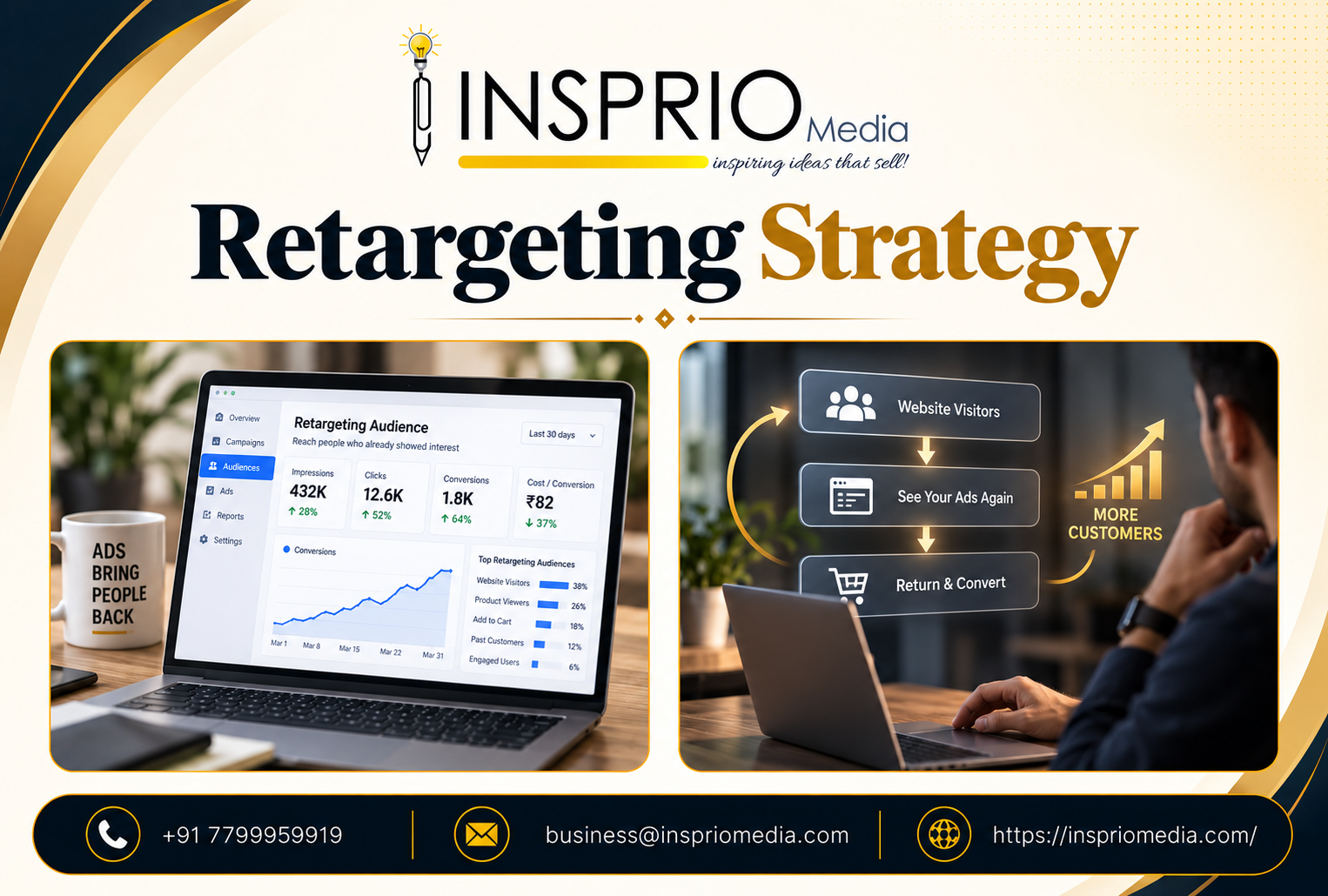
What Is a Retargeting Strategy?
A Retargeting Strategy is a digital advertising approach designed to reconnect with people who have previously interacted with a business but have not yet completed the desired conversion. The interaction might involve visiting a website, viewing a product, reading a service page, adding an item to a shopping cart, watching a video, opening a lead form, or engaging with social media content.
The core principle behind a Retargeting Strategy is simple: a person who has already demonstrated interest is usually more valuable than a completely unfamiliar prospect. The visitor already knows something about the business, which means future advertising does not always need to start by explaining the brand from the beginning.
A Retargeting Strategy can therefore focus on the next objection, question, or motivation that may influence the user's decision. For example, someone who visited a pricing page may respond to a value-focused advertisement, while a person who abandoned a shopping cart may respond to a product reminder or delivery message.
Retargeting can be implemented through advertising platforms that support website audiences, customer lists, application audiences, video engagement audiences, and other permitted audience signals. A well-designed Retargeting Strategy combines audience data with persuasive creative and an appropriate conversion path.
Why Most Website Visitors Do Not Convert Immediately
Businesses often invest heavily in SEO, paid search, social media, content marketing, and website development to generate traffic. However, traffic alone does not guarantee sales. A visitor can show genuine interest without being ready to make an immediate decision. This is exactly where a Retargeting Strategy becomes valuable.
Visitors may leave because they are researching options, comparing companies, waiting for approval, checking their budget, looking for additional information, or simply browsing during a busy moment. A Retargeting Strategy gives the business another chance to communicate with those users at a more suitable time.
For service businesses, the buying cycle may be particularly long. A customer researching website development, branding, real estate, construction, professional services, business software, healthcare services, or high-value products may require several interactions before making contact. A Retargeting Strategy supports this longer journey by keeping the business visible without forcing the customer to remember the company independently.
The objective is not to chase every visitor indefinitely. Effective advertising requires relevance and restraint. An intelligently configured Retargeting Strategy prioritizes valuable audiences, controls advertising frequency, uses appropriate membership durations, and excludes customers or users who no longer need the advertisement.
How Retargeting Converts Awareness Into Action
The first website visit often creates awareness rather than a conversion. A prospect may remember only part of the brand name or a general impression of the company. A Retargeting Strategy reinforces that initial exposure by presenting the brand again through carefully selected digital touchpoints.
Repeated visibility can make a company easier to recall when a customer becomes ready to act. However, the strength of a Retargeting Strategy comes from more than repetition. The most effective campaigns change the message according to what the visitor previously demonstrated interest in.
Someone who viewed a general homepage should not necessarily receive the same advertisement as someone who spent time on a specific high-intent service page. A mature Retargeting Strategy creates different audience groups and aligns the advertisement with the user's likely stage of consideration.
Example: A visitor researching performance marketing might first see an educational advertisement explaining measurable growth. If the visitor later views a case study or pricing page, the Retargeting Strategy can move toward proof, consultation offers, results, or a stronger call to action.
The Customer Journey and Retargeting
A useful way to build a Retargeting Strategy is to divide the customer journey into stages: awareness, consideration, evaluation, conversion, and retention. Each stage requires different communication.
Awareness Stage
At the awareness stage, the visitor may have only briefly explored the website. A Retargeting Strategy at this stage should prioritize education, familiarity, and credibility instead of immediately pushing for a sale.
Content such as educational videos, practical articles, guides, industry insights, and brand-focused creatives can help a Retargeting Strategy strengthen recognition without creating unnecessary pressure.
Consideration Stage
A visitor who explores multiple service pages or returns several times demonstrates stronger intent. The Retargeting Strategy can now use testimonials, differentiators, portfolios, demonstrations, detailed benefits, comparisons, and problem-solution messaging.
Evaluation Stage
Visitors who reach pricing pages, enquiry forms, booking pages, product pages, or checkout processes may be closer to converting. At this point, the Retargeting Strategy should reduce uncertainty and make the next action easy.
Strong calls to action, consultation reminders, delivery details, guarantees, FAQs, service benefits, or customer success stories may help the Retargeting Strategy convert hesitation into action.
Conversion Stage
Once the desired conversion takes place, the Retargeting Strategy should normally exclude that customer from acquisition-focused advertising unless there is a relevant cross-sell, upsell, renewal, or retention objective.
How Retargeting Technology Works
A typical Retargeting Strategy uses permitted tracking and audience technologies provided by advertising and analytics platforms. When people interact with a website, defined actions can be recorded, subject to applicable privacy requirements, consent mechanisms, and platform policies.
These actions can help marketers build audience groups around meaningful behaviours. Google, for example, provides audience tools that allow advertisers to work with groups of users who previously interacted with a business. The terminology, technical implementation, and privacy requirements can change over time, so every Retargeting Strategy should be maintained rather than treated as a one-time setup.
Businesses should also configure analytics and conversion measurement so that a Retargeting Strategy is judged by meaningful business outcomes rather than impressions or clicks alone.
Audience Segmentation Is the Foundation of Better Retargeting
Treating every visitor identically is one of the most common mistakes in a Retargeting Strategy. A visitor who spent five seconds on the homepage has a very different level of intent from someone who reviewed a service page, opened a form, and visited the contact page.
Audience segmentation allows the Retargeting Strategy to match advertising intensity and messaging with user behaviour.
| Audience | Likely Intent | Recommended Retargeting Message |
|---|---|---|
| Homepage visitors | Low to moderate | Brand value, key services, useful educational content |
| Service-page visitors | Moderate | Service benefits, case studies, expertise, results |
| Multiple-page visitors | Moderate to high | Strong proof, consultation, comparison messaging |
| Pricing-page visitors | High | Value explanation, consultation, ROI, objections |
| Form starters | Very high | Reminder, reassurance, simple next step |
| Cart abandoners | Very high | Product reminder, delivery information, checkout return |
| Converted customers | Existing relationship | Exclude or use relevant retention and upsell messaging |
Segmenting audiences this way makes a Retargeting Strategy more relevant and can help prevent unnecessary advertising spend.
Retargeting Strategy for Homepage Visitors
Homepage visitors usually represent a broad audience. They may have discovered the brand through search, social media, referrals, advertising, directories, or offline activity. A Retargeting Strategy for this group should generally avoid making assumptions about a specific service unless other behaviour provides stronger evidence.
The advertisement can reinforce the brand's primary value proposition, show the most important services, highlight credibility, or direct the visitor toward helpful content. In this situation, the Retargeting Strategy is essentially helping the prospect understand why the company deserves another visit.
Retargeting Strategy for Service-Page Visitors
Service-page visitors provide a stronger intent signal because they have shown interest in a particular solution. A Retargeting Strategy should use this information to make advertising more specific.
If a visitor viewed performance marketing services, the Retargeting Strategy might emphasize measurable campaigns, conversion tracking, lead generation, and ROI. Someone who explored branding could instead see creative emphasizing brand consistency, positioning, recognition, and professional identity.
This alignment between previous behaviour and future messaging is one of the strongest advantages of a segmented Retargeting Strategy.
Retargeting Strategy for Cart and Form Abandonment
Cart abandoners and form abandoners often represent some of the highest-intent users available to marketers. They have moved beyond browsing and have started taking a conversion-related action. A targeted Retargeting Strategy can remind these visitors to complete what they started.
For e-commerce, the Retargeting Strategy may show the product viewed or added to the cart. For lead-generation websites, advertising can remind prospects about the service, consultation, quote request, or registration they were considering.
The message should focus on reducing friction rather than adding more complexity. A concise Retargeting Strategy might answer a common objection, provide trust signals, emphasize an easy enquiry process, or take the user directly back to the relevant page.
Dynamic Retargeting for Product-Based Businesses
Dynamic advertising can make a Retargeting Strategy especially useful for stores or websites with large product inventories. Instead of manually creating a separate advertisement for every product, compatible advertising systems can use a product feed and audience behaviour to personalize what is displayed.
A shopper who viewed a particular product can potentially be shown that product or related items later. This makes the Retargeting Strategy considerably more relevant than a generic brand advertisement.
Dynamic campaigns still require careful configuration. Product information should be accurate, destination pages should work properly, unavailable items should be handled appropriately, and the Retargeting Strategy should avoid excessive repetition.
Google Ads and Retargeting
Google advertising can play an important role in a multichannel Retargeting Strategy. Depending on campaign type, eligibility, audience size, and platform rules, businesses can use their first-party audience data to reconnect with previous website visitors across relevant Google advertising environments.
Google's documentation now commonly refers to many remarketing audiences as “your data” segments. A business building a Retargeting Strategy should therefore follow current platform documentation rather than relying on outdated setup tutorials.
Search-based audience approaches can be especially valuable because a former visitor may later search again when their buying intent is stronger. A Retargeting Strategy that combines prior engagement with fresh search intent can reconnect the business with a prospect at an important moment.
Social Media Retargeting
Social platforms are another major component of a modern Retargeting Strategy. Website visitors often continue browsing social networks after leaving a business website, creating additional opportunities for brand exposure.
Visual content, short videos, testimonials, offers, product demonstrations, educational content, and case-study snippets can all support a social Retargeting Strategy.
The creative should be designed for the platform rather than simply reusing the same banner everywhere. Mobile-first design, strong opening visuals, short copy, recognizable branding, and a clear call to action can improve the effectiveness of the Retargeting Strategy.
Retargeting and Performance Marketing
Retargeting is closely connected with performance-focused advertising because marketers can define measurable actions and compare advertising cost against conversions. An effective Retargeting Strategy should therefore be evaluated through metrics connected to business outcomes.
Businesses interested in improving measurable digital campaigns can also explore Insprio Media's guide to Performance Marketing: Driving Business Growth and Maximizing ROI. Performance marketing and a Retargeting Strategy work particularly well when conversion tracking is configured correctly and campaigns are continuously optimized.
Build a Stronger Marketing Ecosystem Around Retargeting
A Retargeting Strategy performs best when it is supported by a broader digital marketing ecosystem. Retargeting cannot compensate permanently for a poor website, weak positioning, irrelevant traffic, slow loading pages, or an unclear offer.
For example, social media creates awareness and engagement before and after website visits. Learn more about why social media management is essential for business growth in 2026. Combining consistent social communication with a Retargeting Strategy can create stronger continuity across customer touchpoints.
Local businesses should also build organic visibility. Insprio Media's guide to GMB SEO services for higher Google Maps and local search visibility explains another important acquisition channel. Visitors generated through local search can later enter an appropriate Retargeting Strategy when permitted and relevant.
Organic rankings can continuously introduce new prospects to a company. Read more about website SEO services for higher Google rankings and sustainable business growth. SEO and a Retargeting Strategy serve different purposes, but together they can help attract, educate, and reconnect with prospects.
Strong visual presentation can also improve advertising effectiveness. Businesses using product visualization, architectural concepts, technical graphics, or immersive experiences can explore 3D design services that transform ideas into visual experiences. High-quality assets can make a Retargeting Strategy more distinctive and memorable.
Advertising creative must communicate quickly. The article on graphic design services for building a powerful brand identity provides additional perspective on professional brand communication. A visually consistent Retargeting Strategy helps users recognize the company across repeated interactions.
Offline campaigns can also support digital journeys when customers later search for or directly visit the brand. A coordinated Retargeting Strategy can help continue that journey after measurable online engagement occurs.
Branding matters because prospects must recognize the company when an advertisement appears again. Strong colors, typography, messaging, visual consistency, and positioning give the Retargeting Strategy a better foundation.
Website development is equally important. Driving a user back to a slow, confusing, or poorly optimized landing page weakens even an excellent Retargeting Strategy. Conversion-focused website improvements should therefore be considered part of the larger campaign system.
Creating Retargeting Ads That People Actually Notice
Audience targeting determines who sees the advertisement, but creative determines whether the advertisement earns attention. A strong Retargeting Strategy requires advertisements specifically created for returning prospects.
A visitor who already understands the basic service may not need another generic “we provide digital marketing” message. The Retargeting Strategy can instead address a deeper consideration such as measurable ROI, strategic expertise, customized solutions, turnaround time, case studies, or consultation availability.
Use a Clear Visual Hierarchy
The advertisement should be understandable within seconds. A Retargeting Strategy becomes less effective when designs contain excessive text, weak contrast, confusing calls to action, or too many competing elements.
Keep Branding Consistent
A visitor should recognize the business quickly. Logo placement, colors, typography, image style, and messaging consistency help a Retargeting Strategy reinforce memory.
Focus on One Main Message
An advertisement does not need to explain every service. A focused Retargeting Strategy aligns one strong message with one audience and one desired action.
Use Social Proof Carefully
Testimonials, ratings, numbers, awards, client logos, case-study results, and experience indicators can support a Retargeting Strategy when those claims are genuine, accurate, and appropriately presented.
Landing Pages Matter as Much as Ads
Retargeting advertisements are only one part of the conversion experience. After users click, they need to reach a page that continues the same conversation. A Retargeting Strategy should therefore connect advertisements with relevant landing pages.
If an advertisement promotes a particular service but sends the visitor to a generic homepage, the user may need to search again for the information they expected. A stronger Retargeting Strategy sends visitors to the most relevant service, product, consultation, case-study, or checkout page.
The landing page should have a clear headline, strong value proposition, readable content, visible call to action, trust indicators, responsive design, and fast loading performance. These elements can determine whether the Retargeting Strategy generates conversions or simply produces more clicks.
How Frequency Affects Retargeting Performance
Repeated visibility is useful, but excessive exposure can create fatigue. Frequency management is therefore an important part of a responsible Retargeting Strategy.
Users who see the same advertisement too often may begin ignoring it. Creative variation can keep a Retargeting Strategy fresh while also allowing marketers to test different benefits, formats, offers, and calls to action.
Frequency should be evaluated in context. A short-term event campaign may require a different Retargeting Strategy from a business-to-business service with a six-week consideration cycle.
How Long Should Retargeting Audiences Remain Active?
Audience duration should reflect the natural decision cycle of the product or service. An impulse purchase and an expensive business service should not use identical audience windows. A Retargeting Strategy should consider how long the user's original interest remains meaningful.
Shorter windows can focus on recent visitors with stronger immediate intent. Longer windows can support products or services with extended research cycles. A sophisticated Retargeting Strategy can divide visitors into recency groups such as recent visitors, medium-term visitors, and older visitors.
Recent visitors may receive stronger conversion messaging, while older visitors may need fresh educational or brand-focused communication. This approach makes the Retargeting Strategy more aligned with the probability that the user is still actively considering the purchase.
Retargeting Strategy for B2B Companies
Business-to-business purchasing often involves multiple decision-makers, long evaluation periods, budget approvals, demonstrations, proposals, and internal discussions. A B2B Retargeting Strategy should therefore support the buyer with useful information over time.
Case studies, downloadable guides, demonstration invitations, consultation offers, technical information, webinars, industry reports, and comparison content can all support a B2B Retargeting Strategy.
Instead of repeating an aggressive “contact us now” advertisement, the Retargeting Strategy can progressively build credibility until the organization is ready to speak with a sales representative.
Retargeting Strategy for E-Commerce
E-commerce businesses can use a Retargeting Strategy to reconnect with product viewers, category visitors, repeat shoppers, cart abandoners, previous buyers, and other valuable groups.
Product-focused creative is particularly useful because the advertisement can remind the shopper about an item they previously considered. A good Retargeting Strategy may also introduce complementary products or relevant categories instead of repeatedly displaying the same product indefinitely.
For cart abandoners, the Retargeting Strategy should focus on completing the existing journey. Messages around delivery, returns, product benefits, availability, or checkout simplicity may be more persuasive than a generic discount.
Retargeting Strategy for Local Businesses
Local service providers frequently depend on customers who compare several nearby businesses before making an enquiry. A Retargeting Strategy can help maintain visibility during this comparison period.
Advertisements can highlight location, experience, reviews, service quality, consultation options, availability, specializations, or other verified differentiators. A local Retargeting Strategy works particularly well when combined with strong search visibility and accurate business information.
Retargeting Strategy for High-Value Services
High-value services typically involve greater perceived risk, which means prospects require more information before converting. A Retargeting Strategy can systematically address those concerns over several touchpoints.
The first advertisement might highlight expertise, the second might feature a customer result, the third may explain the process, and another may invite the user to a consultation. This sequence makes the Retargeting Strategy feel more like guided communication than repetitive advertising.
Sequential Retargeting
Sequential advertising is an advanced form of Retargeting Strategy in which users are exposed to a planned progression of messages rather than one advertisement repeated continuously.
For example, a Retargeting Strategy could begin with educational content, progress to proof and testimonials, explain the service process, and eventually present a stronger conversion-focused invitation.
This technique reflects how human decision-making works. Buyers often need information in stages. A sequential Retargeting Strategy allows the brand to provide those stages more intentionally.
Retargeting and Content Marketing
Not every advertisement needs to lead directly to a sales page. Educational content can play an important role in a Retargeting Strategy, particularly when the audience is still researching.
Articles, guides, comparisons, checklists, videos, webinars, and case studies can answer questions that prevented the visitor from converting initially. A content-led Retargeting Strategy builds trust while allowing the prospect to continue evaluating the company.
Retargeting and Search Engine Optimization
SEO brings visitors to a website through organic search, while a Retargeting Strategy can continue communication after those visitors leave. This makes the two approaches complementary rather than competitive.
A visitor may discover an educational article through Google, leave without converting, later see an advertisement, and finally return to the website. The Retargeting Strategy extends the value of the original SEO visit by creating additional opportunities for engagement.
Retargeting and Social Media Management
Social media management helps brands maintain an active public presence, while a Retargeting Strategy can focus advertising on previously engaged audiences. Together, organic social content and paid retargeting can reinforce messaging across the customer journey.
A prospect who recognizes a company from useful social posts may respond more positively when the Retargeting Strategy later presents a relevant offer or service message.
Conversion Tracking: The Measurement Foundation
A Retargeting Strategy cannot be properly optimized if the business cannot measure meaningful outcomes. Website forms, calls, purchases, registrations, bookings, downloads, qualified leads, and other relevant actions should be measured appropriately.
Marketers should distinguish between activity metrics and business metrics. Impressions and clicks help explain campaign behaviour, but a Retargeting Strategy should ultimately be evaluated by outcomes such as cost per qualified lead, revenue, conversion value, customer acquisition cost, and return on advertising investment.
Important Metrics to Monitor
| Metric | Why It Matters |
|---|---|
| Impressions | Shows how often advertisements are delivered. |
| Reach | Indicates how many unique users are reached. |
| Frequency | Helps identify overexposure and creative fatigue. |
| Click-through rate | Indicates whether messaging generates interest. |
| Conversion rate | Measures how effectively traffic completes desired actions. |
| Cost per conversion | Helps evaluate efficiency. |
| Revenue or conversion value | Connects advertising with commercial performance. |
| ROAS | Compares advertising spend with attributable revenue where appropriate. |
No single metric should determine whether a Retargeting Strategy is successful. Marketers should evaluate the complete customer journey and the quality of resulting customers.
Attribution and Retargeting
Customers may interact with several channels before converting, which makes attribution important. A Retargeting Strategy can influence a decision without necessarily being the only reason the conversion occurred.
For example, a user might first arrive through organic search, later see a social advertisement, return directly, and finally convert through a branded search campaign. Evaluating the Retargeting Strategy only through simplistic last-click measurement may hide some of its contribution.
Businesses should use available analytics, advertising reports, CRM data, and sales-quality feedback to understand how the Retargeting Strategy fits within the broader customer journey.
Privacy, Consent, and Responsible Retargeting
Privacy must be considered when implementing any Retargeting Strategy. Businesses should follow applicable laws, advertising platform requirements, consent obligations, data-processing rules, and internal privacy standards relevant to their markets.
A modern Retargeting Strategy should rely on transparent data practices and properly configured measurement technologies. Marketers should avoid collecting unnecessary information and should keep tracking implementations updated as browser, platform, and regulatory environments evolve.
Responsible advertising is not only a compliance issue. Trust affects customer relationships. A respectful Retargeting Strategy avoids misleading targeting, inappropriate personalization, excessive frequency, and messaging that could make customers uncomfortable.
Authoritative Resources for Retargeting and Measurement
Businesses implementing a Retargeting Strategy should refer directly to current platform documentation because advertising technologies and requirements change regularly. The following authoritative resources provide useful technical and strategic information:
- Google Ads – About Your Data Segments
- Google Ads – Audience Segments and Audience Manager
- Google Analytics – Introduction to Audiences
- Google Ads – Data Segments for Search Ads
- Google Tag Platform Documentation
- Meta Business Help Center
These resources can help technical teams keep a Retargeting Strategy aligned with current audience, measurement, advertising, and implementation requirements.
Common Retargeting Mistakes
1. Targeting Every Visitor With the Same Advertisement
A one-size-fits-all Retargeting Strategy ignores differences in intent. Segmenting users according to their behaviour can produce more relevant communication.
2. Sending Every Click to the Homepage
A good Retargeting Strategy should continue the conversation. Service-specific advertisements should usually lead to relevant pages rather than forcing visitors to navigate from the beginning.
3. Showing the Same Creative for Too Long
Creative fatigue can reduce engagement. A healthy Retargeting Strategy regularly tests new imagery, formats, headlines, benefits, and calls to action.
4. Forgetting to Exclude Converted Users
Continuing acquisition advertising after someone has already converted may waste money and create a poor customer experience. A properly managed Retargeting Strategy uses appropriate exclusions.
5. Optimizing Only for Clicks
Clicks do not automatically equal business growth. A Retargeting Strategy should prioritize meaningful conversions and customer quality.
6. Ignoring Mobile Users
A large proportion of website and social traffic may come from mobile devices. Every Retargeting Strategy should use mobile-friendly advertisements and landing pages.
7. Retargeting Poor-Quality Traffic
If the original traffic is irrelevant, a Retargeting Strategy may simply spend additional money pursuing the wrong audience. Acquisition targeting and traffic quality must also be improved.
How to Build a Retargeting Strategy Step by Step
Step 1: Define the Business Goal
Start by deciding what the Retargeting Strategy should achieve. The goal might be enquiries, online sales, booked consultations, registrations, downloads, demonstrations, appointments, or repeat purchases.
Step 2: Review Website Behaviour
Identify pages and actions that indicate meaningful intent. A Retargeting Strategy is stronger when the audience definition reflects genuine customer behaviour.
Step 3: Configure Measurement
Implement appropriate analytics, tags, consent mechanisms, and conversion events. Without reliable data, the Retargeting Strategy becomes difficult to evaluate.
Step 4: Build Audience Segments
Create practical groups based on page visits, engagement, recency, funnel stage, or conversion behaviour. Avoid unnecessary complexity, but make the Retargeting Strategy specific enough to support relevant messaging.
Step 5: Define Exclusions
Exclude customers, employees, irrelevant visitors, or other groups when appropriate. Exclusions can improve the efficiency of a Retargeting Strategy.
Step 6: Create Audience-Specific Advertising
Build advertisements that address what each segment needs next. Creative relevance is essential to a successful Retargeting Strategy.
Step 7: Match Ads With Landing Pages
Every advertisement should have a logical destination. A Retargeting Strategy loses momentum when users land on unrelated pages.
Step 8: Launch With Controlled Budgets
Start with sensible budgets, monitor audience size, and collect performance data. A Retargeting Strategy should scale according to verified results rather than assumptions.
Step 9: Test Creatives and Offers
Experiment with different headlines, formats, benefits, landing pages, testimonials, and calls to action. Continuous testing helps the Retargeting Strategy improve over time.
Step 10: Review Business Outcomes
Compare advertising performance with actual enquiries, lead quality, sales, and revenue. This final step ensures the Retargeting Strategy remains connected to commercial objectives.
Creating a Full-Funnel Retargeting System
The most effective campaigns do not view retargeting as a single audience and a single advertisement. A full-funnel Retargeting Strategy creates different experiences for people depending on what they have already done.
A top-of-funnel visitor could receive educational content. A mid-funnel visitor could receive proof and case studies. A high-intent visitor could receive a consultation invitation. A converted customer could enter a retention campaign. This makes the Retargeting Strategy more relevant throughout the relationship.
Businesses should map these stages before designing advertisements. When each segment has a defined next step, the Retargeting Strategy becomes easier to manage and measure.
Why Personalization Matters
Personalization does not mean using sensitive information or making advertisements feel intrusive. In a practical Retargeting Strategy, personalization simply means making the message relevant to demonstrated interests and permitted audience information.
A visitor who explored branding services can receive branding-related messaging rather than an unrelated advertisement. A shopper who viewed a category can receive relevant product communication. This form of contextual relevance makes the Retargeting Strategy more useful to the customer.
Why Retargeting Can Improve Advertising Efficiency
Cold-audience campaigns introduce a business to people who may know nothing about it. Retargeting focuses on users who have already interacted with the brand. Because of that previous familiarity, a Retargeting Strategy can help marketers allocate part of their budget toward prospects who have demonstrated some degree of interest.
This does not mean every retargeting campaign will automatically outperform every prospecting campaign. Audience quality, market demand, creative execution, landing-page quality, competition, pricing, tracking, and customer experience all influence results. The Retargeting Strategy must still be optimized like any other marketing campaign.
Why Retargeting Works Best With Strong Branding
Retargeting relies partly on recognition. If website visitors cannot remember or distinguish the company, repeated exposure becomes less powerful. A visually consistent Retargeting Strategy reinforces the same brand identity users encountered on the website.
Advertisement colors, typography, logo usage, tone of voice, photography style, and messaging should feel connected to the landing page. This consistency allows the Retargeting Strategy to strengthen familiarity rather than creating disconnected experiences.
Retargeting for Lead Generation Businesses
Lead-generation companies can create a Retargeting Strategy around service interest, enquiry behaviour, landing-page engagement, and content consumption.
A visitor who reads a service page but does not enquire may still be evaluating options. The Retargeting Strategy can introduce testimonials, explain the process, answer common questions, or promote a consultation.
Form abandonment deserves particular attention. If technically and legally appropriate, the Retargeting Strategy can remind highly engaged users about the opportunity without displaying unnecessary personal detail.
Retargeting for Repeat Customers
Retargeting is not limited to first-time conversions. A customer-focused Retargeting Strategy can support repeat purchases, complementary products, renewals, upgrades, seasonal services, and relevant new offers.
Existing customers should be separated from acquisition audiences. A retention-oriented Retargeting Strategy should recognize that the relationship has already progressed beyond initial trust building.
Testing and Optimization
No Retargeting Strategy should remain unchanged indefinitely. Customer behaviour evolves, competitors adjust their campaigns, creative becomes familiar, pricing changes, and advertising platforms introduce new features.
Regular testing helps identify opportunities for improvement. Marketers can test audience windows, creative concepts, calls to action, landing pages, offers, formats, bidding approaches, and segmentation rules within the Retargeting Strategy.
Tests should be structured rather than random. Changing too many variables simultaneously can make it difficult to understand what actually improved the Retargeting Strategy.
Creative Rotation and Advertisement Fatigue
Even a strong advertisement can become less effective after repeated exposure. Creative rotation should therefore be built into the Retargeting Strategy.
One variation might emphasize expertise, another customer outcomes, another speed or convenience, and another educational value. This helps the Retargeting Strategy communicate different reasons to return without relying on the exact same message.
Budgeting for Retargeting
Retargeting budgets should be based on audience size, conversion economics, campaign objectives, platform behaviour, and available traffic. A Retargeting Strategy cannot spend efficiently if the audience is too small for the allocated budget.
Likewise, businesses should avoid underfunding high-value segments if data shows they consistently generate profitable results. Budget allocation within the Retargeting Strategy should be guided by evidence.
How Retargeting Supports Brand Recall
People often forget the exact company they discovered during early research. A Retargeting Strategy can reinforce the connection between the customer's problem and the brand's proposed solution.
When the customer becomes ready to make a decision, familiarity may help the company return to the consideration set. This is one reason a Retargeting Strategy can contribute value even when every advertisement does not receive an immediate click.
Retargeting Should Not Replace Prospecting
A company still needs new visitors entering the funnel. A Retargeting Strategy works with acquisition channels rather than replacing them.
SEO, paid search, social advertising, content marketing, referrals, email, offline marketing, partnerships, and direct traffic can continually introduce new users. The Retargeting Strategy then creates additional opportunities to convert suitable visitors who do not act during the first session.
Combining Retargeting With Email Marketing
Where customers have lawfully provided contact information and appropriate permission exists, email and a Retargeting Strategy can reinforce each other. Email can provide detailed information, while advertising maintains visual brand visibility.
The messaging should be coordinated. Sending one offer through email while presenting a contradictory advertisement can weaken the Retargeting Strategy. A consistent campaign calendar creates a more coherent experience.
Retargeting Strategy Checklist
- Define the primary conversion objective.
- Confirm analytics and conversion tracking are configured correctly.
- Identify high-value pages and behaviours.
- Create audience segments according to intent.
- Choose sensible audience durations.
- Build exclusions for converted or irrelevant users.
- Create advertisements specifically for each important segment.
- Use clear branding and calls to action.
- Send clicks to relevant landing pages.
- Monitor frequency and creative fatigue.
- Measure qualified leads, sales, revenue, and conversion value.
- Review privacy, consent, and platform requirements.
- Test creative and landing-page variations.
- Adjust budgets according to verified performance.
Following this checklist can make a Retargeting Strategy more organized, measurable, and commercially focused.
Frequently Asked Questions About Retargeting
1. What is a Retargeting Strategy?
A Retargeting Strategy is a marketing approach that reconnects with people who have previously visited a website or interacted with a business but did not complete the desired action. The campaign uses relevant audience segments and advertising messages to encourage those prospects to return.
2. How does retargeting help convert website visitors?
A Retargeting Strategy keeps the brand visible after a visitor leaves the website. It can remind users about products or services, answer objections, provide social proof, and make it easier for interested prospects to continue their buying journey.
3. Is retargeting useful for small businesses?
Yes. A small business can use a Retargeting Strategy to focus advertising on people who have already demonstrated interest. The appropriate budget and audience structure depend on website traffic, customer value, and business objectives.
4. Which website visitors should be retargeted?
A Retargeting Strategy may prioritize visitors to key service pages, product pages, pricing pages, checkout pages, contact pages, or other high-intent areas. Businesses should also consider engagement quality, recency, privacy requirements, and audience size.
5. How long should a retargeting campaign run?
There is no universal duration. A Retargeting Strategy should reflect the buying cycle of the business. Short purchase cycles may require shorter audience windows, while complex or expensive services may need longer consideration periods.
6. Can retargeting become annoying?
Yes, particularly when customers repeatedly see the same advertisement. Frequency management, exclusions, useful creative, and regular creative rotation can make a Retargeting Strategy more respectful and effective.
7. What is the difference between retargeting and remarketing?
The terms are often used interchangeably in everyday marketing discussions, although specific platforms may use different terminology. Regardless of terminology, a Retargeting Strategy generally focuses on reconnecting with previous visitors, users, customers, or engaged audiences through permitted marketing channels.
8. What type of advertisements work best for retargeting?
The best advertisements depend on audience intent. A Retargeting Strategy can use product reminders, testimonials, case studies, educational content, offers, consultation invitations, videos, or benefit-focused creative. Relevance is usually more important than using one particular format.
9. How do I measure retargeting success?
A Retargeting Strategy can be evaluated using conversion rate, cost per conversion, qualified leads, sales, customer acquisition cost, conversion value, return on ad spend, frequency, assisted conversions, and other business-specific measures.
10. Can retargeting increase ROI?
A well-managed Retargeting Strategy can improve advertising efficiency by reconnecting with prospects who have already demonstrated interest. However, results depend on traffic quality, audience segmentation, creative, offer quality, landing pages, measurement, competition, and overall campaign execution.
11. Should customers who already purchased be excluded?
Often, yes. Acquisition-focused advertising should usually exclude completed customers when the message is no longer relevant. However, a separate Retargeting Strategy can be created for repeat purchases, renewals, upgrades, or complementary services.
12. Does retargeting work without a good website?
Advertising can bring users back, but a poor landing experience can still prevent conversion. A successful Retargeting Strategy should be supported by fast loading pages, responsive design, clear calls to action, useful information, trust signals, and a simple conversion process.
Why Work With Insprio Media?
Successful retargeting requires more than activating an audience and running a banner. Businesses need strategic audience planning, conversion tracking, creative design, campaign optimization, landing-page alignment, and performance analysis. Insprio Media approaches a Retargeting Strategy as part of a broader growth system rather than an isolated advertising activity.
By connecting performance marketing, digital strategy, web development, branding, graphic design, SEO, social media, and conversion-focused thinking, businesses can create a more consistent customer journey. A properly developed Retargeting Strategy helps ensure that valuable website traffic is given more than one opportunity to convert.
Explore Insprio Media to learn more about digital marketing, creative, branding, web development, and performance-focused solutions that can support your customer acquisition strategy.
Conclusion
Generating website traffic is valuable, but the real commercial opportunity begins when that traffic is converted into meaningful customer relationships. Most visitors will not take action immediately, and businesses that rely exclusively on the first website session may lose prospects who were genuinely interested but not yet ready.
A thoughtfully designed Retargeting Strategy solves this problem by creating additional, relevant opportunities to reconnect. It can remind customers about the brand, address unanswered questions, present social proof, highlight benefits, recover abandoned journeys, promote helpful content, and guide prospects toward the next logical action.
The strongest approach combines accurate measurement, meaningful segmentation, high-quality creative, suitable frequency, relevant landing pages, privacy-conscious implementation, continuous optimization, and clear business objectives. When all of these components work together, a Retargeting Strategy becomes much more than an advertising reminder—it becomes an important part of the complete customer journey.
Businesses should also remember that a Retargeting Strategy works best alongside strong acquisition channels. SEO, performance marketing, social media, branding, web development, content, creative design, and offline marketing can attract and educate prospects, while retargeting creates additional opportunities to convert that interest.
Ultimately, the goal is not to follow visitors everywhere. The goal is to deliver relevant communication at appropriate moments. A disciplined Retargeting Strategy respects the customer while giving the business more opportunities to turn genuine interest into measurable growth.
Build a Smarter Retargeting Campaign With Insprio Media :
Phone: +91 7799959919
Email: business@inspriomedia.com
Website: https://inspriomedia.com/