Search Intent SEO: How to Create Content That Ranks
Ranking content is not simply a matter of placing keywords on a page. Strong organic performance starts with understanding what a person expects to find after typing a query and then building a page that satisfies that expectation more completely, clearly and efficiently than competing results.
Why Search Intent Has Become Central to Modern SEO
Search Intent SEO begins with one practical idea: every search is performed because somebody wants something. The person may want a definition, instructions, a comparison, a nearby service, a specific website or an immediate way to purchase. A page becomes useful when its purpose closely matches that goal instead of simply containing the words that appeared in the search query.
Search Intent SEO changes content planning because keywords are no longer treated as isolated phrases. Two terms with similar words can require completely different pages. A person searching “what is technical SEO” expects education, while someone searching “technical SEO agency” is evaluating providers. Publishing the same page structure for both queries makes it difficult to satisfy either audience properly.
Search Intent SEO also helps businesses avoid investing time in content that attracts traffic without generating meaningful engagement. High search volume can appear attractive during keyword research, but volume alone does not tell you whether the visitor needs the information, product or service your business provides. Intent connects keyword opportunities with real business relevance.
Search Intent SEO should therefore influence the topic, page format, headings, examples, depth, calls to action and internal links before writing starts. Instead of asking only, “How can this keyword appear in the article?” ask, “What would make someone searching this phrase feel that they have reached the right page?” That question creates a much stronger foundation.
Search Intent SEO is especially important for businesses developing a complete digital presence. A company may need informational articles, commercial comparison pages, location-specific landing pages and conversion-focused service pages working together. Businesses looking at SEO as part of wider digital growth can also explore Insprio Media to understand how search visibility connects with web, branding and marketing strategy.
What Does Search Intent Actually Mean?
Search Intent SEO focuses on the underlying purpose of a query rather than looking only at the literal words entered into Google. When users type a phrase, they carry an expectation about what kind of answer should appear. Understanding that expectation is essential because a technically optimized page can still perform poorly when its format does not match what searchers want.
Search Intent SEO requires marketers to separate the keyword from the task behind the keyword. Someone searching “email marketing” could be trying to understand the concept, find software, compare agencies or build a campaign. The broad keyword reveals the topic, but the search results and query modifiers reveal more about the actual job the searcher is trying to complete.
Search Intent SEO becomes clearer when you study language patterns. Words such as “how,” “why,” “guide” and “tutorial” commonly suggest a learning goal. Phrases containing “best,” “versus,” “review” or “top” often signal comparison. Searches containing “hire,” “price,” “service,” “book” or “near me” usually indicate that the searcher is closer to taking action.
Search Intent SEO should not rely only on these modifiers, however. Search engines interpret queries using context, language, location, freshness and many other signals. A keyword that appears informational at first glance may produce product pages, videos, maps or comparison articles. The live search results often provide a stronger indication of expected content than assumptions based on wording alone.
Search Intent SEO is therefore both a research process and a content strategy. The goal is not to guess what users want but to collect evidence from results pages, keyword data, customer questions, Search Console queries, sales conversations and competitor pages. These signals can then be converted into a useful page that addresses the actual reason behind the search.
Why Matching Intent Can Improve Ranking Potential
Search Intent SEO supports relevance, and relevance is fundamental to useful search results. Google explains that its ranking systems use many signals and systems to identify results that are relevant and useful for individual queries. This means content teams should think beyond exact keyword matching and create pages that genuinely address the needs represented by the query.
Search Intent SEO reduces a common mismatch where businesses attempt to rank product or service pages for searches dominated by educational resources. If most leading results are tutorials, definitions or detailed guides, a short promotional landing page may struggle because it asks visitors to buy before answering the question that brought them to the search engine.
Search Intent SEO can also improve engagement because users immediately see information that corresponds with their expectations. A visitor looking for a step-by-step process should not have to scroll through several sales sections before finding instructions. Clear alignment between query, title, introduction and page structure allows the visitor to understand quickly that the page is relevant.
Search Intent SEO helps websites compete intelligently rather than simply creating longer pages. Google explicitly notes in its people-first content guidance that there is no preferred word count that automatically produces rankings. Depth should be determined by what is necessary to answer the topic well, not by stretching an article solely to reach an arbitrary length.
Search Intent SEO therefore encourages useful completeness rather than unnecessary volume. Some queries need a concise answer, while complex business decisions may require comparisons, examples, FAQs and detailed explanations. The correct amount of content is the amount required to resolve the searcher's primary question and the most likely follow-up questions without adding irrelevant filler.
The Four Main Types of Search Intent
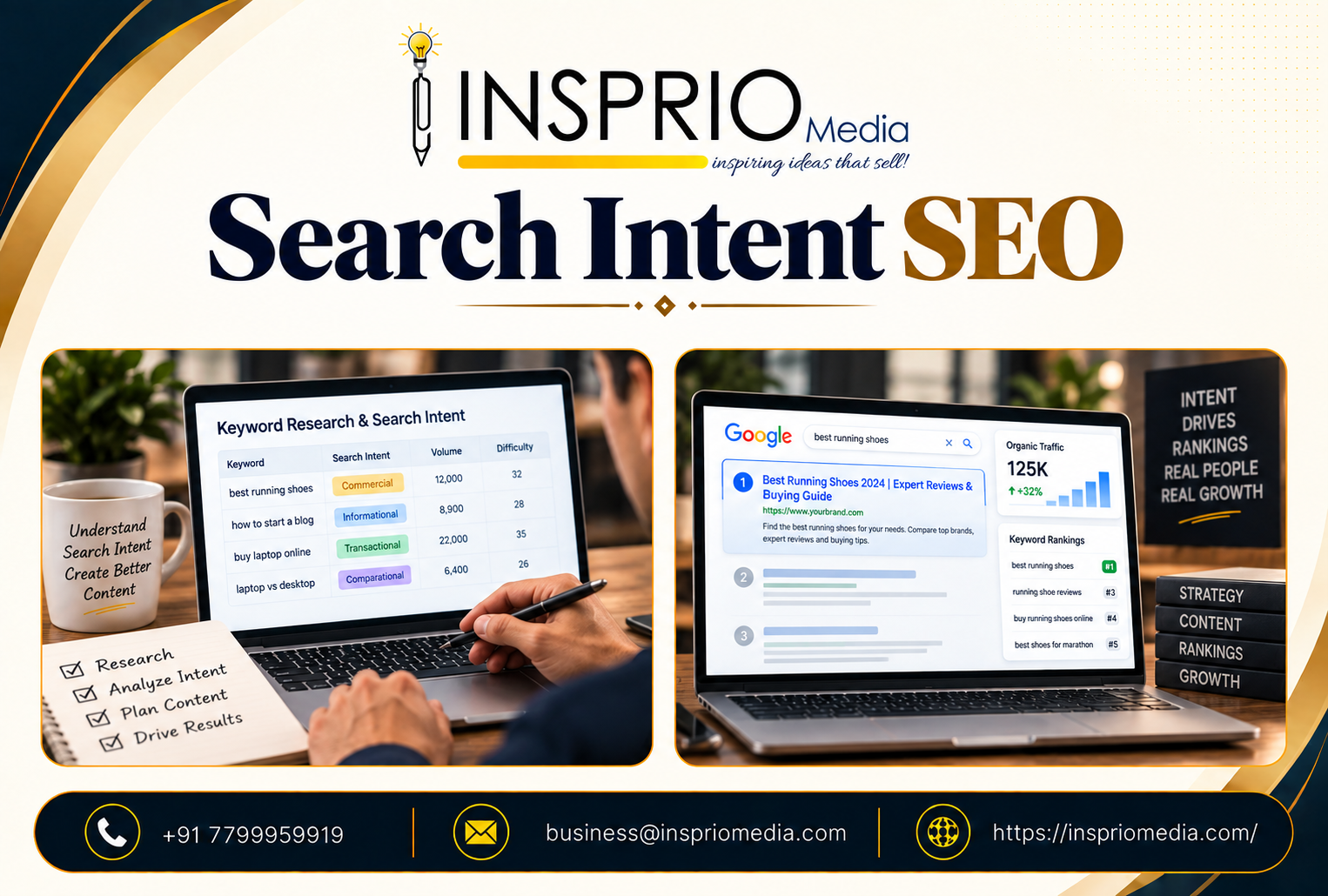
Search Intent SEO is commonly organized into four broad categories: informational, navigational, commercial and transactional. These categories are useful because they give content teams a starting framework for deciding what kind of page should be created. However, they should be treated as strategic guides rather than rigid rules because many real searches contain more than one motivation.
Search Intent SEO for informational queries aims to educate. A person searching “how does local SEO work?” is primarily trying to understand a subject. Detailed guides, tutorials, checklists, definitions, videos and explanatory articles are natural formats for this stage. The primary call to action should usually support learning instead of interrupting it with an aggressive sales message.
Search Intent SEO for navigational queries is different because the searcher already has a destination in mind. Searches for a company name, login page, particular product or branded resource often fall into this category. Clear site architecture, strong branded pages and descriptive page titles help search engines and users reach the correct destination efficiently.
Search Intent SEO for commercial investigation serves users who are evaluating alternatives but have not yet completed a purchase. Comparison articles, case studies, “best” lists, solution pages, pricing explanations and buyer guides can work well. These users usually need evidence that helps reduce uncertainty: features, advantages, limitations, use cases, proof and meaningful differences between available choices.
Search Intent SEO for transactional queries focuses on action. Searchers using terms such as “buy,” “book,” “hire,” “get quote,” “pricing” or highly specific service phrases may be ready to convert. Pages should make the next step obvious with clear offers, trust signals, concise benefits, contact options and minimal friction between the search result and desired action.
| Intent Type | Typical Search Goal | Common Query Examples | Suitable Content |
|---|---|---|---|
| Informational | Learn or solve a problem | How does SEO work? What is search intent? | Guides, tutorials, explainers, checklists |
| Navigational | Reach a known website or page | Google Search Console login, Insprio Media | Brand pages, login pages, product pages |
| Commercial | Compare options before deciding | Best SEO agency, SEO tools comparison | Comparisons, reviews, case studies |
| Transactional | Purchase, book or enquire | Hire SEO agency, book consultation | Service pages, product pages, landing pages |
How to Analyze the Search Results Before Writing
Search Intent SEO research should begin with the actual search engine results page. Enter the target query and examine what Google currently considers useful for that search. Look beyond individual competitors and identify patterns. Are the leading results articles, category pages, videos, tools, product pages, local results or detailed service pages? Repetition across results provides important evidence.
Search Intent SEO analysis should record the dominant format as well as outliers. If eight leading results are beginner guides and two are product pages, the educational format is probably the safer starting point. If results are evenly divided, the keyword may have mixed intent, which gives you more flexibility but also requires more careful page design.
Search Intent SEO research should also examine titles. Repeated title patterns often reveal the angle users expect. Words such as “guide,” “examples,” “checklist,” “best,” “pricing,” “near me” or a specific year can indicate whether searchers prioritize learning, comparison, freshness, local availability or a purchase decision. These patterns are more useful than blindly copying competitor keywords.
Search Intent SEO should include SERP features in the analysis. Featured snippets, People Also Ask questions, video results, map packs, shopping modules and image results can reveal the type of information Google believes is helpful. A query dominated by map results, for example, has a strong local component that a generic national article may not satisfy effectively.
Search Intent SEO analysis becomes stronger when repeated across related keywords instead of being performed for one phrase in isolation. Search several close variations and note where the same pages appear. If multiple terms consistently return similar results, they may belong on the same page. When results change substantially, separating the terms into distinct pages may prevent intent conflict.
Match the Content Type, Format and Angle
Search Intent SEO can be translated into three practical decisions: content type, content format and content angle. Content type refers to the page itself, such as a blog article, product page, category page, landing page or video. Selecting the wrong type can create an immediate disconnect even when the information on the page is technically accurate.
Search Intent SEO content format describes how the information is presented. A search may favour step-by-step tutorials, comparison lists, comprehensive guides, templates, calculators or case studies. For example, when people repeatedly choose “how-to” results, writing a broad opinion article may be less helpful than providing an actionable sequence that lets readers complete the task.
Search Intent SEO content angle reflects the specific perspective that appears most useful. Searchers may prefer beginner-friendly guidance, affordable solutions, fast methods, advanced strategies, local expertise or recent information. The angle helps distinguish your page from competing results while still satisfying the core expectation represented by the query.
Search Intent SEO should not become an excuse to clone whatever already ranks. Existing results reveal the minimum expectation, not the maximum value you can provide. After identifying the dominant pattern, look for missing explanations, weak examples, outdated information, unclear steps or unanswered questions. Your page can respect established intent while offering a better experience.
Search Intent SEO becomes particularly powerful when type, format and angle reinforce one another. If a query requires a beginner tutorial, an effective page might be a long-form blog post organized into numbered steps with screenshots, definitions and common mistakes. Every structural decision should make it easier for the intended audience to accomplish its goal.
Use Intent During Keyword Research, Not After It
Search Intent SEO should influence keyword selection before content is assigned to writers. Traditional keyword research often prioritizes volume and difficulty, but those numbers do not explain whether a term belongs within your business strategy. A lower-volume query with strong commercial relevance can sometimes provide more value than a broad high-volume term that attracts unrelated visitors.
Search Intent SEO keyword research starts by assigning each promising term to a probable journey stage. Informational topics often support awareness, commercial topics support evaluation and transactional topics support conversion. This creates a portfolio of content rather than a disconnected list of keywords and makes it easier to build internal pathways between educational and conversion-focused pages.
Search Intent SEO research also benefits from examining query modifiers. “What,” “why,” “how,” “examples” and “meaning” commonly suggest education. “Best,” “top,” “review,” “alternative” and “versus” often suggest comparison. “Company,” “agency,” “services,” “cost,” “quote,” “book” and location terms frequently indicate stronger commercial or transactional motivation.
Search Intent SEO should also account for business fit. A keyword can have attractive demand yet still be unsuitable if the company cannot provide an authoritative answer or meaningful next step. Strong content strategies focus on areas where audience need, organizational expertise and business relevance overlap instead of publishing unrelated topics simply because they receive searches.
Search Intent SEO becomes more reliable when keyword tools are treated as inputs rather than final authorities. Intent labels supplied by SEO platforms can accelerate research, but reviewing the live SERP remains valuable because intent can vary by location, device and time. Search behaviour evolves, and page planning should reflect what users appear to need now.
Build Topic Clusters Around Different User Needs
Search Intent SEO can guide topic-cluster architecture by separating keywords according to what users are trying to accomplish. A broad pillar page can introduce a subject, while supporting articles answer narrower informational questions. Commercial pages can compare solutions, and service pages can capture visitors ready to enquire. Each page has a distinct job within the cluster.
Search Intent SEO prevents the common mistake of creating several articles that compete for almost identical queries. If two keywords produce largely the same top results, they may belong together. Combining them into one authoritative page can concentrate relevance and links instead of spreading similar information across multiple URLs that confuse both visitors and search engines.
Search Intent SEO also helps identify situations where similar wording represents different needs. “SEO pricing,” “how SEO pricing works” and “SEO agency pricing” may require different levels of commercial emphasis. SERP overlap, customer expectations and your own offering should determine whether these phrases live on a single page or separate pages.
Search Intent SEO clusters should include a natural progression. A reader who learns how a strategy works may later want implementation guidance, case studies or professional support. Internal links should make those transitions obvious without forcing the reader. This allows informational traffic to discover relevant commercial resources while preserving the educational purpose of the original article.
Search Intent SEO topic architecture becomes especially valuable as a website grows. Without a map of user needs, teams often create content reactively and eventually discover duplicated topics, orphaned pages and competing URLs. An intent-based content inventory helps clarify which page owns each search problem and where new content genuinely fills a gap.
Create an Intent-Led Content Brief Before Drafting
Search Intent SEO should appear directly inside every content brief. A writer needs more than a primary keyword and word-count target. The brief should describe the audience, their likely situation, the question being answered, the dominant page format in the SERP, important secondary questions and the action the reader should understand or take after consuming the content.
Search Intent SEO briefs should define the primary intent in a single sentence. For example: “The reader is a business owner trying to understand whether local SEO can generate more enquiries.” That sentence provides better writing direction than simply telling the writer to mention “local SEO services” repeatedly because it establishes the reader's motivation and decision stage.
Search Intent SEO planning should then identify the information required to satisfy that motivation. A commercial comparison page may need features, advantages, trade-offs, pricing factors and selection criteria. An informational article may need definitions, processes, examples and troubleshooting. A local service page may need service areas, availability, proof, directions and contact options.
Search Intent SEO briefs should include competitor gaps without turning into instructions to copy competitors. Writers can review leading pages and record what they explain well, what they omit and where the reader experience is weak. Original examples, expert insights, firsthand processes and practical checklists can then create added value rather than another version of existing content.
Search Intent SEO briefs also benefit from a clear internal-linking plan. Writers should know which supporting articles explain related concepts and which service page represents the appropriate next step. Planning these links early produces a more natural user journey and avoids adding random links after the article has already been written.
Recommended Content Brief Fields
- Primary query and related query group
- Primary user goal
- Audience and stage of awareness
- Dominant SERP content type
- Preferred format and angle
- Questions that must be answered
- Unique expertise or examples to include
- Relevant internal links
- Desired next action
- Success metrics after publication
Write for the Question Behind the Keyword
Search Intent SEO writing should make relevance obvious from the opening paragraph. Visitors should not need to read several hundred words before discovering whether the page answers their query. State the core answer or promise early, then develop the explanation in a logical order. This respects the reader's time while creating a strong foundation for deeper engagement.
Search Intent SEO content should use headings as navigation rather than decoration. Many visitors scan before reading closely, particularly on mobile devices. Descriptive H2 and H3 headings let them find the section that matters most. Each heading should communicate a specific topic instead of using vague labels such as “More Information” or “Things to Know.”
Search Intent SEO writing should provide enough context for beginners without frustrating experienced readers. Definitions can be concise and followed by more advanced detail. Tables, bullets and examples make complex topics easier to process. When information can be expressed clearly in ten words, stretching it into a long paragraph does not improve usefulness.
Search Intent SEO content becomes more distinctive when it includes observations that come from actual experience. Explain mistakes clients commonly make, decisions your team frequently encounters or the reasoning behind a recommended process. Generic summaries are easy to reproduce. Practical expertise creates information that readers can apply and that competitors may not offer.
Search Intent SEO writing should answer likely follow-up questions before the visitor has to return to Google. If someone searches how to choose an SEO agency, they may also want to know what questions to ask, how contracts work, what reports should contain and how long meaningful results can take. Anticipating these needs improves completeness without adding unrelated filler.
Align On-Page SEO Elements With User Expectations
Search Intent SEO should influence the title tag because the title is often the first opportunity to demonstrate relevance. A strong title describes what users will receive and reflects the expected format. Informational titles can promise a guide or explanation, while commercial titles may emphasize comparison, pricing, alternatives or selection criteria depending on the query.
Search Intent SEO should also shape the H1 so the page's purpose is immediately clear after the click. The title tag and H1 do not have to be identical, but they should promise the same experience. A search result that advertises a detailed tutorial should not lead to a page dominated by sales content or a form before any useful instructions appear.
Search Intent SEO affects meta descriptions even though descriptions are not a simple ranking lever. A useful description can communicate why the result is relevant and encourage the right searchers to click. It should summarize the value of the page accurately rather than using exaggerated claims that create expectations the content cannot fulfil.
Search Intent SEO also connects with URL structure. Descriptive URLs give users and search engines additional context about a page. Avoid unnecessary strings, excessive folders and URLs that no longer reflect the actual content. Consistency becomes increasingly valuable when a site contains hundreds of articles, services and location pages.
Search Intent SEO optimization includes images as well. Images should support understanding instead of existing only as visual decoration. Descriptive filenames and alt text help explain their purpose, while screenshots, diagrams, comparison graphics and process illustrations can make difficult topics easier to understand. The visual format should serve the information need represented by the query.
Use Internal Links to Support the Search Journey
Search Intent SEO becomes more valuable when educational content connects naturally with related marketing topics. Readers exploring organic acquisition may also benefit from understanding performance marketing and ROI and learning why social media management matters for business growth. These links help users continue their research without interrupting the main topic.
Search Intent SEO strategies often overlap with both local and website optimization. Businesses targeting geographically relevant customers can explore GMB SEO services for stronger Google Maps visibility, while companies seeking broader organic growth can review website SEO services for sustainable Google rankings. The right supporting link depends on what the reader is likely to need next.
Search Intent SEO also works alongside visual communication because search visitors evaluate a brand after reaching the website. Businesses interested in richer digital presentation can learn how 3D design services can transform visual experiences and how graphic design supports stronger brand identity. Good traffic has greater value when the destination communicates professionally.
Search Intent SEO should also be integrated with wider brand visibility rather than operating as an isolated channel. The relationship between online discovery and real-world awareness becomes clearer when reviewing offline marketing strategies for local visibility together with branding services that build recognizable business identities. Consistency across channels can improve the experience after discovery.
Search Intent SEO ultimately depends on the quality of the website receiving search visitors. A slow, confusing or poorly structured destination can undermine strong content. Businesses planning improvements can explore web development for fast and search-friendly websites and digital marketing services for broader online growth to understand how content, technology and acquisition can work together.
Optimize Commercial and Transactional Pages Differently
Search Intent SEO for commercial queries requires more than turning a blog article into a sales pitch. Users at this stage are actively evaluating options, so the page should help them make a decision. Explain differences, selection criteria, suitable use cases and potential limitations. Evidence becomes more important because readers are deciding whether a solution deserves further consideration.
Search Intent SEO on service pages should communicate the offer quickly. Visitors searching for a specific professional service already understand more of the problem than someone reading an introductory article. They usually need to know what the company does, whom it serves, how the process works, what differentiates the service and how to begin a conversation.
Search Intent SEO for transactional pages should remove unnecessary friction. Important actions such as requesting a quote, booking an appointment or contacting the company should be easy to find on both desktop and mobile. Forms should request only information that is genuinely useful at that stage rather than creating a long administrative hurdle before the first conversation.
Search Intent SEO can also improve trust on high-intent pages through proof that supports the decision. Depending on the business, this may include case studies, testimonials, certifications, portfolios, service processes, warranties or transparent explanations of pricing factors. The goal is not to decorate the page with badges but to answer the doubts a serious prospect is likely to have.
Search Intent SEO requires calls to action that match readiness. An informational visitor might prefer a related guide, while a commercial visitor may want a comparison or case study. A transactional visitor may be ready to request a quote. Matching the CTA to the stage of intent creates a more natural journey than giving every visitor the same aggressive conversion prompt.
Understand Local Search Intent
Search Intent SEO for local queries is influenced by geography and immediate availability. Searches containing city names, neighbourhoods, “near me,” opening hours or directions often indicate that the user wants a nearby business rather than a general educational article. Local pages should therefore make location, service coverage and contact information clear rather than hiding them deep in the website.
Search Intent SEO in local markets should consider the role of map results and business profiles. A searcher may make a decision without visiting several websites, especially for straightforward services. Accurate business details, relevant categories, photos, reviews and consistent information across the web can support the broader local search experience alongside website optimization.
Search Intent SEO for city landing pages should avoid producing dozens of pages where only the place name changes. Useful local content explains genuine service differences, coverage areas, customer needs, examples, logistics or region-specific considerations. Pages created solely to target location variations without distinctive value risk becoming repetitive for both users and search engines.
Search Intent SEO for local services should also consider urgency. A person searching for emergency assistance needs direct phone access, availability and service-area confirmation. Someone researching a long-term professional partner may prefer case studies, detailed capabilities and consultation information. Both searches are local, but the desired experience can be very different.
Search Intent SEO improves local content when businesses examine Search Console data and customer conversations together. Search queries may reveal neighbourhood names, service variants and questions the team did not anticipate. Sales staff can add context by explaining what customers actually ask before booking, creating a richer picture of local needs than keyword volume alone provides.
Handle Mixed or Ambiguous Intent Carefully
Search Intent SEO becomes more challenging when results contain several page types. A broad keyword may trigger definitions, product pages, videos and comparison content simultaneously. This does not necessarily mean Google is uncertain; it can mean different groups of searchers use the same wording for different purposes. Your page must decide which segment it serves best.
Search Intent SEO for mixed queries often benefits from choosing a dominant purpose and supporting secondary needs without trying to become everything at once. A commercial guide can include a concise definition for beginners, but its main structure should still help comparison. A service page can answer common educational questions without transforming into a 5,000-word introductory textbook.
Search Intent SEO analysis should compare several query variations when ambiguity is high. Adding words such as “guide,” “services,” “cost,” “best,” “company” or a location can reveal how the results shift as the user's goal becomes clearer. These variations often identify better long-tail targets and help determine whether multiple pages are justified.
Search Intent SEO also requires awareness that intent can change over time. A keyword associated with a new technology may initially produce news and explanatory articles but later shift toward products, tools and services as the market matures. Periodic SERP reviews help ensure older pages still correspond with what searchers expect today.
Search Intent SEO decisions should be documented when a query is ambiguous. Record which intent was selected, why it was selected and which audience the page serves. This makes future refreshes easier and prevents another team member from rewriting the page toward a conflicting goal simply because a keyword tool assigns it a different label.
Create Helpful, Trustworthy and Experience-Based Content
Search Intent SEO should operate within a people-first content strategy. Google advises creators to produce helpful and reliable information primarily for people rather than content designed mainly to manipulate rankings. That principle aligns naturally with intent optimization because both approaches begin with understanding what the visitor genuinely needs from the page.
Search Intent SEO gains credibility when content demonstrates real knowledge. When appropriate, identify the author, explain professional experience, use accurate examples and cite trustworthy resources. For business content, demonstrate how recommendations are applied in practice rather than presenting generic statements that could have been written for any company in any industry.
Search Intent SEO also benefits from transparency about limitations. A trustworthy article does not pretend that every tactic produces guaranteed rankings or that one strategy fits every website. Explain conditions, trade-offs and variables. Readers making business decisions need realistic information more than exaggerated promises, and nuanced guidance can differentiate expert content from promotional copy.
Search Intent SEO should give readers enough evidence to understand why a recommendation is made. Instead of saying “long-form content always ranks better,” explain that content depth should correspond with the complexity of the query. Instead of promising immediate results, explain that outcomes depend on competition, site condition, authority, implementation and many other factors.
Search Intent SEO performs best as part of a strong overall page experience. Useful information can be undermined by intrusive elements, unreadable typography, unstable layouts, slow performance or poor mobile usability. Content quality and technical usability should support each other because visitors judge the complete experience rather than separating the words from the page delivering them.
Measure Intent Alignment With Real Search Data
Search Intent SEO should be measured after publication rather than treated as a one-time research exercise. Google Search Console can show which queries generate impressions and clicks for individual pages. Reviewing these queries can reveal whether Google associates the page with the intended topic and whether unexpected search patterns are emerging over time.
Search Intent SEO analysis should look at clusters of similar queries instead of obsessing over one exact keyword. Search engines can understand relationships between words and concepts, so a well-performing page may attract many variations. Group queries according to common needs and evaluate whether the page satisfies the broader problem represented by that group.
Search Intent SEO performance should also be interpreted alongside engagement and conversion data. A page can gain impressions but fail to produce business value because the visitors have different needs from the audience the company can serve. Conversely, a lower-traffic page targeting strong commercial intent may contribute more enquiries because its visitors are closer to action.
Search Intent SEO measurement should avoid treating average position as a perfect representation of ranking. Search results vary, and Search Console itself encourages users to focus on broader performance metrics such as impressions and clicks. Evaluate trends over meaningful periods, account for seasonality and compare changes with content updates before drawing conclusions.
Search Intent SEO becomes actionable when measurement leads to specific hypotheses. If impressions grow but clicks remain weak, review titles and SERP competition. If visitors arrive but leave without reaching relevant sections, improve the opening and navigation. If unexpected queries appear repeatedly, decide whether the existing page should expand or a separate page should address that need.
Refresh Content When Search Expectations Change
Search Intent SEO requires periodic content reviews because search behaviour and results change. An article written two years ago may still contain accurate information yet no longer match the preferred format. Competitors may introduce better examples, new tools may alter the workflow, or searchers may begin expecting video, comparison tables or newer information.
Search Intent SEO refreshes should begin with a new SERP analysis rather than immediately rewriting sentences. Compare the current leading results with the assumptions used when the page was created. Identify changes in page type, recurring subtopics, freshness signals, questions and SERP features. This helps distinguish an intent problem from a simple content-quality issue.
Search Intent SEO updates should preserve useful sections while improving areas that no longer satisfy the audience. Add missing steps, replace outdated screenshots, improve examples, clarify confusing explanations and strengthen internal links. Rewriting an entire article unnecessarily can remove information that was already contributing value and make performance changes harder to interpret.
Search Intent SEO refreshes should also review titles and introductions. Sometimes the page contains excellent information but communicates its relevance poorly in the search result or opening screen. A clearer promise, more direct answer or better organization can improve the experience without dramatically increasing word count.
Search Intent SEO content audits are especially useful for websites with large archives. Pages can be grouped into keep, improve, consolidate or remove categories based on relevance, quality, performance and overlap. Consolidating several weak pages that satisfy the same intent may create a stronger resource while simplifying internal linking and reducing competition between similar URLs.
Common Search Intent Mistakes That Limit Content Performance
Search Intent SEO fails when marketers select page formats based on what they want to promote rather than what the searcher wants to accomplish. A business may prefer a service landing page because it converts directly, but if the query is strongly informational, an educational resource may be the more appropriate entry point. Commercial opportunities can be introduced naturally afterward.
Search Intent SEO can also fail through excessive keyword targeting. Repeating phrases without improving meaning does not transform mismatched content into a relevant result. Keywords should help search engines and users understand the topic, while the substance of the page should solve the problem represented by those words. Relevance depends on the complete experience.
Search Intent SEO is weakened by copying top-ranking pages too closely. Competitor analysis is valuable for understanding expectations, but reproducing the same headings and ideas adds little reason for readers to prefer your page. Use competing results to identify the expected baseline, then contribute original examples, processes, expertise, tools or insights that improve upon that baseline.
Search Intent SEO strategies can also break down when every related keyword receives its own page. This creates thin variations and potential cannibalization. Compare SERPs before splitting topics. If search engines consistently return the same URLs for several terms, one comprehensive page may satisfy them more effectively than multiple pages targeting nearly identical needs.
Search Intent SEO should ultimately become a repeatable workflow: research the query, inspect the SERP, identify the user goal, choose the appropriate page type, map required information, create original value, connect related resources, publish, measure and refresh. Following this sequence reduces guesswork and makes content production more strategic across an expanding website.
A Practical Workflow for Creating Content That Can Compete
Search Intent SEO starts with selecting a keyword that fits both the audience and the business. Before considering volume, confirm that your organization can provide useful expertise about the subject and that the visitor's likely goal connects with something your website is designed to offer. This simple filter prevents content teams from chasing irrelevant traffic.
Search Intent SEO research then moves to the results page. Record the leading content types, recurring title patterns, major subtopics, SERP features and apparent audience level. Avoid making assumptions from a single result. Patterns across several leading pages provide stronger evidence about what users expect and what a competitive page should contain.
Search Intent SEO planning should identify what is missing from existing results. Perhaps competing guides explain concepts but provide no implementation checklist. Maybe service pages list benefits without explaining the process. Perhaps comparison articles ignore an important category of buyer. The strongest opportunity often comes from satisfying established intent while solving a gap that others leave open.
Search Intent SEO production should prioritize clarity before optimization details. Build a logical outline, answer the central question early, use descriptive headings and provide examples where they add understanding. Once the page is genuinely useful, refine titles, internal links, images, URLs and supporting keywords. This order keeps optimization from overwhelming the purpose of the content.
Search Intent SEO does not end when the Publish button is pressed. Monitor search queries, traffic quality, conversions and ranking trends. Revisit the live SERP periodically and update the page when expectations shift. Over time, this feedback loop creates a content program that responds to real user behaviour instead of relying only on assumptions made during initial keyword research.
Content Creation Checklist
- Choose a business-relevant query.
- Identify the primary user goal.
- Inspect the live search results.
- Determine the dominant page type and format.
- Review recurring subtopics and questions.
- Find useful gaps in competing content.
- Create a clear intent-led content brief.
- Write the core answer before adding promotional content.
- Add relevant internal links and trustworthy external references.
- Optimize title, headings, images and URL structure.
- Review the page on mobile and desktop.
- Measure real queries and user actions after publication.
- Refresh the page when search expectations change.
Authoritative Resources for Further SEO Research
Content teams should verify SEO decisions against reliable documentation instead of relying only on opinions or outdated tactics. The following resources provide useful guidance on content quality, search systems, performance analysis and intent research. These are standard HTML links without a nofollow attribute.
- Google Search Central – SEO Starter Guide
- Google Search Central – Creating Helpful, Reliable, People-First Content
- Google Search Central – Guide to Google Search Ranking Systems
- Google Search Console – Performance Report Documentation
- Ahrefs – Search Intent Guide
- Semrush – Understanding and Optimizing for Search Intent
Frequently Asked Questions
1. What is search intent in SEO?
Search Intent SEO refers to optimizing a page around the reason a person performs a search rather than simply targeting the words in the query. The goal is to determine whether the visitor wants information, a particular website, a comparison or an action such as buying, booking or contacting a provider, then create a page that matches that expectation.
2. Why is search intent important for Google rankings?
Search Intent SEO is important because search engines aim to return relevant and useful results for a query. A page may contain the correct keyword but still be a poor result if it uses the wrong format or fails to answer the user's actual question. Intent analysis helps align page purpose, information and structure with what searchers appear to want.
3. How do I identify the intent behind a keyword?
Search Intent SEO research usually starts by examining the live SERP. Look at the types of pages ranking, their title patterns, recurring subtopics and special features such as maps, videos, shopping results or People Also Ask questions. Keyword modifiers and SEO tools can provide additional clues, but the current results page offers important evidence of expected content.
4. Can one keyword have more than one search intent?
Search Intent SEO must account for mixed queries because many broad terms can represent several goals. A keyword may produce educational guides, product pages and comparison articles at the same time. In that situation, select the audience most relevant to your business, satisfy its primary goal thoroughly and support secondary questions without making the page unfocused.
5. What is the difference between informational and commercial intent?
Informational intent generally means the searcher wants to learn or solve a problem, while commercial intent usually indicates that the person is comparing available solutions before making a decision. An informational page might explain how a strategy works, whereas a commercial page might compare providers, approaches, costs, features or suitability for different situations.
6. Should every keyword have a separate page?
No. Several related keywords can often be served effectively by one comprehensive page when their search results and underlying goals substantially overlap. Creating individual pages for every slight keyword variation may lead to repetitive content and competing URLs. Review SERP overlap and the actual information need before deciding whether a separate page is justified.
7. How often should search intent be reviewed?
Important pages should be reviewed periodically and whenever performance changes significantly. Search expectations evolve as industries, products, terminology and search features change. There is no universal refresh interval for every page; instead, prioritize commercially important content, declining pages, rapidly changing industries and articles where leading results have clearly shifted in format or scope.
8. Does matching search intent guarantee a number-one ranking?
No SEO tactic can guarantee a number-one position. Intent alignment improves relevance, but rankings depend on many systems and signals. Content quality, competition, authority, internal linking, technical accessibility, page experience, freshness where relevant and other factors can all influence performance. Matching intent should be viewed as a foundational requirement rather than a ranking guarantee.
9. Can Search Console help identify user intent?
Yes. Google Search Console shows many of the queries that generated impressions and clicks for your pages. Reviewing these queries helps you understand how Google currently interprets the page and what visitors are searching for. Group similar queries by purpose rather than reviewing each term individually, then compare those patterns with the content's intended audience and goal.
10. Is keyword density more important than search intent?
No fixed keyword-density percentage can replace useful, relevant content. Keywords remain helpful because they communicate subject matter, but repeating a phrase does not correct a page that targets the wrong user goal. Content should use natural language, relevant terminology and sufficient topical detail while prioritizing clarity, usefulness and the needs that caused the search in the first place.
Conclusion: Build Content Around People, Not Just Keywords
The most reliable way to approach intent is to begin with the person behind the query. Keywords provide clues, but successful content planning asks deeper questions: What is the visitor trying to accomplish? What kind of page do they expect? What information will help them move forward? What questions are they likely to ask next?
Once those questions are answered, traditional SEO activities become more useful. Titles can communicate the correct promise, headings can organize the journey, internal links can connect related needs and calls to action can reflect the visitor's level of readiness. Optimization stops being a checklist of isolated tactics and becomes part of a coherent user experience.
Businesses should also remember that ranking is not the only objective. The right traffic should discover accurate information, trust the brand, understand the next step and have a straightforward path toward further research or conversion. A smaller number of highly relevant visitors can often create more meaningful business outcomes than a large volume of poorly matched traffic.
For that reason, search intent should be evaluated during keyword research, content planning, writing, on-page optimization, internal linking and performance analysis. Treat it as an ongoing strategic layer rather than a one-time classification. As search behaviour changes, content should evolve with it while continuing to provide original, trustworthy and useful information.