Why Website Visitors Are Not Turning Into Leads
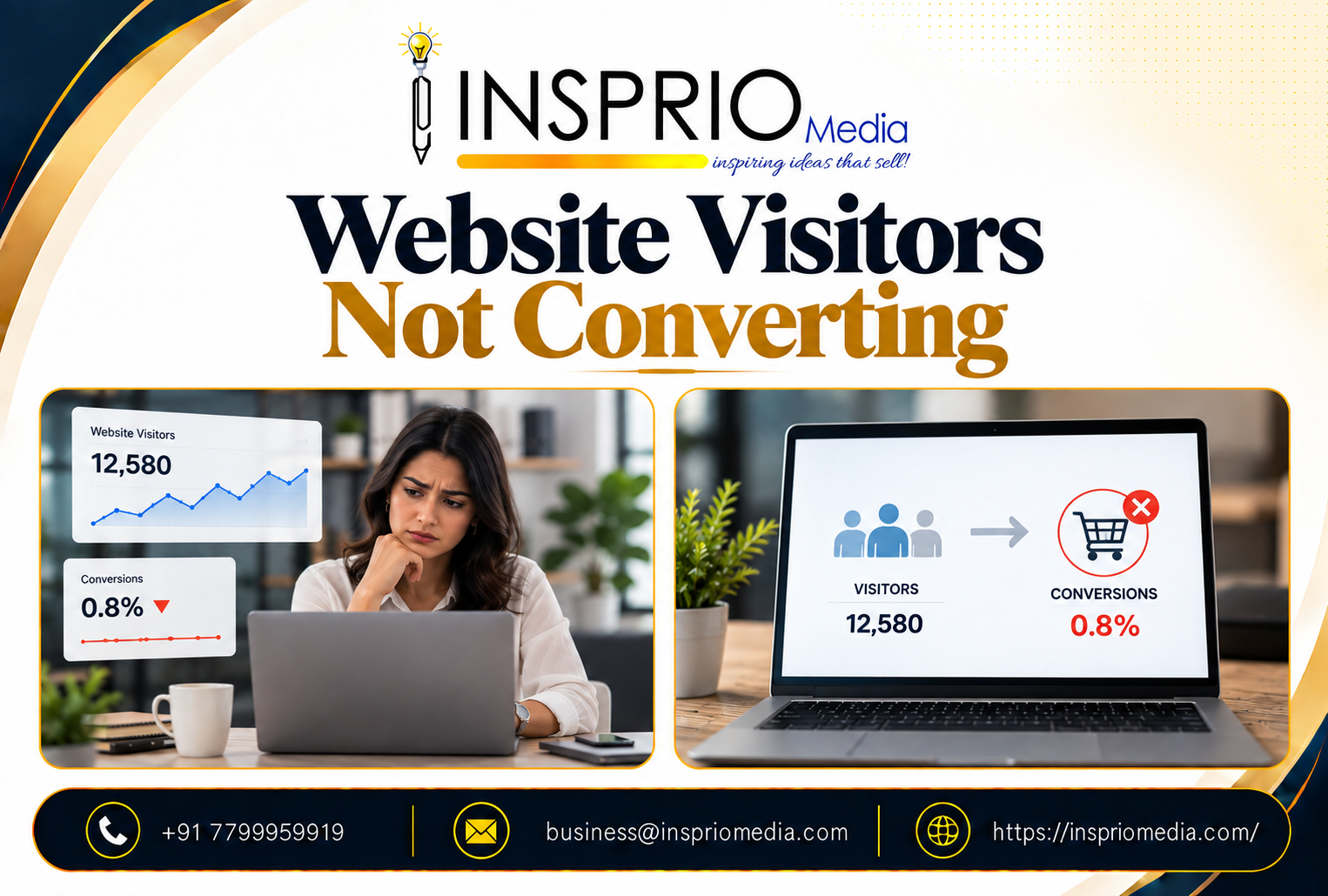
Getting people to visit a website is only half of the digital marketing challenge. The real business value appears when those visitors take meaningful actions: completing an enquiry form, calling your business, requesting a quotation, booking a consultation, downloading an offer, starting a chat, or purchasing a product. When traffic continues to increase but enquiries remain flat, understanding why Website Visitors Not Converting becomes one of the most important growth questions a business can investigate.
Many businesses immediately assume they need more SEO, more advertising or more social media traffic. Traffic certainly matters, but attracting another thousand visitors will not solve a website that is already losing qualified prospects. When Website Visitors Not Converting is the problem, increasing advertising spend can simply increase the number of people experiencing the same conversion barriers.
A website should function as more than an online brochure. It should explain what the business does, demonstrate credibility, answer the questions prospects are thinking about, remove uncertainty and make the next step easy. When these elements are disconnected, Website Visitors Not Converting becomes a predictable outcome rather than a mystery.
This guide explains the major reasons businesses struggle with Website Visitors Not Converting, how to identify the exact points where potential customers are dropping out, and what practical changes can improve lead generation without relying entirely on higher traffic.
Traffic Is Not the Same as Business Opportunity
Website traffic is easy to celebrate because it is highly visible in analytics dashboards. Businesses may see organic sessions increasing, social campaigns generating clicks and paid advertising delivering hundreds of visitors. Yet none of these numbers automatically represent genuine purchase intent. One reason for Website Visitors Not Converting is that traffic volume and traffic quality are fundamentally different metrics.
Imagine a company selling premium business software receiving thousands of visits from students looking for free tutorials. The website might appear successful when measured by sessions, but those visitors were never realistic buyers. In this situation, Website Visitors Not Converting is not primarily a design problem. It is a targeting problem.
Every traffic channel brings different expectations. A visitor searching “best digital marketing agency for local business” may have stronger commercial intent than someone who discovers an educational article through social media. Understanding those differences helps businesses determine whether Website Visitors Not Converting comes from poor audience targeting or weaknesses in the website itself.
Instead of evaluating traffic alone, review conversions by landing page, traffic source, search query, device, geography and campaign. This segmentation often reveals that Website Visitors Not Converting is concentrated in one channel while another produces significantly stronger enquiries.
1. Visitors Cannot Immediately Understand What You Offer
Most visitors do not carefully study a homepage before deciding whether a business is relevant. They scan headings, images and obvious visual elements to determine whether they are in the right place. A major cause of Website Visitors Not Converting is vague messaging that forces people to interpret what the company actually offers.
Headlines such as “Creating Tomorrow Together,” “Unlock Your Potential” or “Innovative Solutions for Success” may sound impressive but communicate very little. A prospect should quickly understand the service, target customer and value. When visitors have to work too hard to understand the offer, Website Visitors Not Converting becomes more likely.
A stronger headline communicates specifics. For example, “SEO and Performance Marketing Services for Growing Businesses” immediately establishes a clearer expectation. Supporting copy can then explain outcomes, expertise and differentiation. This reduces uncertainty and addresses one of the most common reasons for Website Visitors Not Converting.
Review your homepage with someone who has never seen your business before. Give them five seconds and ask what the company sells. If they cannot explain it accurately, improving message clarity should become a priority when investigating Website Visitors Not Converting.
2. Your Website Attracts the Wrong Search Intent
Search engine optimization can generate impressive visitor numbers while producing weak commercial results when pages rank for irrelevant or overly informational searches. This is another important explanation for Website Visitors Not Converting.
A business should evaluate not only where it ranks but why somebody is searching for each keyword. Informational, navigational, commercial and transactional searches represent different stages of the buying journey. If the majority of organic traffic comes from people seeking definitions or free information, Website Visitors Not Converting may simply reflect low purchase readiness.
Google Search Console can help businesses examine queries responsible for impressions and clicks. Compare these searches with the services you want to sell. Pages with strong traffic but poor enquiries should be reviewed carefully because Website Visitors Not Converting often begins with intent mismatch.
Your SEO strategy should balance informative content with commercial service pages, location pages, comparison content, case studies and decision-stage resources. Insprio Media's guide to website SEO services and sustainable search growth provides additional context on building visibility that supports real business goals rather than traffic alone. Aligning search intent correctly can significantly reduce Website Visitors Not Converting.
3. The Value Proposition Is Too Generic
Prospects rarely choose a company because it claims to provide “quality services,” “excellent support” or “competitive prices.” Nearly every competitor says something similar. Generic value propositions contribute heavily to Website Visitors Not Converting because they fail to give customers a compelling reason to continue.
A strong value proposition explains who you help, what problem you solve, what outcome customers receive and why your approach is credible. When these points are missing, Website Visitors Not Converting can happen even when the website looks visually professional.
Consider replacing unsupported claims with specific benefits. Instead of “We deliver exceptional digital solutions,” explain the actual solution: improving local visibility, generating qualified enquiries, redesigning slow websites or reducing advertising waste. Specificity is often the missing ingredient when diagnosing Website Visitors Not Converting.
Customers want to recognise their own problem in your messaging. When the page speaks directly to their frustration and desired outcome, the website feels relevant. That emotional and practical relevance is essential for overcoming Website Visitors Not Converting.
4. Your Website Does Not Build Enough Trust
A visitor may be interested in your service and still hesitate because they are not convinced they can trust the business. Lack of credibility is one of the biggest reasons behind Website Visitors Not Converting, particularly for expensive, sensitive or long-term services.
Trust can be strengthened through authentic customer reviews, detailed testimonials, recognisable clients, case studies, business information, team profiles, portfolio examples, clear policies, professional contact details and evidence of expertise. When these elements are absent, Website Visitors Not Converting can occur because the perceived risk of contacting the company is too high.
Brand consistency also influences credibility. A polished website combined with poor graphics, inconsistent colours or outdated marketing materials creates uncertainty. Insprio Media's guide to branding services and strong business identities explains why consistency across customer touchpoints matters. Strong branding can therefore support efforts to fix Website Visitors Not Converting.
Do not manufacture trust. Fake reviews, fake counters and invented customer logos may create short-term impressions but can damage credibility when discovered. Genuine evidence is far more effective at solving Website Visitors Not Converting.
5. Your Call to Action Is Weak or Unclear
A website can explain a service perfectly yet fail to generate enquiries if visitors do not know what to do next. Weak calls to action are another major reason for Website Visitors Not Converting.
Buttons such as “Submit,” “Click Here” and “Learn More” provide limited motivation. Stronger CTAs communicate the next step or benefit, such as “Request a Free Consultation,” “Get a Website Audit,” “Ask for a Quote” or “Schedule Your Strategy Call.” When the action is clear, one significant barrier behind Website Visitors Not Converting disappears.
CTA placement matters as well. Visitors should not need to reach the footer before discovering how to contact the company. Add relevant actions after important sections and repeat the primary conversion opportunity when appropriate. This is particularly important on long service pages affected by Website Visitors Not Converting.
However, avoid placing five competing actions beside each other. Too many choices create decision friction. One primary CTA supported by one secondary action is usually easier to understand and can improve situations where Website Visitors Not Converting is caused by unclear direction.
6. Your Contact Forms Ask for Too Much
A form should collect enough information to begin a useful conversation without making the visitor feel they are completing an application form. Excessive fields are a classic source of Website Visitors Not Converting.
The W3C's Web Accessibility Initiative guidance on forms highlights the importance of clear, usable form experiences. For lead generation, businesses should carefully question whether every field is genuinely necessary. When users encounter ten mandatory questions before they can contact you, Website Visitors Not Converting becomes understandable.
For many service businesses, name, phone or email and a short requirement field may be enough for the first interaction. Additional qualification can occur during the follow-up. Simplifying this process can directly address Website Visitors Not Converting.
Also test the form regularly. Confirmation messages, validation, email notifications and mobile usability should work properly. Sometimes businesses spend months investigating Website Visitors Not Converting before discovering that completed forms were not being delivered correctly.
7. Your Website Is Too Slow
Visitors expect modern websites to respond quickly. Large images, overloaded plugins, unnecessary scripts, weak hosting and poorly optimized code can make a website frustrating to use. Slow performance is a technical cause of Website Visitors Not Converting that should never be ignored.
Performance should be checked on real mobile connections, not only on a fast office broadband connection. Google's Core Web Vitals resources provide useful guidance for understanding important user-experience performance metrics. Improving speed can reduce friction associated with Website Visitors Not Converting.
Compress images, implement caching, remove unnecessary scripts, optimize fonts, improve hosting where necessary and review third-party tools carefully. Every additional delay between visitor intent and visible content can contribute to Website Visitors Not Converting.
Performance is particularly important for paid campaigns. If you pay for every click and send visitors to an unnecessarily heavy landing page, advertising budget can disappear before prospects even evaluate the offer. Fixing technical performance should therefore be part of any audit into Website Visitors Not Converting.
8. Mobile Visitors Are Having a Poor Experience
A website that looks excellent on a large desktop monitor may still perform badly on a phone. Small buttons, oversized headings, horizontal scrolling, intrusive popups and difficult forms frequently explain Website Visitors Not Converting on mobile devices.
Review conversion rates separately for desktop and mobile. If mobile traffic is substantial but generates very few enquiries compared with desktop, investigate the experience directly. This segmentation can reveal exactly where Website Visitors Not Converting is occurring.
Test every important page using multiple screen sizes. Ensure phone numbers are clickable, menus are easy to use, forms fit properly, CTAs remain visible and important information appears early. Mobile usability can have a direct impact on resolving Website Visitors Not Converting.
Do not treat responsive design as simply shrinking the desktop layout. Mobile users may have different needs, shorter attention windows and different interaction patterns. Designing specifically around those behaviours is critical when addressing Website Visitors Not Converting.
9. Your Website Design Looks Outdated or Unprofessional
People make credibility judgments quickly. A website with outdated visuals, inconsistent fonts, broken layouts or low-quality graphics can create doubt before visitors read the service details. Visual credibility therefore plays a meaningful role in Website Visitors Not Converting.
Professional design does not mean filling every area with animation. It means clear hierarchy, readable typography, intentional spacing, consistent branding and visual elements that support the message. When design distracts from the offer, Website Visitors Not Converting becomes more likely.
High-quality brand visuals help customers understand and remember a company. You can explore Insprio Media's insights on graphic design services and brand identity for a deeper look at how visual communication supports business growth. Improving presentation can remove one important cause of Website Visitors Not Converting.
Creative formats can also strengthen product visualization where appropriate. Insprio Media's article on 3D design services and visual experiences demonstrates how richer visuals can help communicate concepts that ordinary images may struggle to explain. Used carefully, better visual communication can help address Website Visitors Not Converting.
10. Visitors Cannot Find the Information They Need
Customers arrive with questions. How much will it cost? Who is this service for? How does the process work? How long will it take? What results can I realistically expect? Why should I choose this company? When pages do not answer these questions, uncertainty can drive Website Visitors Not Converting.
Service pages should be designed around the customer's decision process rather than the company's internal terminology. Explain problems, solutions, deliverables, process, benefits, timelines, proof and next steps. Comprehensive information helps reduce Website Visitors Not Converting because prospects do not need to leave the website to understand the offer.
Frequently asked questions are especially useful for handling objections that do not fit naturally into the main sales copy. Pricing expectations, eligibility, customization, support and implementation concerns can all be addressed before a sales conversation. This can reduce hesitation behind Website Visitors Not Converting.
Review customer emails and sales calls to identify repeated questions. Every question asked repeatedly by real prospects is potentially information that your website should explain. This customer-led approach is one of the most useful ways to tackle Website Visitors Not Converting.
11. Your Landing Page Does Not Match the Advertisement
Message mismatch creates immediate friction. If an advertisement promises one service while the landing page discusses something broader or different, visitors may leave quickly. This disconnect frequently contributes to Website Visitors Not Converting.
Paid campaigns should maintain strong message continuity between keyword, advertisement, headline, imagery, offer and CTA. A visitor who clicked an advertisement for Google Ads management should land on a page specifically discussing Google Ads management rather than a generic digital marketing homepage. This alignment can reduce Website Visitors Not Converting.
If paid traffic is part of your acquisition strategy, review Insprio Media's guide to performance marketing, business growth and ROI. Campaign performance improves when traffic acquisition and landing-page conversion strategy work together, particularly when Website Visitors Not Converting has reduced advertising efficiency.
Create dedicated landing experiences for major campaigns rather than forcing every visitor through the same page. Relevance increases clarity, lowers cognitive effort and can directly improve Website Visitors Not Converting.
12. You Are Sending Visitors to Your Homepage Instead of the Right Page
The homepage is useful for broad brand discovery, but it is not always the most appropriate destination for every campaign. Sending every advertisement, social post and search visitor to the homepage is a frequent cause of Website Visitors Not Converting.
A prospect searching specifically for local SEO should arrive on a page explaining local SEO. Someone interested in website development should reach a development page. This shortens the journey between visitor intent and relevant information, helping resolve Website Visitors Not Converting.
For businesses pursuing location-based visibility, Insprio Media's article about GMB SEO services, Google Maps and local search provides useful context. Local visitors often have strong intent, but the destination page still needs to match their requirements to prevent Website Visitors Not Converting.
Map campaigns to specific landing pages before launching them. This simple planning step can prevent a large amount of wasted traffic and reduce Website Visitors Not Converting.
13. Your Content Talks About the Company Instead of the Customer
Many websites begin every section with “we,” “our,” and “us.” While prospects need to understand the company, they primarily care about their own goals. Excessively company-focused copy is another subtle cause of Website Visitors Not Converting.
Instead of saying, “We use advanced strategies and have an experienced team,” translate expertise into customer value: “Get a measurable marketing strategy designed to improve qualified leads while reducing wasted advertising spend.” This customer-centred approach can improve pages affected by Website Visitors Not Converting.
The best website copy demonstrates empathy by naming real frustrations. Low enquiry volume, poor rankings, expensive clicks, outdated websites, inconsistent branding and weak local visibility are concrete business problems. Addressing these directly makes the content more relevant and helps solve Website Visitors Not Converting.
Company credentials should support the customer outcome rather than replace it. This balance improves persuasion without making exaggerated promises and can reduce Website Visitors Not Converting.
14. There Is Too Much Distraction
Conversion is not improved by adding more things to click. Websites sometimes contain rotating sliders, multiple popups, chat windows, notification prompts, social buttons, autoplay videos and competing offers on the same screen. This overload can contribute significantly to Website Visitors Not Converting.
Every page should have a clear primary purpose. On a service page, that purpose may be generating a consultation request. Secondary content should support that goal rather than compete with it. Simplifying visual hierarchy can improve Website Visitors Not Converting.
Remove elements that exist simply because a plugin or template included them. If a feature does not improve understanding, trust, usability or conversion, test whether the page performs better without it. This is especially useful when diagnosing Website Visitors Not Converting.
Minimalism alone is not the objective. Clarity is. A page can be visually rich while still guiding attention effectively. The important question is whether each element helps visitors move closer to action or contributes to Website Visitors Not Converting.
15. Your Website Has No Strong Proof of Results
Marketing claims become more persuasive when they are supported by evidence. Prospects are naturally cautious, especially when many competitors make similar promises. Weak proof is therefore an important factor behind Website Visitors Not Converting.
Case studies can show the customer's initial challenge, your approach, implementation and measurable outcome. Testimonials can provide context around communication, reliability and customer experience. Portfolio examples demonstrate practical ability. Together, these elements can improve trust when Website Visitors Not Converting is caused by uncertainty.
Avoid vague testimonials such as “Great service!” when detailed customer feedback is available. A specific statement explaining what changed and why the customer valued the experience is usually more useful in addressing Website Visitors Not Converting.
Where possible, connect proof to the relevant service instead of putting every testimonial on one general page. A web development prospect benefits most from web development examples. Relevant proof can therefore help reduce Website Visitors Not Converting.
16. Your Follow-Up Process Is Too Slow
Website conversion does not end when a visitor submits a form. A qualified enquiry can still be lost if nobody responds quickly or the lead is handled poorly. For this reason, some businesses mistakenly classify Website Visitors Not Converting when the real weakness exists after the website enquiry.
Track form submissions all the way to qualified opportunities and customers. Determine how long it takes the team to respond, whether calls are answered, whether enquiries are assigned correctly and whether follow-up attempts are documented. This broader view can reveal that Website Visitors Not Converting is actually a sales-process problem.
Automated acknowledgement emails can reassure users that the enquiry was received, while a human response should follow according to the urgency of the service. Improve internal workflows before spending heavily on additional traffic if Website Visitors Not Converting is linked to lead handling.
Marketing and sales should agree on what counts as a lead, what information is required and how quickly different enquiry types should be contacted. Alignment can prevent valuable prospects from being incorrectly blamed on Website Visitors Not Converting.
17. You Are Not Measuring the Right Conversion Events
A website may appear to produce no results simply because measurement is incomplete. Form submissions might be tracked while phone calls, WhatsApp clicks, booking confirmations and email links are ignored. Incorrect tracking can therefore create a misleading picture of Website Visitors Not Converting.
Configure meaningful conversion events based on actual business actions. For some companies, form completion is the primary event. For others, phone calls or appointment bookings matter more. Reliable measurement is essential before making major decisions about Website Visitors Not Converting.
Google provides extensive resources through Google Analytics Help for businesses configuring analytics and event measurement. Combine analytics with CRM or sales information when possible so you can distinguish enquiry volume from enquiry quality. This produces a much clearer view of Website Visitors Not Converting.
Do not optimize for an easy-to-measure action that has no commercial value. Ten thousand video plays may look impressive, but if the business needs consultation requests, those plays should not disguise Website Visitors Not Converting.
18. You Have Not Studied Real Visitor Behaviour
Analytics explains what happened, but behavioural tools can help explain how visitors interacted with the page. Heatmaps and session recordings can reveal confusing interfaces, ignored CTAs and unexpected click behaviour behind Website Visitors Not Converting.
Microsoft Clarity provides behavioural analytics functionality including heatmaps and session recordings. Observing aggregated interaction patterns can help teams identify areas where Website Visitors Not Converting may be connected to usability friction.
For example, visitors may repeatedly click an image that is not linked, abandon the page before reaching the CTA, or struggle with a mobile menu. These patterns often reveal practical reasons for Website Visitors Not Converting that ordinary pageview reports cannot show.
Use behavioural data responsibly and respect applicable privacy requirements. The objective is to improve user experience, not invade visitor privacy. Used appropriately, behaviour analysis can become one of the most useful tools for understanding Website Visitors Not Converting.
19. Your Marketing Channels Are Working in Isolation
Customers rarely experience a business through only one channel. Someone might discover a company on Instagram, search its name on Google, read a blog, review the website and then contact the business several days later. When channels are disconnected, Website Visitors Not Converting may be caused by inconsistent messaging across the journey.
Social media should reinforce the same positioning visitors find on the website. Insprio Media's guide to social media management for business growth explores how consistent social presence supports broader digital visibility. Better continuity can help address Website Visitors Not Converting.
Offline visibility matters for some local businesses as well. The article on offline marketing services and local brand visibility demonstrates why customers may encounter a brand across multiple touchpoints before visiting its website. Consistency across those touchpoints strengthens trust and can reduce Website Visitors Not Converting.
Your website should therefore be treated as part of a connected customer journey, not an isolated asset. Integrated marketing makes each interaction reinforce the next and reduces the uncertainty associated with Website Visitors Not Converting.
20. Your Website Technology Is Holding Conversion Back
Old technology can create broken pages, security warnings, browser compatibility problems, poor responsive behaviour and unreliable forms. When the technical foundation is weak, Website Visitors Not Converting can persist despite strong marketing.
A modern website should be secure, maintainable, mobile-friendly and built around customer actions. Insprio Media's guide to web development services for fast, secure and SEO-friendly websites explains why development quality affects more than appearance. Technical reliability is essential for resolving Website Visitors Not Converting.
Conduct regular checks for broken links, JavaScript errors, expired certificates, layout problems, failed forms and checkout issues. These problems can silently produce Website Visitors Not Converting even while marketing campaigns continue to send traffic.
A redesign is not always necessary. Sometimes targeted development improvements can solve the specific problems responsible for Website Visitors Not Converting without replacing the entire website.
21. Your Offer Is Not Compelling Enough
A website cannot compensate indefinitely for an offer customers do not find attractive. Sometimes Website Visitors Not Converting happens because the product, pricing, package or perceived value simply does not compete effectively.
Review competitor offerings, but do not automatically compete on price. Better guarantees, clearer packages, easier onboarding, additional support, faster response, transparent scope or stronger expertise may improve perceived value. This can change the outcome when Website Visitors Not Converting is primarily an offer problem.
Ask existing customers why they chose your business. Their answers may reveal benefits you are not currently communicating. Incorporating those insights into your website can help resolve Website Visitors Not Converting.
Likewise, ask lost prospects what prevented them from proceeding where appropriate. Pricing, timing, uncertainty and lack of a required feature can each point to different solutions for Website Visitors Not Converting.
22. There Is Too Much Friction Before Contact
Every unnecessary action between interest and enquiry creates an opportunity for abandonment. Requiring account creation, forcing visitors through multiple pages or hiding contact information can all contribute to Website Visitors Not Converting.
Map the path from landing page to completed enquiry. Count the decisions, clicks and form fields involved. Then ask whether each one is essential. Reducing unnecessary friction is often one of the fastest approaches to improving Website Visitors Not Converting.
Local service businesses should make calls particularly easy on mobile devices. B2B organisations may benefit from calendar booking. Ecommerce businesses need smooth checkout experiences. Different business models require different solutions, but the principle behind Website Visitors Not Converting remains the same: make the desired action straightforward.
Convenience communicates professionalism. When the buying journey feels organised and predictable, prospects gain confidence. That confidence can significantly reduce Website Visitors Not Converting.
23. Your Pages Lack Local Relevance
Businesses serving specific cities or neighbourhoods often receive visitors who want to confirm that the company genuinely operates in their location. Missing location information can contribute to Website Visitors Not Converting.
Relevant service-area content, local examples, maps, business details and customer proof can help visitors quickly understand whether the business serves them. These elements are particularly useful when Website Visitors Not Converting affects local search traffic.
Avoid creating hundreds of thin location pages containing only city-name substitutions. Provide genuine local value and useful service information. High-quality local content is more credible and better suited to solving Website Visitors Not Converting.
Business information should also remain consistent across important online profiles. Accurate local details reduce confusion during the decision process and can help improve Website Visitors Not Converting.
24. Your Website Is Not Connected to a Complete Digital Strategy
Conversion optimization works best when SEO, paid media, content, social media, branding and web development support the same commercial objectives. Fragmented strategies frequently lead to Website Visitors Not Converting.
For example, SEO might generate informational traffic while paid advertising targets buyers and social media communicates a completely different brand message. Bringing these channels together creates a more predictable customer journey and helps address Website Visitors Not Converting.
Insprio Media's overview of digital marketing services and online business growth provides broader insight into coordinating marketing channels. Integrated strategy is especially valuable when Website Visitors Not Converting cannot be traced to one isolated website issue.
Before adding another marketing channel, determine whether the existing customer journey is converting efficiently. Strengthening the complete funnel can generate more value from the traffic you already have and reduce Website Visitors Not Converting.
25. You Are Making Changes Without Testing Them
Website optimization should not be based entirely on opinions. One team member may prefer a red button, another may prefer blue, while neither knows whether the change affects customer behaviour. Guesswork can prolong Website Visitors Not Converting.
Start with evidence. Review traffic sources, landing pages, conversion rates, search queries, heatmaps, recordings, customer questions and sales feedback. Build hypotheses from those insights. This creates a more disciplined process for improving Website Visitors Not Converting.
Where traffic volume allows, controlled testing can help compare meaningful changes. Test headlines, offers, CTA wording, page structure, form length or proof placement rather than changing twenty elements simultaneously. This makes it easier to identify what actually improves Website Visitors Not Converting.
Conversion optimization is continuous because audiences, competitors and marketing channels change. The goal is not to create a theoretically perfect page but to continuously understand customers better and reduce the barriers behind Website Visitors Not Converting.
Website Conversion Problems at a Glance
| Problem | What Visitors Experience | Recommended Action |
|---|---|---|
| Wrong traffic | Visitors have little commercial intent | Review targeting, keywords and traffic sources |
| Unclear headline | Visitors cannot understand the service quickly | Use specific benefit-focused messaging |
| Weak trust | Prospects hesitate to contact the business | Add genuine reviews, case studies and proof |
| Poor CTA | Visitors do not know what to do next | Create one prominent primary action |
| Long forms | Users abandon enquiries | Request only essential information |
| Slow pages | Visitors leave before engaging | Improve hosting and page performance |
| Poor mobile UX | Navigation and forms become difficult | Optimize specifically for mobile users |
| Weak proof | Visitors doubt claims | Add relevant evidence and customer outcomes |
| Message mismatch | Landing page differs from advertisement | Align campaign promise and landing content |
| Poor measurement | Real conversions are not visible | Configure accurate analytics and lead tracking |
A Practical Conversion Audit Process
When a business experiences Website Visitors Not Converting, random redesigns should not be the first response. A structured audit helps identify the actual bottleneck.
Step 1: Confirm That Tracking Works
Submit every form, click every major phone button, test booking tools and verify that analytics records the events correctly. A measurement issue can easily be mistaken for a conversion issue.
Step 2: Segment Traffic Sources
Compare organic search, paid search, direct traffic, social media, referrals and email visitors. One channel may produce strong leads while another produces almost none.
Step 3: Compare Landing Pages
Identify pages receiving meaningful traffic and compare their enquiry performance. High-traffic, low-conversion pages deserve immediate investigation.
Step 4: Review Search Intent
Use search query data to determine whether visitors are looking for the services your page actually provides.
Step 5: Test the Mobile Experience
Complete the entire customer journey using a real smartphone. Look for layout problems, difficult forms, intrusive popups and buttons that are hard to tap.
Step 6: Review the Value Proposition
Ask whether a new visitor can immediately understand what you offer, who it is for and why it matters.
Step 7: Evaluate Trust
Check whether important pages contain genuine evidence, clear company details and enough information for a prospect to feel comfortable contacting you.
Step 8: Study Behaviour
Use analytics, scroll information, heatmaps and recordings where appropriate to understand what visitors actually do.
Step 9: Interview Sales Teams
Sales representatives often know exactly which objections prevent prospects from moving forward. Use those insights to improve website content.
Step 10: Prioritize Changes
Focus first on high-traffic pages and serious conversion barriers. Fix broken forms before experimenting with button colours.
How to Calculate Your Website Lead Conversion Rate
A simple lead conversion rate can be calculated using:
Lead Conversion Rate = (Number of Leads ÷ Number of Website Visitors) × 100
For example, if a website receives 5,000 relevant visitors and generates 100 enquiries, its visitor-to-lead conversion rate is 2%.
However, do not judge performance from a universal benchmark alone. Conversion expectations vary substantially by industry, service price, traffic source, geographic targeting, offer type and what your analytics platform defines as a conversion.
A better approach is to establish your own baseline and improve it over time. Compare similar traffic segments rather than comparing an informational blog visitor with someone who clicked a high-intent search advertisement.
Why More Traffic Is Not Always the Solution
Suppose a business receives 10,000 visits each month but generates only 20 enquiries. Doubling the traffic may increase enquiries, but it could also double advertising expenses, content requirements and acquisition costs.
If the same business improves its website experience and generates 40 enquiries from the original traffic, it has increased opportunity without needing twice as many visitors.
This does not mean businesses should stop investing in SEO or advertising. It means traffic generation and conversion optimization should develop together.
Authoritative Resources for Improving Website Performance
Businesses and website teams can also consult the following authoritative resources when improving usability, search performance, accessibility and measurement:
- Google Search Central Documentation – official guidance covering how Google Search works and website optimization principles.
- Google Web.dev Core Web Vitals – guidance related to important website user-experience and performance metrics.
- W3C Web Accessibility Initiative – Forms – practical accessibility guidance for web forms.
- Google Analytics Help Center – resources for website measurement, events and analytics configuration.
- Google Search Console Performance Report – official information about analysing search clicks, impressions and queries.
- Microsoft Clarity Documentation – official documentation for behavioural analytics, heatmaps and session recordings.
Frequently Asked Questions
1. Why do I have website traffic but no leads?
Traffic without leads usually indicates one or more problems with audience quality, search intent, website messaging, trust, usability, offer strength or conversion tracking. Start by identifying where visitors come from and whether those people match your target customers. Then review the pages they enter, their behaviour and whether the next action is clear.
2. How can I tell whether my website traffic is good quality?
Analyse traffic by source, search query, landing page, geography, device and eventual lead quality. Good traffic is not simply traffic that spends a long time on the website. It is traffic that matches your target audience and shows behaviour connected to meaningful business outcomes.
3. Can a slow website reduce enquiries?
Yes. Slow pages increase friction and can make users abandon a website before they understand the offer or complete an enquiry. Review important landing pages on both desktop and mobile connections and optimize oversized media, scripts, plugins and hosting issues where necessary.
4. How many fields should a lead generation form contain?
There is no universal number, but every required field should have a clear purpose. If name, phone or email and a short message are enough to begin the conversation, demanding ten additional fields may unnecessarily discourage prospects. Complex B2B services may need more qualification, but friction should still be justified.
5. Should I display prices on my website?
That depends on the business model. Transparent pricing can help qualify prospects and reduce uncertainty, while highly customised services may not have a fixed price. In those cases, explaining typical pricing factors, package structures or what customers receive can still improve clarity.
6. Do testimonials really improve conversions?
Relevant and genuine testimonials can strengthen trust because they provide evidence from previous customers. Detailed testimonials explaining the customer's problem and experience are generally more persuasive than vague statements. Case studies can provide even stronger context for high-value services.
7. How often should I review website conversion performance?
Monitor important lead and traffic metrics regularly, but avoid making major conclusions from very small samples. Monthly reviews are useful for many businesses, while high-volume websites may analyse performance more frequently. Larger strategic audits can be performed quarterly or whenever traffic changes significantly.
8. Is SEO useful if my website does not convert?
SEO remains valuable, but attracting more visitors to a poor conversion experience may produce disappointing returns. Ideally, SEO and conversion optimization should work together so relevant people can discover the business and then find a website capable of turning that interest into action.
9. Should I redesign my whole website to get more leads?
Not necessarily. First identify the actual barriers. A website may need only clearer copy, faster pages, better forms, stronger calls to action or additional trust signals. A complete redesign makes more sense when the underlying architecture, technology, branding or user experience is fundamentally outdated.
10. How long does website conversion optimization take?
Some issues can be fixed quickly, such as broken forms or unclear calls to action. Other improvements require enough traffic and data to evaluate properly. Conversion optimization should be considered an ongoing process of measuring behaviour, identifying friction, implementing changes and learning from results.
Final Thoughts: Turn Existing Traffic Into Real Business Opportunities
A website does not generate leads simply because it receives traffic. Conversion happens when the right visitor encounters the right message, understands the value, trusts the business and can take the next step without unnecessary difficulty.
Instead of immediately trying to increase visitor numbers, businesses should first investigate the journey their current audience experiences. Review targeting, page speed, search intent, messaging, CTAs, mobile usability, forms, trust signals, proof, analytics and sales follow-up.
The most successful conversion strategies are rarely based on one dramatic trick. They are built through dozens of thoughtful improvements that reduce confusion and uncertainty throughout the customer journey.
When SEO, web development, branding, performance marketing, content and conversion strategy support one another, website traffic becomes much more valuable. The objective is not simply to attract clicks. It is to create a digital experience that helps qualified prospects confidently move from interest to enquiry.
Need Help Turning Website Traffic Into Leads?
If your website receives traffic but does not generate enough enquiries, Insprio Media can help evaluate the complete digital journey—from traffic acquisition and search visibility to website design, development, branding, content and conversion opportunities.
Instead of relying only on more traffic, the goal should be to identify the barriers preventing existing visitors from becoming genuine prospects.
Visit Insprio Media to explore digital marketing and web solutions designed to support measurable business growth.
Contact Insprio Media:
Phone: +91 7799959919
Email: business@inspriomedia.com
Website: https://inspriomedia.com/