B2B Digital Marketing Services: A Practical Growth Guide for Modern Businesses
Build brand authority, reach qualified decision-makers, generate sales-ready enquiries, and turn digital activity into measurable revenue with a coordinated business-to-business marketing strategy.
Business buyers rarely make decisions after seeing a single advertisement. They research solutions, compare vendors, read reviews, study case examples, consult colleagues, and evaluate commercial risk before speaking with a sales team. This longer and more complex journey makes B2B Digital Marketing Services essential for companies that want to create demand, earn trust, and develop a predictable pipeline.
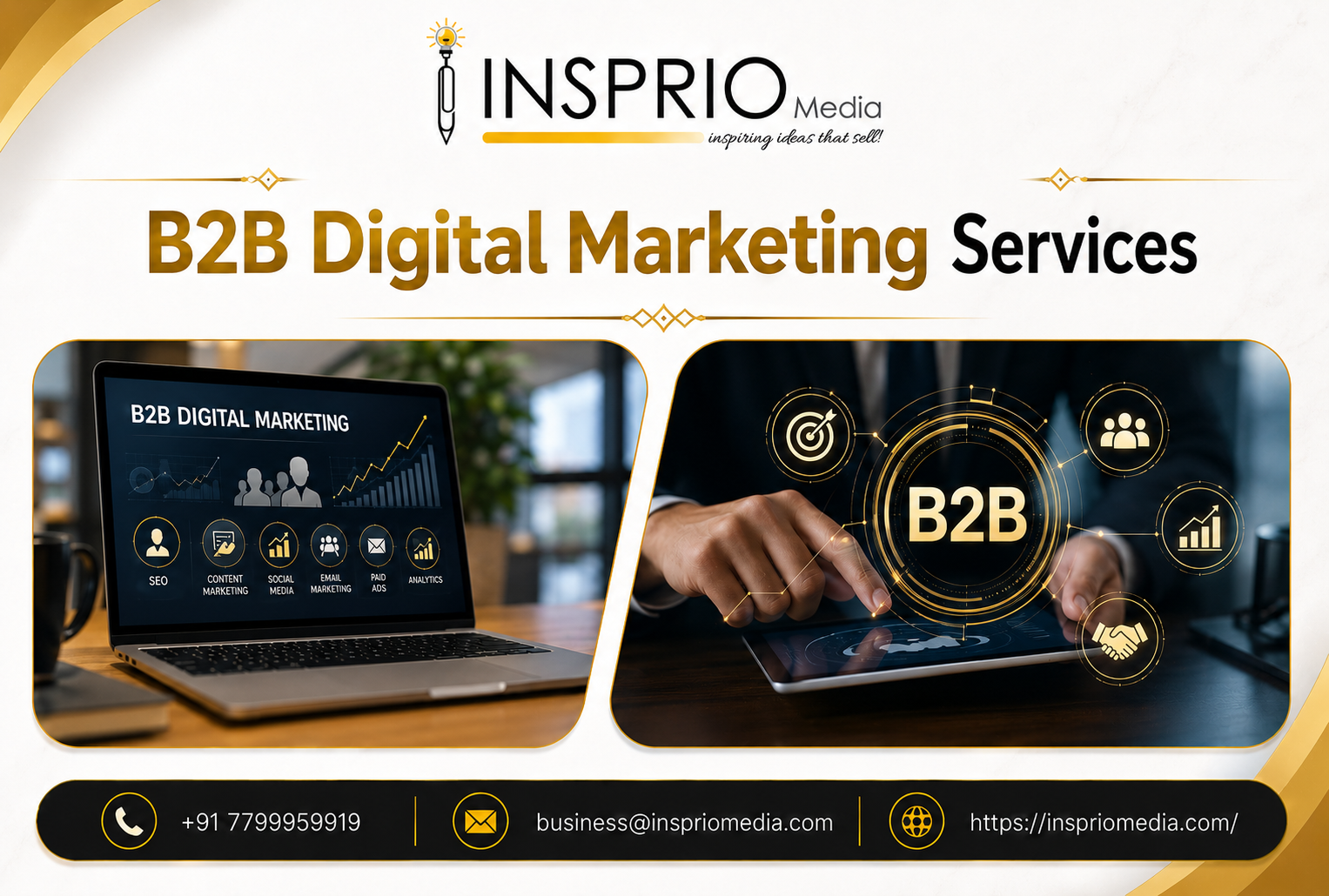
A strong B2B strategy does not rely on isolated campaigns. It connects search visibility, useful content, professional branding, targeted advertising, social engagement, conversion-focused websites, marketing automation, and performance reporting. When these elements work together, a business can attract the right accounts, nurture multiple stakeholders, and help its sales team close opportunities with better context.
What Are B2B Digital Marketing Services?
B2B Digital Marketing Services are specialised online marketing activities designed to promote products or services from one business to another. Unlike consumer campaigns, B2B marketing usually targets a smaller, more defined audience that may include founders, procurement teams, department heads, technical specialists, finance leaders, and senior executives.
The objective is not simply to attract more traffic. The real goal is to attract relevant organisations, educate their decision-makers, establish commercial credibility, and move promising accounts toward an enquiry, consultation, proposal, demonstration, or purchase.
This requires a clear understanding of the ideal customer profile, buying committee, sales cycle, industry language, business problems, objections, and desired outcomes. It also requires close alignment between marketing and sales so that both teams use shared definitions for leads, opportunities, qualified accounts, and revenue contribution.
Why B2B Digital Marketing Matters for Sustainable Growth
Traditional networking, referrals, exhibitions, and outbound sales remain useful, but they are stronger when supported by an authoritative digital presence. A prospect who hears about your company will usually search for your website, review your services, check social profiles, compare competitors, and look for proof before responding.
Well-planned B2B Digital Marketing Services help your company remain visible during this research process. They also create multiple opportunities to reconnect with prospects who are interested but not yet ready to buy.
Reach Better-Fit Prospects
Target audiences by industry, company size, location, job role, search intent, technology usage, and business need instead of promoting to everyone.
Build Trust Before Sales Contact
Use expert articles, case studies, landing pages, testimonials, service explanations, and visual branding to reduce uncertainty.
Support Longer Buying Cycles
Nurture prospects through email, retargeting, educational content, and consistent social communication until the timing is right.
Measure Marketing Contribution
Track qualified enquiries, source quality, lead cost, conversion rate, pipeline value, and revenue instead of relying only on impressions.
Core Components of a Complete B2B Marketing Strategy
1. B2B Search Engine Optimisation
Search engine optimisation helps your company appear when potential buyers actively research a problem, service, supplier, or solution. Effective B2B SEO includes technical improvements, keyword mapping, service-page optimisation, authoritative content, internal linking, local optimisation, and credible backlink development.
High-intent pages should clearly explain who the service is for, what challenges it solves, how delivery works, and what action the visitor should take next. Learn how Insprio Media approaches website SEO services for sustainable business growth and GMB SEO services for local visibility.
2. Content Marketing and Thought Leadership
B2B buyers need enough information to justify a decision internally. Content marketing provides that information through service pages, blogs, industry reports, comparison guides, case studies, FAQs, white papers, videos, and email resources.
Good content should address real commercial questions rather than repeat generic definitions. It can explain implementation, expected timelines, costs, risks, compliance considerations, integration requirements, or the difference between available solutions. LinkedIn’s official resources on B2B content types offer useful context on how different formats support awareness, lead generation, and authority.
3. Performance Marketing and Paid Campaigns
Paid search, LinkedIn advertising, social advertising, display campaigns, retargeting, and account-based advertising can place your offer in front of carefully selected audiences. The campaigns should be organised around buyer intent and funnel stage rather than a single generic advertisement.
A high-performing paid strategy connects precise targeting with a strong offer, dedicated landing page, lead qualification process, CRM tracking, and regular optimisation. Read more about performance marketing for business growth and ROI.
4. Social Media Management
For B2B companies, social media is a credibility and relationship channel. It allows businesses to share expertise, explain complex services, highlight client outcomes, introduce team members, respond to industry developments, and remain familiar to potential buyers.
LinkedIn may be central for many professional audiences, but the right mix can also include Instagram, Facebook, YouTube, or industry communities. Explore why social media management is essential for business growth.
5. Conversion-Focused Web Development
Your website is often the main validation point in the buying process. It should load quickly, work smoothly on mobile devices, explain services clearly, present proof, answer objections, and guide visitors toward a meaningful action.
A B2B website should include focused service pages, relevant calls to action, case studies or project evidence, simple enquiry forms, tracking tools, strong security, and search-friendly architecture. Insprio Media’s guide to fast, secure, SEO-friendly web development services explains these foundations in more detail.
6. Brand Strategy and Creative Communication
Professional buyers compare both capability and perceived reliability. A consistent brand identity makes your business easier to recognise and helps communicate quality across proposals, websites, presentations, advertisements, social posts, and sales materials.
Branding should connect visual identity with positioning, audience needs, competitive differentiation, and a clear value proposition. Related resources include branding services for powerful business identities, graphic design services for business growth, and 3D design services for visual communication.
7. Email Marketing and Lead Nurturing
Many B2B prospects are interested long before they are ready to request a proposal. Email nurturing helps maintain the relationship with useful insights, implementation advice, case evidence, product updates, event invitations, and personalised follow-ups.
Segmentation is important. A technical evaluator may need different information from a finance leader or company founder. Messages should reflect the prospect’s industry, stage, interests, and previous interactions. Marketing automation can support consistency, but human review is still essential for relevance and tone.
8. Account-Based Marketing
Account-based marketing focuses resources on a defined list of high-value companies. Marketing and sales collaborate to personalise communication for the needs, stakeholders, and opportunities within each account.
ABM is particularly useful when deal values are high, target markets are narrow, or several people influence the purchase. Salesforce provides an authoritative overview of account-based marketing principles.
9. Offline and Digital Integration
Digital marketing becomes even more effective when coordinated with exhibitions, print materials, outdoor promotion, dealer activity, conferences, local events, and sales outreach. Consistent messaging and trackable QR codes or campaign landing pages can connect offline attention with measurable online action.
See how offline marketing services can strengthen local brand visibility.
How Effective B2B Digital Marketing Services Work
A successful programme begins with strategy, not random content or advertising. The following framework keeps activity connected to commercial priorities.
| Stage | Main Activities | Business Outcome |
|---|---|---|
| Research | Audience analysis, competitor review, customer interviews, keyword research, and analytics audit | Clear understanding of opportunities and buyer needs |
| Positioning | Value proposition, offer structure, messaging, proof points, and brand consistency | Stronger differentiation and relevance |
| Foundation | Website improvements, tracking, CRM setup, landing pages, and content planning | Reliable measurement and conversion readiness |
| Activation | SEO, content, paid media, social media, email, retargeting, and outreach support | Awareness, engagement, and qualified demand |
| Optimisation | Lead-quality review, attribution analysis, A/B testing, and budget adjustment | Improved efficiency and return on investment |
| Scale | Expansion of successful channels, accounts, topics, locations, and offers | Predictable pipeline and sustainable growth |
Define the Ideal Customer Profile
Start by identifying the types of companies most likely to benefit from your offer. Consider industry, employee count, turnover, location, maturity, technology, buying triggers, common challenges, and deal potential. Then identify the people involved in research, evaluation, approval, procurement, and implementation.
Map Content to the Buying Journey
Awareness-stage prospects may search for explanations and problem-solving advice. Consideration-stage buyers need comparisons, processes, examples, and proof. Decision-stage buyers need pricing context, implementation details, timelines, guarantees, security information, or a clear consultation pathway.
Align Marketing With Sales
Sales feedback helps marketing understand which enquiries are genuinely qualified and which messages resonate in conversations. Marketing data helps sales understand a prospect’s interests and engagement history. Shared reporting creates a clearer view of pipeline performance.
Use Reliable External Guidance
Businesses can strengthen their planning with official resources such as LinkedIn’s B2B marketing plan guide, Salesforce’s B2B marketing strategy guide, HubSpot’s State of Marketing report, and Google’s Analytics Help Centre.
How to Measure B2B Marketing Performance
The value of B2B Digital Marketing Services should be measured using metrics linked to lead quality, sales progress, and revenue. Traffic and impressions provide context, but they do not tell the complete story.
- Qualified lead volume: Enquiries that match your customer profile and have a relevant need.
- Conversion rate: Percentage of visitors or leads completing the desired action.
- Cost per qualified lead: Marketing spend divided by qualified opportunities, not all form submissions.
- Lead-to-opportunity rate: Percentage of leads accepted into the active sales pipeline.
- Pipeline influenced: Potential deal value connected to marketing interactions.
- Customer acquisition cost: Combined sales and marketing cost required to acquire a customer.
- Revenue and return on investment: Commercial return generated in relation to marketing investment.
- Sales-cycle length: Time required to move from first interaction to a completed deal.
Attribution should be interpreted carefully because B2B buyers often interact with several pages, advertisements, emails, and team members. Combining analytics data, CRM records, call tracking, campaign tagging, and sales feedback produces a more realistic view.
Common B2B Marketing Mistakes to Avoid
Targeting an Audience That Is Too Broad
Trying to reach every company usually weakens messaging and wastes budget. Precise segmentation allows you to speak directly to the priorities of a specific industry, role, company size, or use case.
Sending Paid Traffic to Generic Pages
A homepage may not match the promise of an advertisement. Dedicated landing pages improve message consistency and make it easier for visitors to understand the offer and take action.
Publishing Content Without Buyer Insight
High content volume cannot replace relevance. Useful topics often come from sales calls, customer questions, lost-deal feedback, search data, and implementation challenges.
Optimising for Cheap Leads Instead of Good Leads
A low cost per form submission can look impressive while producing little revenue. Lead quality, opportunity value, and conversion to sales matter more.
Treating Branding and Performance as Opposites
Brand building creates familiarity and trust, while performance activity captures and converts demand. Strong programmes use both instead of choosing only one.
Why Choose Insprio Media?
Insprio Media brings strategy, design, technology, content, and campaign execution together under one coordinated approach. Our B2B Digital Marketing Services are designed to help businesses improve visibility, communicate their value clearly, generate relevant enquiries, and measure the commercial impact of marketing.
Rather than applying the same plan to every company, we consider your market, customer profile, competitive position, sales cycle, internal capabilities, and growth priorities. This makes it possible to select the channels and content formats most likely to support real business outcomes.
You can also explore our complete overview of digital marketing services for growing your business online. For an incoming link to the main brand website, visit Insprio Media.
Frequently Asked Questions
1. What businesses need professional B2B marketing support?
Manufacturers, technology companies, consultants, professional service firms, distributors, industrial suppliers, training providers, SaaS businesses, agencies, real estate companies, and other organisations selling to businesses can benefit. The strategy should be customised to the sales cycle and target market.
2. How are B2B and B2C digital marketing different?
B2B marketing often involves higher transaction values, longer sales cycles, multiple decision-makers, detailed evaluation, and a stronger need for evidence. B2C campaigns may focus more on individual preferences, faster decisions, emotional appeal, and larger audiences.
3. Which channels work best for B2B lead generation?
The best combination depends on buyer behaviour. Commonly effective channels include SEO, Google Ads, LinkedIn, email marketing, industry content, webinars, retargeting, account-based campaigns, and conversion-focused landing pages.
4. How long does B2B digital marketing take to produce results?
Paid campaigns can begin generating data and enquiries relatively quickly, while SEO, content authority, and brand building usually require consistent effort over several months. Results also depend on demand, competition, offer strength, budget, and sales follow-up.
5. How much should a B2B company spend on digital marketing?
There is no universal figure. The budget should reflect revenue targets, average deal value, market size, competition, required channels, sales capacity, and acceptable customer acquisition cost. A focused pilot campaign can establish benchmarks before scaling.
6. What is a qualified B2B lead?
A qualified lead is a person or company that matches the target customer profile, has a relevant business need, demonstrates reasonable intent, and has the potential to participate in or influence a purchase.
7. Can digital marketing support an offline sales team?
Yes. It can generate enquiries, warm up target accounts, provide sales enablement content, track buyer interests, support follow-up, promote events, and help sales representatives enter conversations with greater credibility.
8. What content is most useful for B2B buyers?
Practical service guides, case studies, comparison articles, implementation checklists, pricing explanations, technical resources, industry insights, FAQs, videos, and webinars can all be effective when they answer genuine buyer questions.
9. How do you calculate ROI from B2B campaigns?
Track campaign costs, qualified leads, opportunities, closed revenue, customer acquisition cost, and customer value. Because several interactions may contribute to a sale, CRM-based attribution and sales feedback should complement website analytics.
10. Why outsource B2B Digital Marketing Services?
Outsourcing gives a business access to strategy, SEO, paid media, content, creative, web development, analytics, and campaign optimisation without building every specialist function internally. The right agency should also provide transparent reporting and align activity with sales outcomes.
Conclusion
Modern business growth depends on being visible, credible, and useful throughout the buyer’s journey. Effective B2B Digital Marketing Services connect audience research, content, SEO, advertising, social media, web development, branding, nurturing, and analytics into one measurable system.
The strongest strategy is not the one using the most channels. It is the one that reaches the right accounts, answers their most important questions, supports sales conversations, and continuously improves based on commercial evidence. With a coordinated plan from Insprio Media, your business can create stronger demand, improve lead quality, and build a more predictable route to revenue.
Contact Us:
Phone: +91 7799959919
Email: business@inspriomedia.com
Website: https://inspriomedia.com/