Conversion Rate Optimization: Turn More Website Visitors into Customers
Learn how a structured, data-led approach can improve landing pages, generate qualified enquiries, reduce wasted advertising spend and help your website produce measurable business growth.
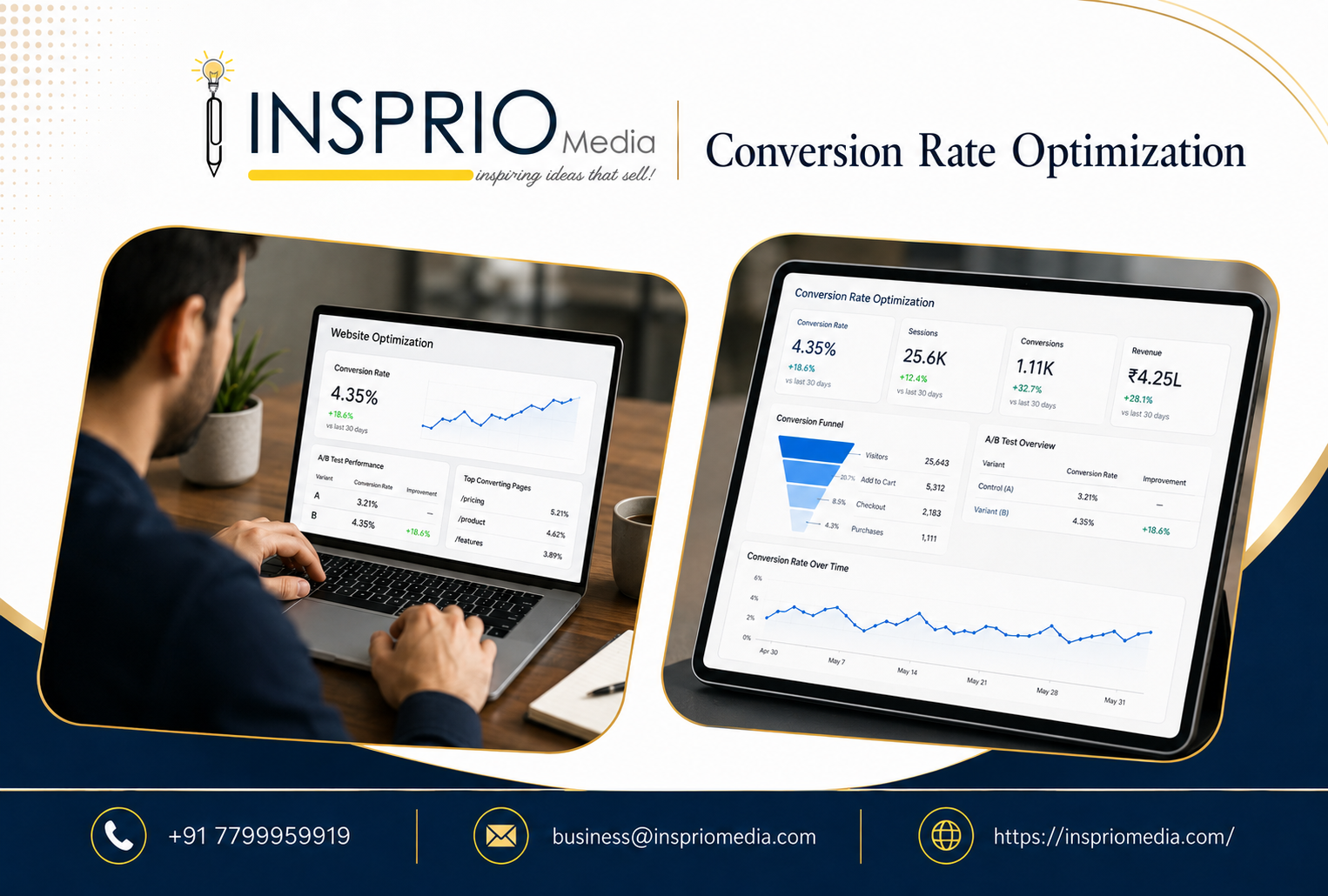
Driving traffic to a website is only the beginning of digital growth. A business can attract thousands of visitors through Google Ads, search engine optimisation, social media and referral campaigns, yet still receive very few calls, form submissions or purchases. The problem is often not traffic volume but the experience visitors have after reaching the website.
Conversion Rate Optimization focuses on improving that experience so a greater percentage of existing visitors complete valuable actions. These actions may include requesting a quotation, calling the company, booking an appointment, purchasing a product, downloading a brochure or subscribing to a service.
At Insprio Media, optimisation is approached as an ongoing business-growth process rather than a collection of cosmetic website changes. Every recommendation should connect customer behaviour, business objectives, persuasive communication and technical performance.
What Is Conversion Rate Optimization?
A conversion rate is the percentage of users who complete a desired action. For example, if 1,000 people visit a landing page and 40 submit an enquiry form, the page has a conversion rate of 4%.
Conversion Rate Optimization is the systematic process of understanding why visitors take action, where they lose confidence and what prevents them from moving forward. It uses analytics, user research, page reviews, experimentation and performance monitoring to create a clearer path from initial interest to final action.
Effective optimisation does not rely on random button colours or design trends. It begins with a specific business question. Why do mobile visitors leave a quotation page? Why are paid-ad users clicking but not enquiring? Why do shoppers add products to their cart but abandon checkout? Each question requires evidence before a solution is implemented.
Why Website Traffic Does Not Automatically Produce Sales
Unclear value proposition
Visitors may not immediately understand what the company provides, who it serves or why it is different. A confusing headline forces users to search for information that should be obvious.
Weak trust signals
Missing testimonials, incomplete contact information, generic claims, poor imagery and an outdated interface can make an otherwise capable company appear unreliable.
Complicated forms
Forms that request unnecessary information create friction. A first-time visitor may not be ready to provide a detailed budget, full address or extensive project information.
Poor mobile experience
Small buttons, oversized pop-ups, slow-loading images and difficult navigation can cause mobile visitors to leave before they understand the offer.
Message mismatch
An advertisement may promise one service while its landing page presents several unrelated options. This disconnect creates uncertainty and weakens campaign performance.
No clear next action
A page may contain useful information but fail to tell users whether they should call, submit an enquiry, schedule a consultation or request pricing.
Business Benefits of a Strong Optimisation Strategy
More enquiries from existing traffic
Improving page clarity and reducing friction can generate additional enquiries without requiring an immediate increase in advertising budgets. This makes current marketing channels more productive.
Lower cost per acquisition
When more visitors convert, the effective cost of generating each lead can decrease. This is particularly valuable for businesses operating in competitive paid-search and social-advertising markets.
Better-quality leads
Optimisation is not only about increasing form submissions. Clear service descriptions, qualification questions and relevant calls to action can help attract people who are better matched to the company’s offer.
Stronger customer understanding
Conversion Rate Optimization reveals what customers care about, what language resonates with them and which concerns delay decisions. These insights can improve advertising, sales conversations, content strategy and service packaging.
Improved scalability
A campaign becomes easier to scale when its landing page and enquiry journey are already effective. Otherwise, increasing traffic may simply magnify existing usability and messaging problems.
The Insprio Media Optimisation Process
1. Define meaningful conversions
The first step is deciding which actions represent genuine business value. A service company may prioritise phone calls and quotation requests, while an online retailer may prioritise purchases, completed checkouts and repeat orders.
Micro-conversions can also provide useful context. These include viewing a pricing page, watching a product video, downloading a catalogue, clicking a WhatsApp button or beginning a form. They show how visitors progress before completing the main conversion.
2. Review analytics and tracking
Reliable measurement is essential. The website should track important actions consistently across relevant pages and traffic sources. Incorrect or duplicated tracking can lead a company to optimise around misleading information.
Google Analytics allows businesses to mark important user actions as key events and use relevant events for conversion measurement across marketing activity. :contentReference[oaicite:0]{index=0}
3. Analyse the customer journey
The next stage identifies where users enter, which pages they visit and where they leave. The review should consider desktop and mobile behaviour separately because the same page may perform differently across devices.
Behavioural questions may include:
- Are visitors reaching the most relevant service page?
- Do paid campaigns send users to a dedicated landing page?
- Can users understand the offer without scrolling extensively?
- Are calls to action visible at decision-making points?
- Does the page answer common objections before requesting contact?
4. Diagnose technical and usability barriers
Slow performance, unstable layouts, broken forms and confusing navigation can damage results regardless of how attractive the design appears. PageSpeed Insights combines laboratory analysis with available real-user performance data to help identify speed and user-experience issues. :contentReference[oaicite:1]{index=1}
5. Develop evidence-based hypotheses
A hypothesis connects an observed problem to a proposed improvement. For example: “Mobile visitors may be abandoning the enquiry page because the form appears too long. Reducing the number of required fields may increase completed submissions.”
This is more useful than simply saying, “Make the form shorter,” because it explains the audience, problem, proposed change and expected outcome.
6. Prioritise improvements
Not every idea should be implemented immediately. Changes can be prioritised according to expected impact, available evidence, implementation effort and business importance. Fixing a broken enquiry button should come before testing minor visual adjustments.
7. Test, measure and refine
Conversion Rate Optimization works best as a cycle. Businesses should review results, document what changed, evaluate lead quality and use each finding to inform the next improvement.
Website Elements That Commonly Influence Conversions
| Website Element | Common Problem | Potential Improvement | Business Impact |
|---|---|---|---|
| Headline | Generic or unclear wording | Communicate the service, audience and primary benefit | Improves immediate understanding |
| Call-to-action button | Vague wording such as “Submit” | Use action-oriented wording related to the offer | Clarifies what happens next |
| Contact form | Too many required fields | Request only information needed for the first response | Reduces abandonment |
| Service copy | Focuses only on features | Connect features to customer outcomes and concerns | Strengthens relevance |
| Social proof | Unsupported marketing claims | Add authentic reviews, results, certifications or projects | Builds trust |
| Mobile interface | Small controls and difficult navigation | Use clear menus, readable content and tap-friendly buttons | Improves mobile engagement |
| Page performance | Large files and slow loading | Compress assets and improve technical delivery | Reduces early exits |
How CRO Supports Other Digital Marketing Services
Website optimisation should not operate separately from advertising, search visibility, branding or content. It strengthens each channel by helping users take action after they arrive.
Explore Related Growth Services from Insprio Media
- Performance Marketing and ROI Growth
- Social Media Management for Business Growth
- GMB SEO and Local Search Visibility
- Website SEO for Sustainable Rankings
- Graphic Design and Brand Communication
- Branding Services for Stronger Business Identity
- Fast and SEO-Friendly Web Development
- Complete Digital Marketing Services
- Professional 3D Design Services
- Offline Marketing and Local Visibility
Search engine optimisation attracts people who are actively researching a subject. Paid campaigns create targeted visibility. Branding establishes recognition and confidence. Web development creates the technical foundation. Conversion Rate Optimization connects these efforts by making the final website experience clearer and more persuasive.
Visit the Insprio Media official website to explore integrated solutions for digital strategy, website development, creative services, advertising and business growth.
Common CRO Mistakes Businesses Should Avoid
Copying competitors without context
A competitor’s layout may serve a different audience, pricing model or traffic source. Borrowing design patterns without understanding why they work can produce poor results.
Changing several variables at once
Replacing the headline, form, images, pricing structure and page layout simultaneously makes it difficult to identify which change affected performance.
Optimising only for submission volume
A landing page can generate more enquiries while producing less revenue if those enquiries are irrelevant. Lead quality, sales acceptance and eventual customer value should remain part of the evaluation.
Ignoring the sales response process
Website improvements cannot compensate for slow follow-up, unclear quotations or inconsistent customer service. Marketing and sales processes should support each other.
Ending optimisation after one successful test
Customer expectations, traffic sources, devices, offers and competitors change. A successful page should still be monitored for new opportunities and performance problems.
Practical CRO Checklist for Business Websites
- Define the primary action expected from each important page.
- Confirm that analytics records calls, forms, purchases and other valuable actions correctly.
- Match landing-page content with the advertisement or search query that brought the visitor.
- Place the main value proposition where users can see it quickly.
- Use specific calls to action rather than generic button text.
- Reduce unnecessary form fields and explain how submitted information will be used.
- Add authentic testimonials, project examples and business credentials.
- Check forms, buttons and menus on multiple mobile screen sizes.
- Review page speed and remove unnecessarily heavy files.
- Evaluate lead quality alongside the number of submissions.
- Document every meaningful test and its outcome.
This checklist provides a starting point, but a professional Conversion Rate Optimization programme should be adapted to the company’s audience, services, sales cycle, average transaction value and marketing channels.
Authoritative CRO and Website Performance Resources
Frequently Asked Questions
1. What is Conversion Rate Optimization in digital marketing?
It is the process of improving websites, landing pages and user journeys so a higher percentage of visitors complete valuable actions such as enquiries, calls, registrations or purchases.
2. How is a website conversion rate calculated?
Divide the number of completed conversions by the number of relevant visitors or sessions, then multiply the result by 100. The exact calculation should remain consistent when comparing performance over time.
3. What is considered a good conversion rate?
There is no universal figure because performance depends on the industry, offer, device, traffic source, price and conversion type. The most useful benchmark is the company’s own historical performance combined with lead quality and profitability.
4. Does CRO require A/B testing?
Not always. Technical repairs, broken forms, misleading content and obvious usability barriers should often be corrected directly. Controlled testing is valuable when several reasonable alternatives exist and sufficient traffic is available.
5. How long does it take to see results?
Some improvements may affect performance quickly, while reliable experiments can require more time. The timeline depends on website traffic, conversion volume, technical complexity and the significance of the change.
6. Can CRO reduce advertising costs?
It can improve the value received from advertising by helping a greater share of visitors take action. This may lower the effective cost per qualified lead, although results depend on campaign targeting and sales quality as well.
7. Is CRO useful for service-based businesses?
Yes. Service businesses can optimise quotation forms, phone-call journeys, appointment bookings, WhatsApp enquiries, service pages and location-specific landing pages.
8. What tools are commonly used for optimisation?
Common categories include web analytics, tag management, page-performance testing, session analysis, customer surveys, form tracking and experimentation platforms. The correct combination depends on business needs and privacy requirements.
9. Should mobile and desktop conversion rates be reviewed separately?
Yes. Device-specific differences can reveal problems such as difficult navigation, slow mobile performance, unsuitable form layouts or calls to action that are not visible on smaller screens.
10. Why hire Insprio Media for website optimisation?
Insprio Media can connect analytics, landing-page strategy, persuasive content, design, web development, SEO and performance marketing. This integrated approach helps ensure that recommendations support both user experience and commercial objectives.
Conclusion
A successful website should do more than attract visitors. It should communicate value clearly, establish confidence, remove unnecessary friction and make the next step easy to understand. Businesses that continually examine these areas can gain more value from their existing marketing activity.
Conversion Rate Optimization gives companies a structured way to replace assumptions with evidence. By combining reliable measurement, customer-focused messaging, technical performance and thoughtful experimentation, Insprio Media helps transform websites into stronger business-development assets.
Contact Us :
Phone: +91 7799959919
Email: business@inspriomedia.com
Website: https://inspriomedia.com/
Request a Consultation