How to Design a High-Converting Business Website: A Complete Guide
A business website should do much more than look attractive. It should communicate value, build confidence, guide visitors toward the right information, and turn interested users into enquiries, calls, purchases, bookings, or qualified leads.
1. What Makes a Business Website Convert?
A High Converting Website is designed around business goals rather than decoration alone. Every page should answer a visitor's questions, reduce uncertainty and make the next action obvious. Businesses often invest heavily in attractive layouts but overlook the journey users take from first impression to final enquiry. Conversion-focused design begins by understanding that visitors rarely arrive simply to admire graphics. They normally arrive because they need information, a service, a solution or reassurance before making a decision.
Building a High Converting Website therefore requires a combination of user experience, persuasive communication, technical performance, SEO, credibility and intelligent calls to action. The objective is not to pressure visitors. It is to remove unnecessary friction and give people enough useful information to confidently decide whether your business is appropriate for their needs.
The strongest websites establish relevance within seconds. Visitors should understand what the company provides, who it serves and why the offering matters without scrolling through several screens. A High Converting Website uses headlines, supporting copy, imagery and calls to action together rather than treating them as separate design elements.
For businesses investing in professional digital growth, website design should also work alongside advertising, search optimization, content and branding. You can explore more about this integrated approach through Insprio Media. A High Converting Website becomes considerably more valuable when every acquisition channel sends visitors into a clear and measurable conversion journey.
Ultimately, a High Converting Website is not defined by a particular template, color scheme or animation. It is defined by whether the website helps the right audience find what they need and take meaningful action with minimal confusion.
2. Define the Conversion Goal Before Designing
Before building a High Converting Website, define what a successful visit actually means. For an ecommerce company, the primary conversion may be a completed purchase. For a service company, it could be a consultation request. A clinic may want appointment bookings, while a B2B organization may prioritize qualified demo requests.
Without a defined objective, websites often become collections of unrelated sections. Designers add banners, testimonials, portfolios, buttons and forms because those elements are common, not because they support a specific user journey. A High Converting Website instead connects each component to a measurable purpose.
It is also useful to identify micro-conversions. A visitor may not immediately submit an enquiry, but downloading a guide, viewing pricing, watching a product demonstration, joining an email list or clicking to call can indicate valuable engagement. Understanding these smaller actions helps businesses evaluate whether a High Converting Website is successfully moving users closer to a purchase.
When goals are established early, analytics becomes more useful. Rather than looking only at traffic, you can examine conversion rate, form completion, phone clicks, booking starts and revenue. These measurements reveal whether your High Converting Website contributes to real commercial outcomes.
Clear goals also help prevent unnecessary features. Every additional element creates visual and cognitive competition. A High Converting Website concentrates attention on actions that matter instead of asking visitors to process everything at once.
3. Understand Your Audience and Search Intent
Effective design starts with the customer. A High Converting Website reflects how prospective customers think, what problems they are trying to solve and what concerns might prevent them from taking action. This requires more than basic demographic data. Businesses should understand customer motivations, questions, objections and buying triggers.
Search intent is particularly important. Someone searching for educational information may need detailed guidance before a sales message. Someone searching for a specific service in their area may be much closer to contacting a provider. Designing a High Converting Website means matching page structure and messaging to these different levels of intent.
Customer interviews, enquiry records, sales conversations, search queries, analytics and support questions are valuable research sources. These reveal the language people actually use. Incorporating that language into a High Converting Website can make the experience clearer and more relevant than relying on internal industry terminology.
Audience research also influences navigation. A prospective customer should not have to understand your organizational structure to find a service. The information architecture of a High Converting Website should reflect user needs rather than internal departments.
When different customer groups have substantially different needs, consider creating dedicated pages rather than forcing one generic message to serve everyone. This allows a High Converting Website to address each audience with more specific benefits, proof and calls to action.
4. Build a Strong Value Proposition
One of the most important responsibilities of a High Converting Website is to communicate why a visitor should choose the business. Generic statements such as "we provide quality solutions" are rarely persuasive because almost every competitor can make the same claim.
A stronger value proposition explains the service, target customer and meaningful benefit. The message should help users quickly determine whether they are in the right place. On a High Converting Website, this proposition is normally visible near the beginning of the page rather than buried below company history.
Supporting points should then prove the headline. These may include experience, measurable outcomes, specialist capabilities, response times, service coverage, technology, certifications or another advantage that matters to the customer. A High Converting Website does not simply make claims; it supplies reasons visitors can believe them.
Specific language usually communicates more effectively than broad marketing language. Compare "innovative solutions for your success" with a sentence explaining exactly what the company does and the problem it solves. The second approach allows a High Converting Website to establish relevance faster.
Review your homepage headline by asking a simple question: could a competitor replace your logo with theirs and keep exactly the same statement? If the answer is yes, the positioning probably needs improvement. Strong differentiation makes a High Converting Website easier to understand and remember.
5. Create an Intuitive Website Structure
Navigation strongly affects whether visitors stay or leave. A High Converting Website organizes information logically so users can quickly move between important pages without having to guess where content is located. The primary navigation should usually prioritize the pages customers care about most.
Too many menu options can create decision fatigue. If a business offers many products or services, logical categories and dropdown menus may provide better organization than displaying every destination in the main navigation. A High Converting Website balances discoverability with simplicity.
Important service pages should also connect naturally to relevant case studies, FAQs, related services and contact opportunities. This internal connection helps a visitor continue researching without repeatedly returning to the homepage. A High Converting Website therefore treats navigation as a customer journey, not merely a row of links.
Breadcrumbs can improve orientation on larger sites, while a clear footer helps visitors locate contact information, key resources and policy pages. The goal is predictability: users should instinctively understand where to click. That predictability is an underrated characteristic of a High Converting Website.
Search engines can also benefit from logical hierarchy and contextual internal linking. When pages are clearly categorized and connected, a High Converting Website can support both customer usability and stronger organic visibility.
6. Design a Hero Section That Explains the Business Immediately
The first screen creates expectations for everything that follows. A High Converting Website should use its hero section to answer three questions quickly: what does the business offer, who is it for, and what should the user do next?
Large decorative headings may look impressive but can reduce clarity when they replace meaningful communication. Instead, the hero area of a High Converting Website should prioritize a specific headline, a concise supporting statement and one prominent primary call to action.
Images should support the message. A service company may benefit from photographs showing real work, people or outcomes. A software company may show the interface or a clear product visualization. In either case, a High Converting Website uses imagery deliberately instead of selecting generic stock photography merely to fill space.
Secondary proof can also work well near the hero. Client logos, years of experience, ratings, a short trust statement or a meaningful statistic can reduce uncertainty early. This is particularly useful when a High Converting Website serves customers who need substantial reassurance before making contact.
Avoid placing multiple equally prominent buttons beside one another unless the visitor genuinely needs those choices. Visual hierarchy matters. A High Converting Website makes the preferred next step obvious while still providing alternative navigation for users who need additional information.
7. Write Website Copy for Customers, Not for the Company
Website copy should explain outcomes, answer concerns and help visitors understand what happens next. A High Converting Website avoids making every paragraph about the company. Customers generally care first about whether the business can solve their problem.
Features are still valuable, but they become stronger when connected to benefits. Instead of stating that a service uses a particular technology, explain what that technology means for speed, reliability, quality or convenience. This benefit-oriented approach allows a High Converting Website to communicate value without relying on exaggerated claims.
Scannability is equally important. Online users frequently scan headings before reading paragraphs. Clear subheadings, short paragraphs, bullet points and strategic emphasis help people locate relevant information. A High Converting Website therefore uses formatting as part of communication rather than treating typography as decoration.
Address common objections directly. If customers frequently ask about timelines, service areas, support, customization or processes, include those answers on appropriate pages. Anticipating questions makes a High Converting Website more useful while reducing friction in the sales process.
Finally, use an authentic brand voice. Businesses do not need to sound excessively formal to appear professional. Clear, confident and understandable language is often more persuasive. A High Converting Website communicates expertise without forcing visitors to interpret complicated marketing language.
8. Make Calls to Action Clear and Contextual
Calls to action turn browsing into measurable business activity. A High Converting Website places calls to action where they logically match visitor readiness rather than simply adding the same button after every paragraph.
Button text should communicate what will happen after the click. Phrases such as "Book a Consultation," "Request a Quote," "View Services" or "Get a Free Assessment" generally provide more context than a vague "Submit" or "Click Here." On a High Converting Website, clarity usually outperforms cleverness.
CTA prominence also matters. Primary actions should visually stand out from surrounding content, while secondary actions should remain available without competing for equal attention. A High Converting Website creates this hierarchy through spacing, contrast, position and wording.
Longer pages may repeat the main CTA at natural decision points. Someone who becomes convinced after reading testimonials should not be required to scroll back to the top. Strategic repetition makes a High Converting Website easier to use.
However, more buttons do not automatically create more conversions. Too many calls to action can make a page feel aggressive or confusing. The most effective High Converting Website keeps each page focused around a small number of meaningful next steps.
9. Use Professional Visual Design Without Creating Distractions
Visual quality affects perceived credibility. A High Converting Website should feel intentional, consistent and appropriate for the target market. Typography, imagery, color, spacing, icons and interface elements should work together as one visual system.
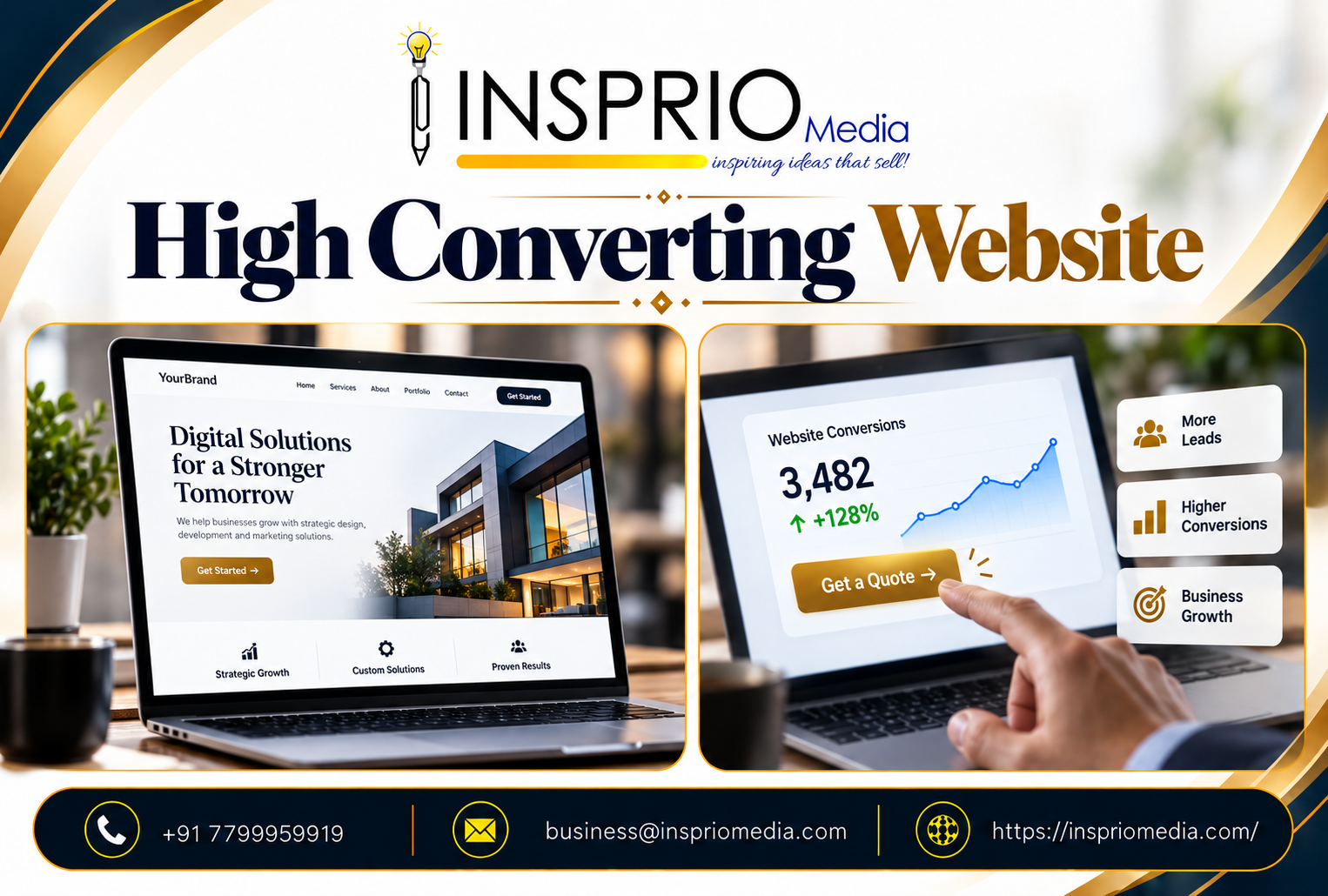
Whitespace is particularly important. Filling every available area can make even valuable information difficult to understand. A High Converting Website uses space to group related elements, create hierarchy and direct attention toward important information.
Consistent typography improves scanning and helps establish visual hierarchy. Headings should look different from body text, but websites rarely need numerous fonts or decorative text styles. A High Converting Website favors readability over visual experimentation when those goals conflict.
The same principle applies to animation. Motion can communicate interaction, reveal content elegantly and create personality, but excessive animation can distract from the commercial message. A High Converting Website uses motion purposefully, especially on mobile devices where performance matters.
Brand consistency should continue throughout the entire site, including forms, service pages, blog posts and contact areas. Consistency helps a High Converting Website feel trustworthy and professionally maintained rather than assembled from unrelated templates.
10. Add Trust Signals and Social Proof
Visitors often hesitate because they do not yet know whether they can trust a company. A High Converting Website reduces this uncertainty with credible evidence instead of relying entirely on self-promotional claims.
Testimonials are more convincing when they include meaningful detail. A statement describing the customer's problem, experience and result is usually stronger than a generic sentence such as "great service." A High Converting Website may also display customer names, companies or photographs when appropriate permission has been obtained.
Case studies can provide deeper proof for high-consideration services. They show how the company approaches a challenge and can demonstrate outcomes without promising identical results for every customer. This evidence strengthens a High Converting Website because users can evaluate the business through real examples.
Other trust indicators might include certifications, professional memberships, customer logos, verified reviews, secure payment indicators, guarantees, physical contact details, awards or transparent policies. A High Converting Website selects proof based on what actually matters within its industry.
Trust is also created indirectly through accuracy. Broken links, outdated information, inconsistent contact details, spelling errors and low-quality images can undermine confidence. Maintaining these details is a fundamental part of operating a High Converting Website.
11. Design Service Pages Around Buying Decisions
Individual service pages deserve more attention than a short description and contact button. A High Converting Website uses these pages to answer the practical questions prospective customers are likely to have before enquiring.
Start by clearly defining the service and the problems it addresses. Then explain the process, major benefits, suitable customers, differentiators and expected next steps. When relevant, a High Converting Website can also include FAQs, examples, testimonials and supporting resources.
Avoid duplicating essentially identical text across multiple service pages. Each page should have a specific purpose and audience. Unique information makes a High Converting Website more useful to visitors and creates stronger opportunities for organic search visibility.
Pricing information should be handled according to the business model. If fixed prices are unrealistic, explain what influences the cost or invite users to request an estimate. Transparency helps a High Converting Website reduce uncertainty without forcing a company into unsuitable standardized pricing.
The closing portion of a service page should make the next action straightforward. Summarize the value, reinforce relevant trust signals and provide a clear conversion opportunity. That logical progression helps transform an informational page into a High Converting Website asset.
12. Optimize Forms for More Qualified Enquiries
Forms are one of the most common conversion points, which makes their usability critical. A High Converting Website collects enough information to qualify an enquiry without creating unnecessary work for the visitor.
Ask whether every field is truly required at the first stage. A visitor requesting an initial consultation may not need to provide extensive project details immediately. Reducing nonessential fields can make a High Converting Website feel less demanding and easier to use.
Form labels should be persistent and understandable. Clearly indicate mandatory fields, use appropriate input types and display validation messages next to the relevant field. A High Converting Website should explain errors in plain language rather than forcing users to determine what went wrong.
The experience after submission matters too. Display a clear success message or direct users to a useful thank-you page explaining what happens next. Confirmation helps a High Converting Website reassure people that their request was successfully received.
Businesses should also test forms regularly. Email configuration, spam filters, server changes or plugin conflicts can interrupt lead delivery without obvious front-end errors. Routine testing protects the commercial performance of a High Converting Website.
13. Prioritize Mobile Conversion
Responsive design is no longer optional. A High Converting Website must work effectively across phones, tablets, laptops and larger desktop screens. Mobile optimization involves more than shrinking desktop layouts.
Navigation should remain easy to operate with a thumb, buttons need adequate size and text must remain readable without zooming. On a High Converting Website, important actions such as calling, booking or submitting an enquiry should be convenient on smaller screens.
Designers should examine the order in which stacked mobile content appears. A two-column desktop section might become a single column, but the correct sequence depends on which information users need first. Thoughtful content order helps a High Converting Website retain persuasive flow across devices.
Large videos, oversized images and complex animations can also create problems on slower mobile connections. Media should be optimized and loaded efficiently. Maintaining responsive performance is essential because a High Converting Website cannot convert users who leave before the page becomes usable.
Test with real phones whenever possible instead of relying exclusively on a desktop browser's responsive preview. Physical-device testing often reveals keyboard, touch, viewport and scrolling issues that affect a High Converting Website.
14. Improve Website Speed and Core Performance
Performance affects both user experience and conversion potential. A High Converting Website should deliver important content quickly and respond smoothly when users interact with buttons, navigation and forms.
Images are a common source of unnecessary page weight. Serve appropriately sized files, compress them and consider modern formats where supported. Lazy loading can also help below-the-fold media. These optimizations allow a High Converting Website to preserve visual quality without sacrificing speed.
Scripts should also be reviewed carefully. Websites sometimes accumulate analytics tools, chat systems, advertising tags, sliders and plugins over time. Every additional resource can affect loading or interaction performance. A High Converting Website includes only technology that creates enough value to justify its cost.
Google's PageSpeed Insights and Web Vitals documentation provide useful performance diagnostics. Measurements should be interpreted alongside real user experience rather than treated as decorative scores. A High Converting Website focuses on practical improvements that make pages faster and more responsive for actual visitors.
Hosting, caching, database optimization and content delivery may also influence speed. Performance is not a one-time development task; maintaining a High Converting Website requires ongoing monitoring as content and functionality change.
15. Build SEO Into the Website Architecture
Search optimization works best when considered during planning instead of being added after development. A High Converting Website combines discoverability with persuasive user experience so qualified search visitors have a logical destination when they arrive.
Important pages should have descriptive titles, useful headings, clear URLs and content aligned with search intent. However, optimization should not make the copy repetitive or unnatural. A High Converting Website needs to satisfy humans first while remaining technically understandable to search engines.
Google's SEO Starter Guide provides guidance on crawlability, content and search fundamentals. Following solid technical principles helps a High Converting Website create a stronger foundation for sustainable organic growth.
Schema markup may also help search engines interpret relevant entities and page content when implemented correctly. XML sitemaps, canonical URLs, sensible redirects and accurate indexing rules should be maintained carefully. These technical elements support the discoverability of a High Converting Website.
Most importantly, SEO traffic should be measured beyond rankings. High visibility has limited commercial value when visitors consistently fail to convert. A true High Converting Website connects organic acquisition to enquiries, bookings, sales and other meaningful outcomes.
16. Connect Website Design With the Wider Digital Marketing Strategy
A High Converting Website should not exist separately from advertising, branding, social media, SEO and content marketing. These channels influence who reaches the website and what expectations they bring with them.
For example, paid advertising requires landing pages that closely reflect the promise made in the advertisement. Social campaigns may send users who are less familiar with the company and therefore need additional trust-building information. A High Converting Website should adapt the experience to the source and intent of the visitor.
Related Insprio Media Resources
- Performance Marketing: Driving Business Growth and Maximizing ROI
- Why Social Media Management Is Essential for Business Growth
- GMB SEO Services for Better Google Maps Visibility
- Website SEO Services for Higher Google Rankings
- 3D Design Services by Insprio Media
- Graphic Design Services for Powerful Brand Identity
- Offline Marketing Services for Local Brand Visibility
- Branding Services That Build Strong Business Identities
- Web Development Services for Fast and SEO-Friendly Websites
- Digital Marketing Services for Online Business Growth
These connected disciplines are important because design cannot compensate for inconsistent branding or irrelevant traffic. Similarly, excellent marketing campaigns can underperform when they direct visitors toward confusing pages. A High Converting Website serves as the central conversion environment where these marketing activities come together.
Consistency matters across channels. The same visual identity, core positioning and customer promise should continue from advertisements and social posts into landing pages. This continuity helps a High Converting Website feel credible because users encounter the experience they expected.
Businesses should therefore evaluate website performance alongside marketing performance. Acquisition cost, conversion rate, lead quality and revenue can reveal whether a High Converting Website is supporting the overall digital strategy effectively.
17. Use Analytics and Conversion Rate Optimization
Publishing the site is the beginning of optimization, not the end. A High Converting Website improves through observation, testing and evidence. Analytics can reveal what visitors actually do instead of what a design team assumes they will do.
Track important events such as contact submissions, purchases, phone clicks, downloads, booking starts and completed registrations. These events give businesses a clearer picture of whether a High Converting Website produces useful commercial activity.
Funnel analysis can identify where visitors abandon important processes. For example, if many users begin an enquiry form but few complete it, the problem may involve field quantity, technical errors or unclear expectations. Investigating these patterns allows a High Converting Website to improve systematically.
A/B testing can be useful when the website receives enough traffic for meaningful results. Businesses might compare alternative headlines, CTA wording, layouts or forms. The purpose is not to test random design variations. A High Converting Website uses testing to answer specific questions based on observed problems.
Qualitative feedback is equally valuable. User interviews, sales-team observations and customer support conversations can reveal issues that numbers alone cannot explain. Combining quantitative and qualitative evidence produces a more informed High Converting Website optimization process.
18. Accessibility, Security and Technical Trust
Accessibility improves usability for a wider range of visitors. A High Converting Website should provide sufficient text contrast, descriptive image alternatives, keyboard-friendly navigation, understandable form labels and logical document structure.
The W3C Web Content Accessibility Guidelines provide a valuable framework for understanding accessible web experiences. Considering accessibility from the beginning is generally easier than retrofitting it later and helps create a more inclusive High Converting Website.
Security also affects trust. Use HTTPS, maintain software updates, restrict administrative access appropriately, use reliable hosting and protect forms against abuse. Customers may never see these measures directly, but failures can seriously damage a High Converting Website.
Privacy expectations should also be considered when analytics, advertising platforms, cookies or customer data collection are involved. Businesses should implement policies and consent mechanisms appropriate to their jurisdiction. Responsible data handling helps maintain confidence in a High Converting Website.
Usability guidance from the Nielsen Norman Group is also useful when reviewing interface decisions. Clear feedback, understandable controls and error prevention all contribute to a more effective High Converting Website.
19. Common Website Design Mistakes That Reduce Conversions
A High Converting Website is often created as much by removing problems as by adding new features. One of the most common mistakes is prioritizing visual trends over usability. Complex navigation, low-contrast typography and excessive animations can make a site memorable for the wrong reasons.
Another mistake is sending every customer to the homepage instead of creating relevant landing experiences. Visitors arriving from an advertisement for one particular service should normally reach information about that service. Relevance is one reason a High Converting Website can outperform a generic corporate site.
Weak or hidden contact information can also hurt results. Customers should not have to search extensively for a phone number, enquiry option or location details. A High Converting Website provides practical contact opportunities wherever they make sense.
Another issue is making unsupported claims. Statements such as "the best," "guaranteed results" or "number one" may reduce credibility when there is no evidence. A High Converting Website is usually stronger when it uses specific, verifiable proof rather than exaggerated language.
Finally, businesses sometimes stop maintaining a site once it launches. Outdated plugins, old offers, inaccurate opening hours and broken forms gradually weaken performance. Continuous maintenance is part of operating a reliable High Converting Website.
20. Build, Launch, Measure and Continuously Improve
Creating a High Converting Website should be approached as an ongoing business process. Research provides the foundation, strategy defines the customer journey, design organizes information, development ensures reliable functionality, and measurement reveals opportunities for improvement.
Before launch, test navigation, forms, links, responsive behavior, page speed, metadata, analytics, redirects and important conversion actions. A detailed quality-assurance process prevents small technical problems from undermining an otherwise strong High Converting Website.
After launch, establish a review schedule. Examine conversion performance, traffic sources, popular pages, search queries and customer feedback. Changes in customer expectations, services or marketing strategy may require the High Converting Website to evolve.
Avoid redesigning based only on personal preference. Design discussions can easily become subjective, particularly around colors, fonts and layouts. Whenever possible, use customer needs, analytics and measurable business objectives to guide decisions about a High Converting Website.
The long-term goal is not perfection at launch. It is a system that becomes more useful and commercially effective as the business learns from real customer behavior. That continuous-improvement mindset is one of the strongest foundations for a sustainable High Converting Website.
Conversion-Focused Website vs Typical Business Website
| Website Element | Typical Approach | Conversion-Focused Approach |
|---|---|---|
| Homepage headline | Generic company slogan | Clearly explains the offer and customer benefit |
| Navigation | Based on internal company structure | Organized around visitor needs and intent |
| Calls to action | Randomly placed buttons | Contextual actions aligned with page intent |
| Content | Primarily describes the company | Answers customer questions and objections |
| Mobile design | Desktop layout scaled down | Purposefully designed mobile journey |
| Trust | General claims | Reviews, case studies and verifiable evidence |
| Performance | Considered after launch | Optimized throughout development |
| Measurement | Traffic and page views only | Conversions, funnel performance and lead quality |
Business Website Conversion Checklist
Before publishing or redesigning your business website, review the following areas. This checklist helps ensure design decisions support users rather than adding unnecessary complexity.
- Define one primary conversion goal for every important landing page.
- Clearly communicate your main service and customer benefit above the fold.
- Keep the navigation simple and predictable.
- Create dedicated pages for major products or services.
- Use original, relevant and professionally produced imagery where practical.
- Keep typography readable across desktop and mobile devices.
- Use whitespace to create hierarchy rather than filling every available area.
- Place calls to action at logical decision points.
- Use descriptive CTA wording instead of vague labels.
- Add real reviews, testimonials, case studies or other relevant trust evidence.
- Provide clear phone, email or enquiry options.
- Reduce unnecessary form fields.
- Test forms after website updates.
- Compress large images.
- Remove unnecessary scripts and plugins.
- Check loading performance on mobile connections.
- Use descriptive page titles and heading structures.
- Add meaningful internal links between related pages.
- Check canonical URLs and redirects during redesign projects.
- Implement HTTPS and maintain software security.
- Review basic accessibility requirements.
- Configure analytics and important conversion events.
- Monitor conversion rate rather than traffic alone.
- Review landing pages used for advertising campaigns.
- Update outdated content, contact information and service information.
Useful Authoritative Resources for Website Improvement
Website teams can also use established web standards and platform documentation when evaluating technical quality. The following external resources offer additional guidance:
- Google Search Central – SEO Starter Guide
- Google PageSpeed Insights
- Google web.dev – Core Web Vitals
- W3C Web Content Accessibility Guidelines
- Nielsen Norman Group – Usability Heuristics
- MDN Web Docs – Web Development Guidance
Frequently Asked Questions
1. What is a high-converting business website?
It is a website intentionally designed to guide relevant visitors toward meaningful actions such as enquiries, phone calls, bookings, registrations, purchases or quote requests. It combines useful content, clear navigation, trust signals, performance, responsive design and strategically positioned calls to action.
2. What is a good website conversion rate?
There is no universal percentage that defines success because conversion rates vary greatly by industry, traffic source, offer, device, conversion type and customer intent. Businesses should establish their own baseline and monitor whether qualified conversions improve over time rather than relying exclusively on generalized benchmarks.
3. How can website design improve conversions?
Good design reduces friction. Clear headings help visitors understand an offer, predictable navigation makes information easier to find, strong visual hierarchy directs attention, credible proof reduces uncertainty, and effective calls to action make the next step obvious.
4. Does website loading speed affect conversions?
Performance can influence user experience because visitors may abandon pages that load slowly or respond poorly. Fast image delivery, optimized scripts, caching, efficient hosting and clean development practices can improve usability while also supporting technical SEO.
5. Is mobile-first design important for business websites?
Yes. Mobile visitors need readable text, touch-friendly controls, concise layouts, usable forms and reliable page performance. Responsive design should be tested on realistic screen sizes and physical devices where possible.
6. How many calls to action should a page contain?
There is no fixed number. Long service pages may repeat the primary action several times, while shorter pages may require fewer buttons. What matters is maintaining a clear visual hierarchy and avoiding several competing actions with equal prominence.
7. Should every service have a separate webpage?
Major services usually benefit from dedicated pages when customers need different information or when each service represents a distinct search intent. Separate pages make it easier to provide specific benefits, FAQs, proof, processes and conversion opportunities.
8. Are testimonials important for website conversion?
Testimonials can increase credibility when they are genuine, relevant and specific. Detailed customer experiences, case studies and verifiable reviews generally provide more useful evidence than anonymous or extremely generic praise.
9. How often should a business website be updated?
Technical maintenance should occur regularly, while content should be updated whenever products, services, prices, staff, locations, policies or important customer information changes. Analytics should also be reviewed periodically to identify underperforming pages.
10. How can I determine why visitors are not converting?
Review analytics, traffic sources, device performance, funnel abandonment, form completion and landing-page relevance. Combine this data with customer questions, sales-team feedback and usability testing. Common issues include unclear offers, insufficient trust, slow loading, weak calls to action, difficult forms or irrelevant traffic.
Conclusion: Design Around Customer Decisions, Not Decoration
Business website design becomes more effective when every decision begins with the visitor. Customers need to quickly understand what you provide, whether it solves their problem, why they should trust your organization and what they should do next.
Attractive visual design remains important, but aesthetics alone cannot solve unclear positioning, weak content, slow performance, difficult navigation or complicated forms. Conversion-focused design brings branding, user experience, development, SEO, messaging and analytics together into one coordinated system.
Businesses should also avoid treating launch day as the end of the process. Real customer behavior will reveal opportunities that were impossible to identify during initial planning. Reviewing analytics, testing conversion paths, updating content and listening to customer feedback allow the website to improve as the company grows.
Whether you are launching a new brand, improving an existing website or creating dedicated landing pages for digital campaigns, focus on clarity first. Make important information easy to understand, demonstrate credibility with evidence, reduce unnecessary friction and ensure every page has a meaningful purpose.
Contact Insprio Media:
Insprio Media provides digital solutions designed to connect website development, branding, SEO and digital marketing with practical business objectives.
Phone: +91 7799959919
Email: business@inspriomedia.com