How Much Should You Spend on Google Ads?
One of the first questions businesses ask before launching paid advertising is how much they should actually spend. There is no universal answer because the right Google Ads Budget depends on your industry, location, competition, average customer value, profit margin, conversion rate and growth target. A local service company may need a very different investment compared with an ecommerce store, B2B company or national brand.
The objective should not be to choose the smallest possible Google Ads Budget. You need enough investment to generate useful traffic, collect meaningful data and create a realistic opportunity for conversions. Spending too little can leave campaigns without enough clicks for proper analysis, while spending aggressively without reliable tracking can waste money.
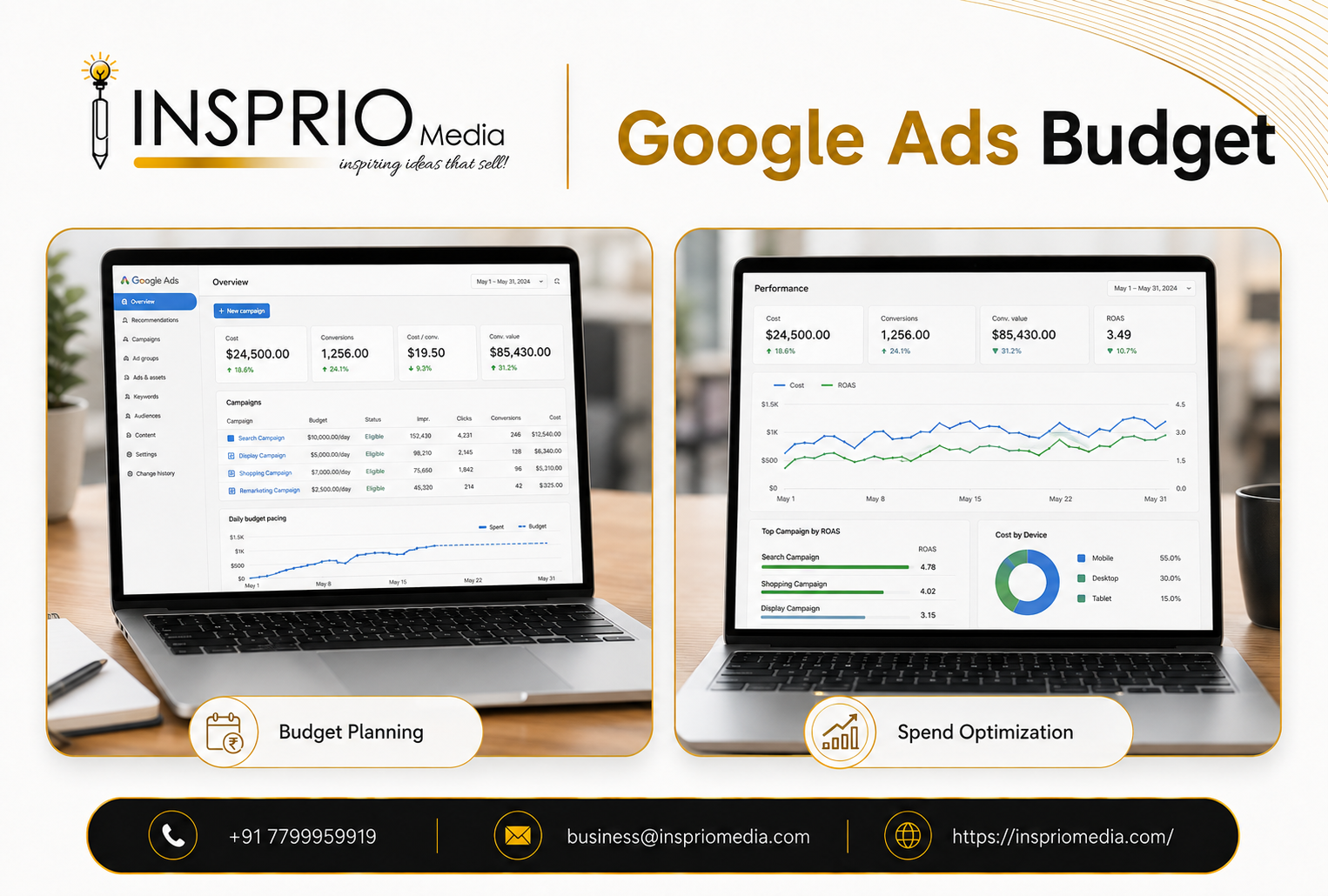
Start With a Clear Business Goal
Your Google Ads Budget should begin with a business objective instead of a random daily number. Decide whether you want to generate leads, phone calls, purchases, appointment bookings, store visits or enquiries for a particular service.
For example, if your goal is 40 qualified leads every month and you can profitably pay ₹1,500 for each lead, a theoretical monthly Google Ads Budget may be around ₹60,000. The actual amount must then be adjusted according to campaign performance.
Desired monthly conversions × acceptable cost per conversion = estimated monthly advertising investment.
Understand Cost Per Click Before Setting Your Budget
Search advertising costs can vary dramatically between industries and keywords. Google's Keyword Planner helps advertisers research keywords and view estimated targeting costs. Your Google Ads Budget needs to reflect whether the keywords that matter to your business cost ₹20, ₹100, ₹500 or considerably more per click.
If your average click costs ₹100 and your daily Google Ads Budget is only ₹300, you may receive just a few clicks per day. That can make it difficult to accurately evaluate keywords, search terms, advertisements and landing pages.
How to Calculate a Practical Starting Budget
A practical way to calculate your Google Ads Budget is to work backwards from your desired conversions. Suppose your website converts 5% of advertising visitors into leads. You would need approximately 20 clicks to generate one lead on average.
If those clicks cost around ₹80 each, the estimated advertising cost per lead would be ₹1,600. If you want 30 leads per month, a starting Google Ads Budget could therefore be approximately ₹48,000.
This calculation does not guarantee 30 leads, but it gives you a much more rational starting point than choosing an arbitrary number.
Daily Budget vs Monthly Advertising Budget
Google Ads generally allows advertisers to set an average daily campaign budget. Google explains in its official average daily budget guide that campaign spending can vary from one day to another. Therefore, when calculating a monthly Google Ads Budget, businesses should remember that individual daily spend can fluctuate.
One planning method is to divide your monthly Google Ads Budget by approximately 30.4 to estimate the average daily amount. For example, ₹60,800 per month is approximately ₹2,000 per day on average.
Conversion Tracking Should Come Before Scaling
Increasing a Google Ads Budget without accurate conversion tracking is risky. You should know whether campaigns are generating genuine enquiries, purchases, phone calls or other valuable business actions.
Google provides guidance on conversion tracking. Once tracking is reliable, the Google Ads Budget can be directed toward campaigns producing the strongest business results.
This is also where paid advertising becomes part of a broader performance marketing strategy, where advertising investment is measured against leads, sales, revenue and return on investment.
Use the Right Bidding Strategy
Even a well-planned Google Ads Budget can underperform when the bidding strategy does not match the campaign objective. Google's Smart Bidding guide explains bidding approaches designed around conversions and conversion value.
New campaigns should not normally be judged after only a few clicks. Give the Google Ads Budget enough opportunity to generate useful data and then evaluate cost per lead, search terms, conversion quality and revenue contribution.
Google Ads Should Work With Your Wider Marketing Strategy
Your Google Ads Budget should not operate separately from the rest of your digital marketing. Search advertising can work alongside website SEO services and GMB SEO services to improve both paid and organic search visibility.
Businesses can also strengthen brand awareness through social media management. Strong landing pages created through professional web development services can help turn more advertising visitors into customers.
Conversion performance can also improve when your business uses consistent graphic design and professional branding services.
Depending on your audience, your Google Ads Budget can form part of a larger plan involving digital marketing services, offline marketing services and creative solutions such as 3D design services.
How Much Should a Small Business Spend?
A small business should select a Google Ads Budget according to local demand, estimated CPC, customer value and the number of clicks required to generate meaningful campaign data.
Instead of spreading a small Google Ads Budget across dozens of services, locations and keywords, concentrate it on your most profitable services and highest-intent searches. Once the campaign demonstrates profitable conversions, you can scale gradually.
When Should You Increase Your Advertising Spend?
Consider increasing the Google Ads Budget when campaigns consistently generate profitable leads or sales and additional demand is available.
Before scaling the Google Ads Budget, evaluate sales quality, conversion rates, customer value, search terms and whether your business has the operational capacity to handle additional enquiries.
A Practical Google Ads Budget Checklist
Before approving a Google Ads Budget, confirm your target locations, highest-value products or services, estimated CPC, desired lead volume, acceptable acquisition cost and conversion tracking setup. A Google Ads Budget should always be measured against genuine business outcomes instead of impressions alone.
Google's official guidance on managing Google Ads spend explains how advertisers can control advertising costs. Google's Quality Score guide also provides useful diagnostic information related to expected click-through rate, ad relevance and landing-page experience.
Use your Google Ads Budget to prioritize campaigns generating profitable customers first. When results improve, increase the budget gradually. If efficiency declines, move the Google Ads Budget toward stronger keywords, locations, devices or campaigns.
Frequently Asked Questions
1. What is a good Google Ads Budget for beginners?
A beginner should choose a Google Ads Budget that generates enough relevant clicks for useful testing without putting unnecessary pressure on business cash flow. Keyword costs, conversion rates and acceptable cost per lead should guide the starting amount.
2. Can I start Google Ads with a small budget?
Yes. However, a very small Google Ads Budget can limit traffic and slow campaign learning. If funds are limited, narrow your locations, keywords, services and campaign schedule so the available investment targets the most valuable searches.
3. Should my advertising budget be daily or monthly?
Businesses commonly establish a monthly marketing investment and convert it into an average daily Google Ads Budget for their individual campaigns.
4. How do I know if I am spending too much?
Your ad budget may be too high when additional spend repeatedly generates unprofitable leads, poor-quality enquiries or sales that do not justify the acquisition cost. Measure profit and customer value rather than clicks alone.
5. How often should I change my advertising budget?
Change the campaign budget when performance data supports the decision. Budget changes should normally relate to profitability, seasonal demand, available search volume, campaign performance or changes in business objectives.
6. Does a higher budget guarantee more sales?
No. A higher advertising budget can create more opportunities, but sales still depend on targeting, keywords, ad quality, your offer, landing-page experience, conversion tracking, pricing and your sales process.
Final Thoughts
The right Google Ads Budget is not a fixed number that works for every business. It should be calculated around desired conversions, keyword costs, acceptable acquisition cost, conversion rate, customer value and profitability.
Start with measurable goals, track every important action and scale only when performance supports additional investment. Professional campaign management can help ensure your Google Ads Budget is directed toward the keywords, audiences and campaigns most likely to create meaningful business growth.
Businesses looking for a complete digital growth strategy can work with Insprio Media for Google Ads, SEO, website development, branding and performance-focused digital marketing solutions.
Contact Insprio Media :
Need help deciding how much to invest in Google Ads? Insprio Media can help you build a campaign strategy.
Phone:
+91 7799959919
Email:
business@inspriomedia.com