How to Increase Website Conversion Rates: A Complete Business Growth Guide
Getting more visitors to a website is valuable, but traffic alone does not create revenue. A business website becomes commercially useful when visitors call, enquire, book a consultation, subscribe, request a quotation, purchase a product, or complete another meaningful action. Learning how to Increase Website Conversions therefore allows businesses to generate more value from traffic they already receive instead of depending entirely on higher advertising budgets.
Many companies spend heavily on search engine optimization, Google Ads, social media, content marketing, and branding while paying comparatively little attention to what happens after a visitor reaches the website. To Increase Website Conversions, businesses need to examine the complete visitor journey—from the first headline people see to the final form field, checkout screen, telephone button, or enquiry confirmation.
Conversion rate optimization is not about inserting aggressive pop-ups or turning every section into a sales pitch. Businesses Increase Website Conversions when they remove uncertainty, improve relevance, reduce unnecessary effort, establish credibility, and make the next logical action obvious to the visitor.
Even a well-designed website can underperform when its message does not match visitor intent. A beautiful landing page may receive hundreds of visits but very few enquiries when visitors cannot quickly understand the service, price expectation, location, process, or reason to trust the provider. Addressing these gaps can Increase Website Conversions without redesigning an entire website.
At Insprio Media, a conversion-focused digital strategy considers design, development, SEO, advertising, analytics, content, branding, and user behaviour together. Businesses seeking to Increase Website Conversions should treat these disciplines as connected parts of one customer journey rather than separate marketing activities.
What Is a Website Conversion?
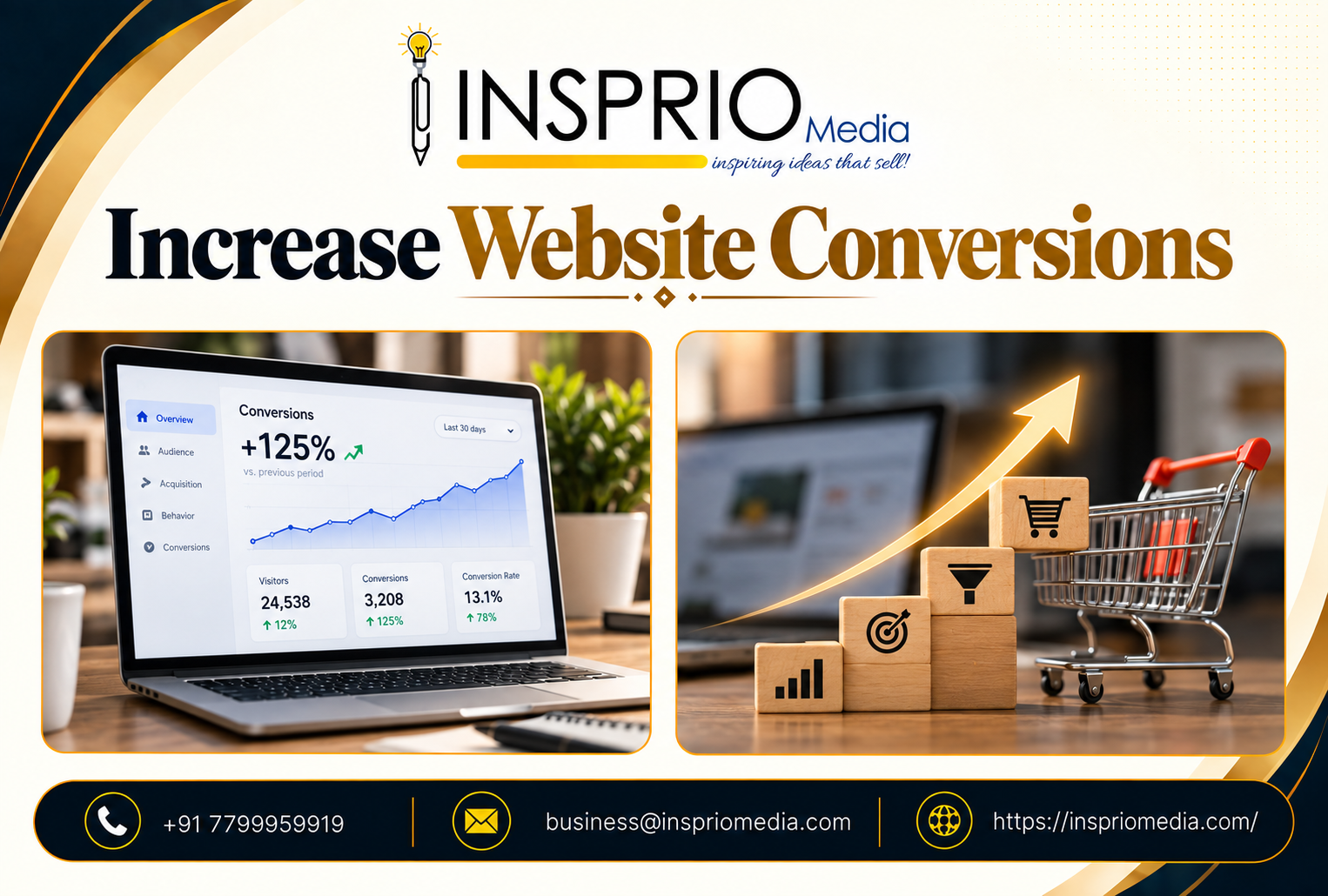
A conversion occurs whenever a visitor completes an action that supports a business objective. For an ecommerce website, that action may be a purchase. For a service business, it may be a phone call, WhatsApp conversation, consultation request, quotation form, appointment booking, or email enquiry. Before attempting to Increase Website Conversions, define which actions genuinely contribute to revenue.
Not every conversion has to represent an immediate sale. A newsletter subscription, brochure download, account registration, product demo request, or webinar registration can represent an important step in a longer buying journey. Businesses can Increase Website Conversions more intelligently when macro conversions and micro conversions are measured separately.
A macro conversion is generally the primary commercial objective, such as completing a sale or submitting a qualified lead. Micro conversions represent supporting behaviours such as viewing a pricing page, watching a product demonstration, reading a case study, or adding a product to a cart. Tracking both helps marketers understand how visitors progress and where opportunities exist to Increase Website Conversions.
The correct conversion event depends heavily on the business model. A hospital may prioritize appointment requests, a construction company may prioritize project enquiries, an educational institute may measure admissions leads, and a B2B company may focus on scheduled demonstrations. Clear priorities make it easier to Increase Website Conversions because optimization efforts are connected to measurable business outcomes.
Avoid measuring success using page views alone. A campaign that generates 10,000 visitors and 20 qualified enquiries may be less commercially useful than a campaign generating 3,000 visitors and 90 enquiries. Looking beyond traffic numbers helps businesses identify which channels genuinely Increase Website Conversions and revenue opportunities.
How to Calculate Website Conversion Rate
The standard calculation is straightforward: divide the number of conversions by the number of relevant visitors or sessions and multiply the result by 100. Measuring consistently is important when trying to Increase Website Conversions, because optimization should be based on changes in real performance rather than impressions about whether a new design “looks better.”
For example, if a landing page attracts 2,000 visitors and generates 80 enquiries, its conversion rate is 4%. If optimization later produces 120 enquiries from the same amount of traffic, the conversion rate reaches 6%. That improvement illustrates why businesses often attempt to Increase Website Conversions before investing significantly more money into acquisition.
The denominator should remain consistent when comparing performance. Some teams calculate using users while others use sessions. Ecommerce reporting may use sessions, purchases, and revenue, whereas lead-generation teams may evaluate unique leads against landing-page users. Consistency matters when measuring efforts designed to Increase Website Conversions.
Businesses should also segment performance by channel, device, location, campaign, page type, and audience. A website-wide average can conceal major differences. Organic mobile traffic may behave differently from desktop paid traffic. Segment analysis often reveals specific opportunities to Increase Website Conversions without making unnecessary changes across the entire website.
Google Analytics provides landing-page reporting that can help businesses understand where users first enter a website and how those pages perform. Reviewing landing pages alongside conversion events makes it easier to identify pages that receive meaningful traffic but fail to Increase Website Conversions.
For additional measurement guidance, review the official Google Analytics landing page documentation. Combining reliable analytics with regular experimentation provides a stronger foundation for decisions intended to Increase Website Conversions.
Start With Visitor Intent
One of the biggest conversion mistakes is designing a webpage around what the company wants to say instead of what the visitor needs to know. To Increase Website Conversions, each important page should immediately answer three questions: Where am I? Is this relevant to my problem? What should I do next?
Search intent provides valuable clues. Someone searching for “best digital marketing company near me” may be evaluating providers, while a user searching “how does SEO work” may still be researching. Matching content, calls to action, and offers with the visitor's stage can Increase Website Conversions because the request feels appropriate instead of premature.
Transactional visitors generally need direct information about services, outcomes, process, credibility, and next steps. Informational visitors often need useful education before they are ready to speak with a company. Understanding this distinction can Increase Website Conversions by preventing every visitor from being forced into the same sales journey.
Intent also changes depending on traffic source. Someone clicking a social advertisement may know less about your company than someone searching your brand name. Landing pages can Increase Website Conversions when they acknowledge these differences and provide the right amount of context for each audience.
Before redesigning a page, ask what motivated the visitor to arrive there. Review search terms, advertising messages, social campaigns, referral sources, and preceding pages. Alignment between visitor expectations and website content is one of the most dependable ways to Increase Website Conversions.
Create a Clear Value Proposition Above the Fold
Visitors should not need to scroll repeatedly to understand what a company provides. The opening portion of an important landing page should communicate the service, customer, meaningful benefit, and next action. A concise value proposition can Increase Website Conversions because users immediately understand whether the page deserves further attention.
Generic statements such as “We Deliver Excellence” may sound polished but reveal very little. A more specific headline communicates what the business actually does. Specificity can Increase Website Conversions by reducing the mental effort visitors need to determine whether the solution is relevant.
Supporting copy should clarify the headline rather than repeat it. Include information that matters to the target audience: service area, experience, turnaround expectations, special expertise, measurable outcomes, or a differentiating approach. Strong supporting information can Increase Website Conversions by answering immediate questions before uncertainty develops.
Avoid overcrowding the hero section with multiple competing actions. A visitor confronted with “Buy Now,” “Read More,” “Download,” “Subscribe,” “Book Demo,” and “Contact Us” simultaneously may hesitate. A dominant primary CTA and carefully selected secondary option can Increase Website Conversions by simplifying choice.
Visual hierarchy is just as important as wording. The headline, supporting statement, key visual, and primary CTA should form an obvious path for the eye. Professional graphic and interface design can Increase Website Conversions when it guides attention rather than merely adding decoration.
Improve Your Calls to Action
A CTA should tell users what happens when they click it. “Submit” gives little context, whereas “Request My Consultation,” “Get a Free Quote,” “Book an Appointment,” or “View Pricing” communicates the next step clearly. Descriptive calls to action can Increase Website Conversions by reducing uncertainty.
CTA positioning should correspond with user readiness. Some visitors are prepared to act near the top of a page, while others need evidence first. Repeating the primary action naturally after important sections can Increase Website Conversions without forcing users to scroll back to find a button.
Button visibility also matters. CTAs should have sufficient contrast, comfortable spacing, readable text, and a clear clickable area. Visitors should never have to search for the action you want them to take. Improving visibility helps Increase Website Conversions especially on mobile screens.
Avoid placing different conversion goals beside one another with equal visual importance. When every button looks like the primary action, none of them is truly primary. Building an intentional action hierarchy can Increase Website Conversions because users understand the recommended next step.
CTA copy should also match the perceived commitment. Someone reading an introductory article may respond better to “Explore Our Services” than “Buy Today.” Matching the request to the user's level of intent can Increase Website Conversions without making the experience feel overly aggressive.
Make Your Website Faster
A slow website creates friction before a visitor even sees the offer. Images, scripts, poorly optimized themes, excessive plugins, third-party trackers, weak hosting, and inefficient code can delay page rendering. Performance improvements can Increase Website Conversions because visitors reach usable content faster.
Cloudflare notes that faster websites tend to provide better user experiences and that performance can influence conversion behaviour. Businesses seeking to Increase Website Conversions should therefore treat loading speed as a commercial metric rather than only a technical concern.
Useful improvements include compressing images, serving modern image formats, implementing browser caching, minimizing unnecessary JavaScript, reducing third-party requests, lazy-loading non-critical assets, and choosing reliable hosting. These steps can Increase Website Conversions while also improving overall usability.
Mobile performance deserves particular attention because many visitors browse over cellular networks and less powerful devices. A desktop page that appears fast on a high-speed office connection may perform poorly on a budget smartphone. Mobile testing can reveal important ways to Increase Website Conversions.
Use tools such as Google PageSpeed Insights and review Cloudflare's website performance guidance. Technical improvements based on real measurements can Increase Website Conversions more effectively than simply removing visual elements at random.
Design for Mobile Users First
Mobile optimization means much more than shrinking the desktop website. Buttons, forms, menus, text, images, sticky elements, and interactive features need to work naturally on smaller screens. A truly responsive experience can Increase Website Conversions among visitors who might otherwise leave because interacting with the website feels difficult.
Telephone-dependent businesses should make phone numbers easily tappable. WhatsApp-based businesses should provide clear messaging actions. Forms need input fields that are large enough to use comfortably. These seemingly small details can Increase Website Conversions by reducing unnecessary mobile friction.
Avoid oversized banners that push meaningful content far below the fold. On mobile, vertical space is limited and visitors often make rapid decisions. A compact opening section with a clear benefit and action can Increase Website Conversions more effectively than a visually dramatic but oversized hero.
Navigation should also remain straightforward. Complex mega menus that work well with a mouse may become frustrating on touchscreens. Simplifying the path to services, pricing, contact information, and important pages can Increase Website Conversions by helping mobile visitors locate answers quickly.
Testing should use real devices whenever possible. Browser simulation is useful, but actual phones reveal issues involving keyboards, touch targets, sticky elements, viewport height, and network conditions. Correcting these issues helps Increase Website Conversions across the devices customers actually use.
Reduce Friction in Lead Generation Forms
Every additional form field introduces effort. If a business only needs a name, telephone number, email address, and short requirement to begin a conversation, requesting ten additional details can discourage enquiries. Shortening unnecessary forms can Increase Website Conversions while preserving the information sales teams genuinely require.
The W3C's accessibility guidance recommends asking users only for information needed to complete a process. This principle can also Increase Website Conversions because shorter and clearer forms generally reduce the perceived effort required to submit an enquiry.
Each field should have a visible label, clear instructions where necessary, useful validation, and informative error messages. Users should understand exactly what needs correction instead of receiving a vague “Invalid entry” warning. Better form usability can Increase Website Conversions by preventing avoidable abandonment.
Read the W3C accessible forms tutorial for detailed recommendations. Accessibility improvements can Increase Website Conversions by making forms easier for a broader range of visitors to understand and complete.
Consider progressive forms for complex services. Instead of displaying fifteen fields simultaneously, divide the information into short logical steps and show progress clearly. This approach can Increase Website Conversions when businesses genuinely require more information before qualifying a lead.
Build Trust Before Asking for Action
Visitors hesitate when they are unsure whether a company is credible. Authentic testimonials, customer reviews, case studies, certifications, awards, recognizable clients, team information, physical addresses, transparent policies, and genuine project photographs can Increase Website Conversions by reducing perceived risk.
Trust elements should be placed near the point where hesitation occurs. Showing testimonials halfway down a page can help, but displaying relevant evidence beside a quotation form may be even more effective. Contextual trust signals can Increase Website Conversions because reassurance appears when visitors need it most.
Avoid exaggerated claims that cannot be supported. Statements such as “number one company” or “guaranteed results” may reduce credibility when no evidence accompanies them. Specific and verifiable proof can Increase Website Conversions more effectively than broad promotional language.
Case studies are especially valuable for complex or high-value services. Showing the problem, strategy, implementation, and measurable result helps prospects imagine a similar outcome. Strong case-study content can Increase Website Conversions among visitors who require more evidence before starting a conversation.
Humanizing the company can also build confidence. Real photographs of team members, workplaces, completed projects, or customer interactions often communicate authenticity more effectively than generic stock imagery. Authentic presentation can Increase Website Conversions by making the business feel more credible and approachable.
Strengthen SEO and Landing Page Relevance
SEO brings the greatest commercial value when search traffic reaches pages that match user intent. Ranking an irrelevant page may produce impressions without meaningful enquiries. A focused SEO strategy can Increase Website Conversions by connecting the right search query with the right service, product, location, or informational page.
For a deeper understanding of attracting relevant search traffic, read Insprio Media's Website SEO Services guide. High-quality organic visibility and conversion optimization work together to Increase Website Conversions.
Local businesses can also improve visibility for location-driven searches. Insprio Media's GMB SEO Services guide explores local search visibility. Relevant local traffic can Increase Website Conversions because users searching by location often have stronger commercial intent.
Create dedicated pages when different services serve different user needs. Sending every visitor to a generic homepage forces them to locate relevant information themselves. More focused landing experiences can Increase Website Conversions by continuing the message established by the search result or advertisement.
SEO copy should remain readable. Repeating keywords unnaturally, adding irrelevant sections, or writing exclusively for search engines can harm the user experience. Helpful, well-structured content is more likely to Increase Website Conversions because it answers questions while supporting discoverability.
Align Paid Marketing With Landing Pages
Advertising performance depends on more than targeting and bidding. If an ad promises a specific service but sends users to a broad homepage, message continuity breaks. Dedicated landing pages can Increase Website Conversions by continuing the promise made in the advertisement.
Campaign managers should compare conversion performance by keyword, audience, creative, placement, device, and landing page. Increasing traffic from a poorly converting source may simply increase wasted expenditure. Performance analysis helps Increase Website Conversions by directing budget toward combinations that produce meaningful actions.
For more on connecting marketing expenditure with measurable outcomes, see Insprio Media's Performance Marketing guide. Performance-focused campaigns attempt to Increase Website Conversions alongside reach and traffic.
Paid landing pages should minimize distractions that are unrelated to campaign intent. While a complete website needs navigation, campaign-specific pages sometimes perform better with a more focused journey. Reducing competing actions can Increase Website Conversions by keeping attention on the offer.
Post-click measurement is essential. Cost-per-click alone cannot determine business value. Teams should examine cost per qualified lead, appointment, sale, revenue, and customer acquisition cost. These commercial metrics clarify whether advertising changes genuinely Increase Website Conversions that matter to the business.
Use Social Media to Build Familiarity Before the Visit
Conversion often begins before a person reaches the website. Regular social media content can establish familiarity, demonstrate expertise, show customer results, and answer common questions. This pre-visit trust can Increase Website Conversions because users arriving from social platforms may already understand the company.
Insprio Media's article on social media management for business growth explains how consistent social activity contributes to a broader digital presence. When messaging remains consistent between social content and landing pages, it can Increase Website Conversions.
Social campaigns should not send every visitor to the same page. A user responding to a post about one service should reach content focused on that service whenever practical. Maintaining topical continuity can Increase Website Conversions because visitors do not need to restart their search after clicking.
Retargeting can also reconnect with users who visited important pages but did not convert. The message should provide useful reasons to return—such as a case study, product benefit, consultation, or reminder—rather than creating pressure. Relevant follow-up can Increase Website Conversions across longer decision cycles.
Social proof collected from social channels can sometimes be incorporated into the website with permission. Genuine customer feedback, user-generated content, or project examples can Increase Website Conversions when they directly address concerns prospective customers commonly have.
Improve Brand and Visual Consistency
Professional branding influences how visitors interpret a company before reading every word. Inconsistent fonts, colors, low-quality images, outdated layouts, broken icons, and mismatched design styles can create uncertainty. Strong visual consistency can Increase Website Conversions by communicating attention to detail.
Read Insprio Media's branding services guide for a broader look at brand identity. A recognizable and coherent brand can Increase Website Conversions because visitors encounter a consistent experience across marketing channels.
Graphic design is equally important for communicating offers clearly. Insprio Media's graphic design services article covers the role of strong visual communication. Strategic design can Increase Website Conversions when it reinforces rather than overwhelms the message.
Images should have a clear purpose. Product photographs can demonstrate details, service images can show real work, diagrams can simplify complex processes, and team photographs can establish authenticity. Choosing purposeful visuals can Increase Website Conversions because imagery supports decision-making instead of functioning as filler.
Businesses offering visual or technical products may also benefit from dimensional visualization. Insprio Media's 3D Design Services article shows another way digital presentation can support communication. Clear visualization can Increase Website Conversions when customers need to understand an idea before purchase.
Make Service Pages More Persuasive
A service page should do more than list features. It should explain the customer problem, describe the solution, clarify the process, establish credibility, answer objections, and make the next step easy. This structure can Increase Website Conversions because it follows the questions prospective customers naturally ask.
Start with outcomes rather than internal terminology. Customers usually care more about what a service helps them accomplish than the technical name of every method involved. Outcome-oriented messaging can Increase Website Conversions while supporting details remain available for visitors who want deeper information.
Explain the service process in a few simple steps. Uncertainty about what happens after contacting a business can stop a qualified visitor from acting. A visible process can Increase Website Conversions because users understand what to expect after submitting an enquiry.
Pricing transparency should reflect the business model. Exact pricing may not be possible for customized services, but businesses can often explain what affects cost, whether consultations are free, or how quotations are prepared. Removing pricing uncertainty where practical can Increase Website Conversions.
Every major service page should end with a relevant next step rather than leaving visitors at a dead end. A contextual CTA following useful information can Increase Website Conversions because the visitor can act immediately after developing confidence.
Upgrade Website Development Quality
Conversion optimization cannot compensate indefinitely for a technically unreliable website. Broken forms, JavaScript errors, inconsistent mobile layouts, missing pages, security warnings, and checkout failures directly prevent conversions. Reliable development can Increase Website Conversions by ensuring the intended journey actually works.
Insprio Media's web development services guide explores the importance of fast, secure, search-friendly websites. Strong technical foundations help Increase Website Conversions by reducing errors and friction.
Forms should be tested end to end. Confirm that submissions arrive at the intended email address or CRM, confirmation messages appear correctly, thank-you pages load, tracking events fire, and spam protection does not block genuine users. Reliable form infrastructure can Increase Website Conversions because valuable leads are not silently lost.
Checkout and payment journeys deserve even stricter testing. Test different devices, payment methods, browsers, coupon scenarios, shipping options, validation errors, and payment failures. Correcting technical barriers can Increase Website Conversions without changing marketing campaigns at all.
Security also supports confidence. HTTPS, software updates, secure payment providers, privacy information, and sensible data handling reassure users that interacting with the site is safe. A secure experience can Increase Website Conversions particularly when customers need to provide personal or payment information.
Connect Digital and Offline Marketing
Website optimization should not be separated from offline marketing. Posters, brochures, packaging, business cards, outdoor advertising, events, and printed campaigns often send prospects to a website. Consistent messaging between these channels can Increase Website Conversions because users recognize the offer they saw offline.
For businesses investing in physical promotion, Insprio Media's offline marketing services article provides additional context. Integrated campaigns can Increase Website Conversions by connecting awareness activity with measurable digital actions.
Use dedicated URLs, landing pages, QR codes, or campaign parameters where appropriate. This makes it easier to identify which offline initiatives send valuable visitors. Better attribution helps teams Increase Website Conversions by understanding which promotions deserve further investment.
The landing page should continue the same message, imagery, promotion, or product featured offline. Sending a person from a specific brochure to an unrelated homepage creates unnecessary searching. Continuity can Increase Website Conversions by moving visitors directly into the relevant journey.
Local businesses can also combine physical proof with digital proof. Showing office locations, completed local projects, regional clients, map details, and locally relevant reviews can Increase Website Conversions among customers who value proximity and accountability.
Use Content Marketing to Handle Objections
Visitors often avoid converting because unanswered questions remain. Blog articles, FAQs, comparison guides, case studies, videos, and downloadable resources can address these concerns before the customer contacts sales. Educational content can Increase Website Conversions by helping users become more confident in their decisions.
Good content should respond to questions sales teams repeatedly hear. If customers frequently ask about cost, timeframes, comparisons, suitability, maintenance, or expected results, create helpful pages around those topics. This can Increase Website Conversions because prospects receive useful information before reaching the enquiry stage.
Content should link naturally to relevant service pages. A user reading an educational article should be able to move into a commercial page when ready. Strategic internal linking can Increase Website Conversions by connecting informational search traffic with relevant services.
Insprio Media's digital marketing services guide looks at the broader relationship between digital channels. Coordinating content, SEO, advertising, and landing pages can Increase Website Conversions more effectively than treating each activity independently.
Do not end every article with an aggressive sales message. A relevant invitation to explore the service, request advice, review related resources, or speak with a specialist can Increase Website Conversions while respecting the reader's current stage in the buying process.
Use A/B Testing Instead of Guesswork
A/B testing compares two versions of an element to understand which performs better under defined conditions. Headlines, CTAs, hero sections, form layouts, offers, social proof, pricing presentations, and page structures can all be tested to Increase Website Conversions.
Testing should begin with a hypothesis. Instead of “let us make the button green,” define why a change might matter. For example, “Making the CTA explain what happens next may reduce uncertainty.” Hypothesis-driven experiments can Increase Website Conversions while generating useful knowledge about customer behaviour.
Avoid changing ten elements simultaneously when trying to understand causation. A dramatic redesign may improve results, but the team may not know why. Controlled experiments make it easier to Increase Website Conversions and reuse successful principles elsewhere.
Sample size and traffic quality matter. A page with very little traffic may fluctuate substantially from week to week. Decisions based on a handful of conversions can be misleading. Reliable experimentation helps Increase Website Conversions without overreacting to random variation.
For a broader introduction to experimentation and CRO, see the HubSpot conversion rate optimization guide. Systematic testing can Increase Website Conversions because changes are evaluated against observed behaviour rather than personal preference.
Improve Accessibility and Usability
Accessible websites support visitors with different visual, motor, cognitive, hearing, and technology needs. Accessibility can also improve general usability through clearer labels, stronger contrast, logical headings, keyboard navigation, understandable instructions, and helpful feedback. These improvements can Increase Website Conversions by removing barriers.
Important interactive elements should be usable with a keyboard. Form labels should clearly describe inputs. Images should contain meaningful alternative text when appropriate. Content should remain understandable when zoomed. Inclusive design can Increase Website Conversions because a wider audience can successfully complete important actions.
Error messages deserve special attention. A form that simply highlights a field in red may not explain what went wrong. Specific instructions such as “Enter a valid 10-digit phone number” reduce confusion. Clear error handling can Increase Website Conversions by helping users recover instead of abandon the form.
Businesses can refer to the Web Content Accessibility Guidelines for established accessibility principles. Building accessibility into the design process can Increase Website Conversions while creating a more inclusive web experience.
Accessibility should not be treated as a final checklist applied after development. Considering it during planning, design, content creation, and development can Increase Website Conversions because usable interactions are built into the website from the beginning.
Optimize Product and Ecommerce Pages
Ecommerce users need enough information to make a purchase confidently. Clear product names, accurate photographs, useful descriptions, pricing, availability, delivery information, returns policies, variants, reviews, and secure payment options can Increase Website Conversions by reducing purchase uncertainty.
Product photographs should show useful perspectives rather than simply filling space. Depending on the item, include scale, texture, packaging, close-ups, dimensions, or examples of the product in use. Better product presentation can Increase Website Conversions because buyers can evaluate the item more confidently.
The add-to-cart experience should provide clear feedback. Users should know whether the item was added and what happens next. Avoid unexpectedly redirecting visitors or hiding cart status. Predictable interactions can Increase Website Conversions by maintaining momentum through the shopping process.
Checkout forms should request only necessary information and clearly display total cost before payment. Unexpected delivery charges introduced late in the process create friction. Transparent checkout information can Increase Website Conversions by preventing unpleasant surprises.
Abandoned-cart analysis can reveal where buyers leave. Review device, traffic source, checkout step, payment method, shipping region, and error reports. Diagnosing specific abandonment points can Increase Website Conversions more effectively than applying generic ecommerce advice.
Personalize Where It Adds Genuine Value
Personalization can make content more relevant when based on appropriate information such as location, previous activity, customer type, or campaign source. Showing relevant services or offers can Increase Website Conversions when personalization genuinely reduces effort for the visitor.
However, personalization should not become distracting or intrusive. Excessive pop-ups, over-specific messaging, or unexpected use of personal data may reduce trust. Responsible personalization can Increase Website Conversions only when the visitor receives clear value from the experience.
B2B websites may personalize journeys by industry or company size. Ecommerce sites may show related categories, while local businesses can emphasize the nearest service area. Relevant segmentation can Increase Website Conversions by presenting information closer to the user's immediate needs.
Start with straightforward segmentation before implementing complex automation. Separate landing pages for different services or audiences can often achieve much of the benefit. Simple relevance improvements may Increase Website Conversions without requiring sophisticated personalization technology.
Any personalization should be measured against a baseline. If customized content does not improve engagement, leads, sales, or customer quality, it may only add complexity. Measurement ensures personalization is actually helping to Increase Website Conversions.
Measure Lead Quality, Not Only Lead Quantity
A higher form-submission rate is not always a better business outcome. If simplified targeting produces many irrelevant enquiries, sales teams may spend more time qualifying poor leads. Businesses should Increase Website Conversions while monitoring whether those conversions represent genuine prospective customers.
Connect analytics with CRM data where practical. Recording lead source, campaign, landing page, qualification status, deal stage, and revenue allows marketers to identify which traffic generates customers. This helps Increase Website Conversions that contribute to actual commercial growth.
Sales-team feedback is valuable CRO data. Representatives often know which leads repeatedly misunderstand an offer or arrive with incorrect expectations. Improving website messaging based on that feedback can Increase Website Conversions while improving lead relevance.
Different conversion events can carry different values. A newsletter subscriber, quotation request, scheduled demonstration, and completed sale should not necessarily receive equal weight. Assigning appropriate importance helps teams Increase Website Conversions that align with business priorities.
Revenue per visitor, qualified-lead rate, customer acquisition cost, sales conversion rate, and lifetime value can provide deeper insight than form submissions alone. These metrics keep initiatives intended to Increase Website Conversions connected to long-term profitability.
Conversion Optimization Checklist
- Define primary and secondary conversions.
- Verify analytics and conversion tracking.
- Review top landing pages.
- Segment results by mobile and desktop.
- Improve above-the-fold messaging.
- Use one clear primary CTA.
- Optimize page loading speed.
- Compress and correctly size images.
- Remove unnecessary form fields.
- Add useful social proof.
- Show authentic customer reviews.
- Create relevant service landing pages.
- Match ads with landing-page content.
- Improve mobile navigation.
- Test telephone and WhatsApp buttons.
- Check form delivery and CRM integration.
- Improve accessibility and labels.
- Analyze customer objections.
- Run controlled A/B tests.
- Monitor lead quality and revenue.
A checklist is useful, but businesses should prioritize changes according to evidence. A broken quotation form deserves attention before a minor button-color experiment. Prioritization helps Increase Website Conversions by directing effort toward issues with the greatest potential impact.
Start with pages that combine high traffic, strong commercial intent, and weak conversion performance. Improvements to these pages can produce meaningful gains more quickly. This approach can Increase Website Conversions while reducing the amount of unnecessary redesign work.
Next, identify major friction points using analytics, customer feedback, support questions, form data, heatmaps, session analysis, and sales-team observations. Evidence from multiple sources can Increase Website Conversions because decisions become less dependent on assumptions.
Create a prioritized optimization backlog containing the issue, hypothesis, proposed change, expected impact, implementation effort, and success metric. A structured process helps teams continuously Increase Website Conversions instead of making disconnected website changes.
Finally, document what was learned from each experiment. Even an unsuccessful change provides useful information when the test was properly designed. Building organizational knowledge makes it easier to Increase Website Conversions over time.
Common Mistakes That Reduce Conversion Rates
One common mistake is sending paid traffic to a generic homepage when the advertisement promotes a specific service. This forces users to search for information they expected immediately. Dedicated campaign pages can Increase Website Conversions by continuing the exact conversation that began in the advertisement.
Another mistake is overcrowding pages with competing CTAs. When every section introduces a different action, visitors may become uncertain about what the business wants them to do. A consistent conversion pathway can Increase Website Conversions by simplifying decisions.
Poor mobile design remains a serious problem. Tiny buttons, horizontal scrolling, oversized pop-ups, unreadable fonts, and forms hidden beneath sticky elements create friction. Fixing these practical usability issues can Increase Website Conversions without changing the underlying offer.
Businesses sometimes copy competitor websites without understanding whether those websites perform well. Competitor research can provide inspiration, but copying assumptions does not guarantee better results. Testing changes against your own audience is a safer way to Increase Website Conversions.
A final mistake is treating CRO as a one-time project. Customer expectations, competitors, traffic sources, devices, products, and marketing campaigns continue changing. Ongoing measurement and refinement are necessary to consistently Increase Website Conversions.
Frequently Asked Questions
1. What is a good website conversion rate?
There is no universal rate that applies to every industry, traffic source, product, and conversion type. A high-value B2B service naturally behaves differently from an inexpensive ecommerce product. The best approach is to establish your own baseline and systematically Increase Website Conversions while monitoring lead quality and revenue.
2. How can I improve conversions without getting more traffic?
Improve landing-page relevance, site speed, messaging, forms, mobile usability, trust signals, CTAs, and technical reliability. These changes can Increase Website Conversions by generating more actions from people who already visit the website instead of depending exclusively on additional acquisition.
3. Does website speed affect conversion rates?
Website performance influences how quickly visitors can access and interact with content. Slow experiences can cause abandonment before the customer evaluates the offer. Improving performance can therefore Increase Website Conversions, particularly for mobile users and pages receiving paid traffic.
4. Should I use a long or short landing page?
The correct length depends on the complexity of the offer and the information visitors require before acting. Simple offers may need less explanation, while expensive or technical services may require detailed proof. The right amount of persuasive information can Increase Website Conversions better than choosing length arbitrarily.
5. How many fields should a lead-generation form have?
Ask for information genuinely required to complete the next step. Excessive fields create unnecessary effort, while insufficient information may create poor-quality leads. Finding the minimum useful amount of information can Increase Website Conversions while preserving lead quality.
6. Do customer reviews improve conversions?
Relevant and authentic reviews can reduce uncertainty by showing that other customers have successfully worked with the company. Reviews placed near important decision points may help Increase Website Conversions, especially when they address concerns relevant to the product or service being viewed.
7. Is SEO enough to generate conversions?
SEO can attract relevant visitors, but the website must still communicate value, establish credibility, answer questions, and provide an easy next step. Combining SEO with CRO is more likely to Increase Website Conversions than focusing only on rankings and traffic.
8. How often should I test website changes?
Testing frequency depends on traffic volume, business priorities, and development capacity. The objective is not to run constant random experiments but to maintain a structured optimization process. Regular evidence-based testing can Increase Website Conversions while steadily improving knowledge about customer behaviour.
9. Can digital marketing improve website conversions?
Yes, particularly when marketing attracts appropriate audiences and the landing experience matches campaign intent. SEO, paid advertising, social media, content, branding, design, and development can work together to Increase Website Conversions when all channels support a consistent customer journey.
10. Why is my website getting traffic but no leads?
Possible causes include irrelevant traffic, unclear messaging, weak CTAs, slow loading, poor mobile usability, complicated forms, insufficient trust, technical errors, or a mismatch between visitor expectations and the offer. Diagnosing the actual cause is essential to Increase Website Conversions rather than simply purchasing more traffic.
Final Thoughts
Conversion optimization is ultimately about making it easier for the right visitor to make a confident decision. Clear communication, fast technology, useful content, credible proof, accessible design, focused landing pages, reliable forms, and accurate measurement work together to Increase Website Conversions.
Businesses should resist the temptation to search for a single conversion “hack.” A button color alone rarely fixes a weak offer, irrelevant traffic, confusing page structure, or broken form. Sustainable results come from understanding customers and systematically improving the points that prevent them from taking action. That process can continuously Increase Website Conversions.
SEO, paid marketing, branding, social media, design, development, content, analytics, and CRO should support one another. When each marketing activity delivers a consistent message and guides visitors toward an appropriate next step, businesses can Increase Website Conversions while making better use of existing marketing investment.
The most useful place to begin is with evidence: identify high-value pages, verify tracking, observe where users leave, collect customer questions, prioritize the largest friction points, and test focused improvements. Repeating this process can Increase Website Conversions without relying on assumptions about what customers want.
If your website attracts visitors but does not consistently turn them into enquiries or customers, the opportunity may not be additional traffic—it may be a stronger customer journey. Insprio Media can help businesses combine marketing, design, content, SEO, and development strategies designed to Increase Website Conversions and support measurable digital growth.
Contact Insprio Media:
Phone: +91 7799959919
Email: business@inspriomedia.com
Website: https://inspriomedia.com/