ROI Marketing: How to Turn Every Marketing Investment into Measurable Business Growth
Discover how a performance-focused strategy can help your business reduce waste, generate better leads, improve conversions and make confident decisions using reliable marketing data.
Businesses no longer want to spend money on promotions without knowing what they receive in return. Every advertisement, social media campaign, website improvement and content initiative should contribute to a measurable business objective. ROI Marketing connects marketing expenditure with outcomes such as qualified leads, sales, revenue, customer retention and long-term brand value.
A successful approach is not limited to reducing advertising costs. It is about investing in the right audience, platforms, content and customer experiences. When businesses understand which activities create value, they can confidently increase investment in successful campaigns and improve or discontinue ineffective ones.
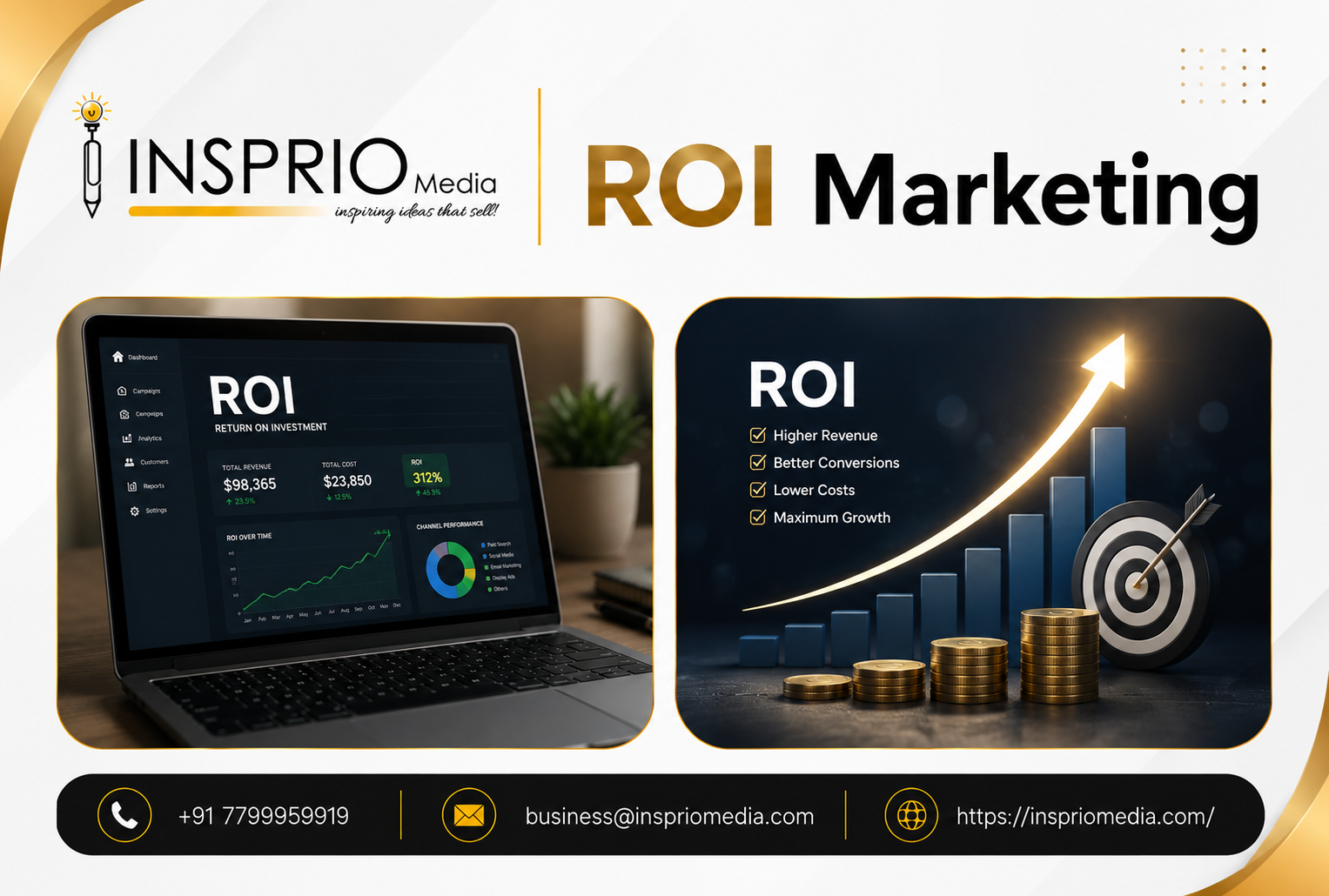
What Is ROI Marketing?
ROI Marketing is the process of planning, executing and improving campaigns according to the financial and business value they generate. It requires businesses to define clear goals, accurately track customer actions and compare marketing costs with measurable returns.
A campaign may generate website traffic, social engagement or video views, but these figures alone do not confirm profitability. Businesses must understand whether those interactions lead to enquiries, purchases, repeat customers or another valuable outcome. This is why return-focused planning goes beyond surface-level metrics.
For example, suppose a business invests ₹100,000 in a campaign and attributes ₹300,000 in revenue to it. After subtracting the campaign cost, the return is ₹200,000. Dividing that return by the initial ₹100,000 investment produces a result of 200%. Actual profitability calculations may also include product costs, agency fees, software subscriptions, employee time and sales expenses.
Why ROI Marketing Matters for Modern Businesses
Customers interact with businesses across search engines, websites, social platforms, maps, emails and offline channels. Because the buying journey is distributed across multiple touchpoints, decision-makers need a structured method for determining which activities contribute to meaningful results.
Return-focused measurement helps marketing teams justify budgets and gives business owners a clearer picture of performance. Instead of relying on assumptions, decisions can be supported by conversion data, sales information and customer behaviour.
Smarter Budgeting
Direct more resources toward channels that consistently generate qualified leads and revenue.
Lower Acquisition Costs
Improve targeting, advertisements and landing pages to reduce the cost of gaining a customer.
Scalable Growth
Expand successful campaigns using verified performance data instead of guesswork.
Core Elements of an Effective ROI Marketing Strategy
1. Define Clear Business Objectives
Every campaign should begin with a specific outcome. Goals such as “increase awareness” or “grow online” are too broad to guide measurement. A better objective might be to generate 100 qualified enquiries, increase online sales by 20%, reduce customer acquisition cost or improve repeat purchases during a defined period.
Clear objectives make it easier to select channels, prepare content and establish relevant key performance indicators. They also help different teams agree on what success means before spending begins.
2. Understand the Target Audience
A campaign cannot produce a strong return when it reaches people who are unlikely to buy. Audience research should identify customer needs, geographic areas, search behaviour, purchasing concerns, preferred platforms and decision-making factors.
Businesses can use customer interviews, enquiry records, website analytics, keyword data, social insights and sales feedback to build accurate audience profiles. Better audience understanding improves advertisement relevance and reduces wasted impressions.
3. Create a Strong Value Proposition
Prospective customers need a compelling reason to choose one business instead of another. A value proposition should clearly explain the problem being solved, the benefit offered and the reason the company is a trustworthy choice.
Generic promises such as “best quality” rarely provide enough differentiation. Stronger messaging may highlight specialist expertise, faster delivery, transparent pricing, a unique process, customised support or evidence of successful client outcomes.
4. Select the Right Marketing Channels
A profitable strategy does not require a presence on every platform. Channel selection should depend on customer behaviour, campaign objectives, competition, available resources and the complexity of the buying journey.
- Search engine optimisation: Suitable for building long-term visibility for high-intent searches.
- Paid search advertising: Useful for reaching customers actively searching for a service or product.
- Social media marketing: Effective for awareness, audience engagement, remarketing and visual storytelling.
- Email marketing: Valuable for nurturing enquiries, encouraging repeat purchases and retaining customers.
- Local SEO: Important for businesses that depend on customers in specific locations.
- Content marketing: Supports search visibility, customer education and sales conversations.
5. Build Conversion-Focused Landing Pages
Advertising performance can decline when visitors arrive on a slow, confusing or irrelevant page. A landing page should continue the promise made in the advertisement and guide visitors toward one primary action.
Effective pages typically contain a clear headline, concise benefits, trust signals, mobile-friendly formatting, visible contact options and a strong call to action. Forms should request only the information necessary for the next step.
6. Implement Accurate Tracking
Measurement should be configured before a campaign begins. Businesses may track form submissions, phone calls, WhatsApp clicks, purchases, appointment bookings, downloads or visits to important pages.
Google explains that website conversion measurement analyses actions users complete after interacting with advertisements. Google Analytics can also use events and key events to measure important customer interactions consistently across platforms.
How to Measure ROI Marketing Performance
ROI Marketing should be evaluated using both financial results and supporting performance indicators. Revenue is essential, but metrics such as conversion rate, lead quality and customer lifetime value explain why returns are increasing or decreasing.
| Metric | What It Measures | Why It Matters |
|---|---|---|
| Conversion Rate | The percentage of visitors who complete a desired action. | Shows how effectively campaigns and landing pages turn interest into results. |
| Cost per Lead | Total campaign spending divided by the number of leads generated. | Helps compare lead-generation efficiency across channels. |
| Customer Acquisition Cost | The total cost required to gain a paying customer. | Reveals whether customer growth is financially sustainable. |
| Customer Lifetime Value | The estimated value produced by a customer throughout the relationship. | Supports better decisions about how much can be spent on acquisition. |
| Return on Ad Spend | Revenue attributed to advertisements divided by advertising expenditure. | Provides a channel-level view of advertising efficiency. |
| Lead-to-Sale Rate | The percentage of leads that become paying customers. | Connects marketing quality with actual sales outcomes. |
Look Beyond Last-Click Attribution
Customers may discover a brand on social media, read an article, search for reviews, revisit through Google and eventually make contact directly. Assigning all credit to the final interaction can hide the contribution of earlier touchpoints.
Businesses should review assisted conversions, first-touch sources, customer journey reports, CRM notes and sales feedback. Larger organisations may also use marketing mix modelling to estimate how different channels influence overall results.
Connect Marketing Data with Sales Data
Lead volume does not always represent business quality. One channel may produce many low-intent enquiries, while another produces fewer leads that close at a higher rate and generate greater revenue.
Integrating advertising platforms, analytics tools and customer relationship management systems helps teams track leads beyond the initial enquiry. This makes it possible to compare channels using actual customer and revenue data.
Explore Related Insprio Media Services and Resources
- Learn how targeted campaigns support measurable growth through performance marketing.
- Understand the role of consistent engagement through social media management.
- Improve local customer discovery with professional GMB SEO services.
- Strengthen organic visibility with website SEO services.
- Create compelling brand visuals through 3D design services.
- Build consistent communication materials with graphic design services.
- Support location-based promotion using offline marketing services.
- Develop a recognisable business identity through professional branding services.
- Improve speed, security and conversions with web development services.
- Discover an integrated approach through digital marketing services.
Benefits of ROI Marketing for Business Growth
Improved Financial Accountability
Measurable campaigns make it easier for business owners, marketing teams and agencies to understand where budgets are going. Reports can focus on commercial outcomes rather than presenting disconnected impressions and clicks.
Better Campaign Optimisation
Reliable data reveals which audiences, keywords, advertisements, offers and landing pages create valuable results. Teams can test improvements and allocate more spending to combinations that perform well.
More Predictable Scaling
When acquisition cost and customer value are known, businesses can estimate how additional spending may affect lead volume and revenue. Although performance can change as campaigns expand, historical data provides a stronger foundation for forecasting.
Closer Alignment Between Marketing and Sales
Marketing teams often focus on lead generation, while sales teams focus on conversion and revenue. Shared definitions for qualified leads, acquisition costs and customer value encourage both teams to work toward the same commercial outcomes.
Continuous Improvement
Return-focused marketing is an ongoing process. Campaign results should be reviewed regularly so that targeting, content, design, offers and follow-up systems can evolve according to customer behaviour.
A Practical Optimisation Cycle
- Establish the campaign objective and target audience.
- Define conversions and financial performance indicators.
- Launch campaigns with accurate analytics and tracking.
- Evaluate lead quality, conversion rates, costs and revenue.
- Identify underperforming advertisements and customer journey gaps.
- Test one meaningful improvement at a time.
- Scale campaigns only after performance becomes consistent.
Common Mistakes That Reduce Marketing Returns
Focusing Only on Traffic
Website traffic is useful only when it includes relevant prospective customers. A smaller number of high-intent visitors can create more business value than thousands of unrelated visits.
Using Incomplete Conversion Tracking
Campaign reports become unreliable when important actions such as calls, WhatsApp enquiries, offline sales or repeat purchases are not tracked. Tracking should reflect the complete customer journey whenever possible.
Ignoring Lead Quality
Low-cost leads may appear attractive but can consume sales time without creating revenue. Businesses should record whether enquiries are relevant, contactable and ready to purchase.
Changing Campaigns Too Frequently
Constant changes can make it difficult to identify what influenced performance. Tests should have a clear hypothesis, sufficient data and a defined evaluation period.
Depending on One Channel
Relying completely on a single advertising platform exposes a business to increasing costs, policy changes and audience saturation. A balanced strategy may combine paid campaigns, organic search, content, social engagement, email and local visibility.
Neglecting the Sales Follow-Up Process
Marketing cannot deliver a strong commercial return when enquiries receive slow or inconsistent responses. Businesses should define response times, qualification questions, follow-up steps and clear ownership of every new lead.
How Insprio Media Builds ROI Marketing Campaigns
Insprio Media develops strategies around business objectives rather than isolated promotional activities. The process begins by understanding the service, audience, competition, customer journey, current marketing performance and commercial priorities.
Campaign planning may include search marketing, social media advertising, local SEO, content creation, website improvements, landing page design, branding and analytics. The recommended mix depends on the customer journey and the channels most likely to influence profitable action.
Performance is then reviewed using relevant indicators such as enquiries, lead quality, conversion rate, acquisition cost and attributed revenue. Insights from the data are used to improve audience selection, creative communication, landing pages and budget distribution.
Authoritative Marketing and Measurement Resources
The following authoritative resources provide additional guidance about return calculations, conversion measurement, analytics and campaign optimisation:
- Google Ads Help: Return on Investment
- Google Ads Help: Conversion Measurement
- Google Analytics Help: Understanding Conversions
- Meta Business Help Center: Conversions API
- Think with Google: Marketing Mix Modelling
- Australian Government: Marketing and Advertising Guidance
Frequently Asked Questions
1. What is ROI Marketing in simple terms?
ROI Marketing means managing marketing activities according to the business value they generate. It connects spending with measurable outcomes such as enquiries, customers, sales and revenue.
2. How is marketing return calculated?
A basic calculation subtracts marketing costs from attributed revenue, divides the result by marketing costs and multiplies it by 100. Businesses may include product, staff, platform and operational costs for a more complete profitability calculation.
3. What is the difference between ROI and ROAS?
Return on ad spend compares advertising revenue with advertising expenditure. ROI is broader and may include other costs required to produce the revenue, making it more useful for evaluating overall profitability.
4. Which marketing channel offers the best return?
There is no single channel that performs best for every organisation. The answer depends on the audience, offer, sales cycle, competition, location, budget and quality of campaign execution.
5. How long does it take to see measurable results?
Paid campaigns may produce early data within days or weeks, while SEO, content and brand-building initiatives generally require more time. A reliable evaluation period depends on traffic volume, conversion frequency and the length of the sales cycle.
6. Can small businesses use return-focused marketing?
Yes. Small businesses can benefit significantly because careful tracking helps protect limited budgets. They can begin with a few important conversions, a clearly defined audience and simple monthly reporting.
7. Why do campaign reports and actual sales sometimes differ?
Differences can result from attribution models, tracking restrictions, offline sales, repeat customers, multiple devices and missing CRM information. Connecting analytics with verified sales records creates a more accurate view.
8. Should campaigns be stopped when they have a low initial return?
Not automatically. Teams should first confirm tracking accuracy, review lead quality and identify whether the campaign needs better targeting, advertisements, offers or landing pages. However, campaigns with sustained poor performance should not continue without a clear improvement plan.
Conclusion: Build Sustainable Growth with ROI Marketing
ROI Marketing gives businesses a practical framework for turning promotional activity into accountable growth. By defining clear objectives, tracking meaningful conversions, connecting marketing with sales and continuously improving campaigns, organisations can use their budgets more effectively.
The objective is not simply to obtain cheaper clicks or more website visitors. It is to attract the right customers, guide them through a strong digital experience and generate measurable commercial value. A strategy supported by accurate data makes it easier to reduce waste, improve decisions and scale successful campaigns with greater confidence.
Visit Insprio Media to explore professional digital marketing, branding, design, web development and performance-focused growth services.
Contact Us :
Phone: +91 7799959919
Email: business@inspriomedia.com
Website: https://inspriomedia.com