Insprio Media SEO Guide
Why Your Website Is Not Ranking on Google: Causes, Fixes & SEO Solutions
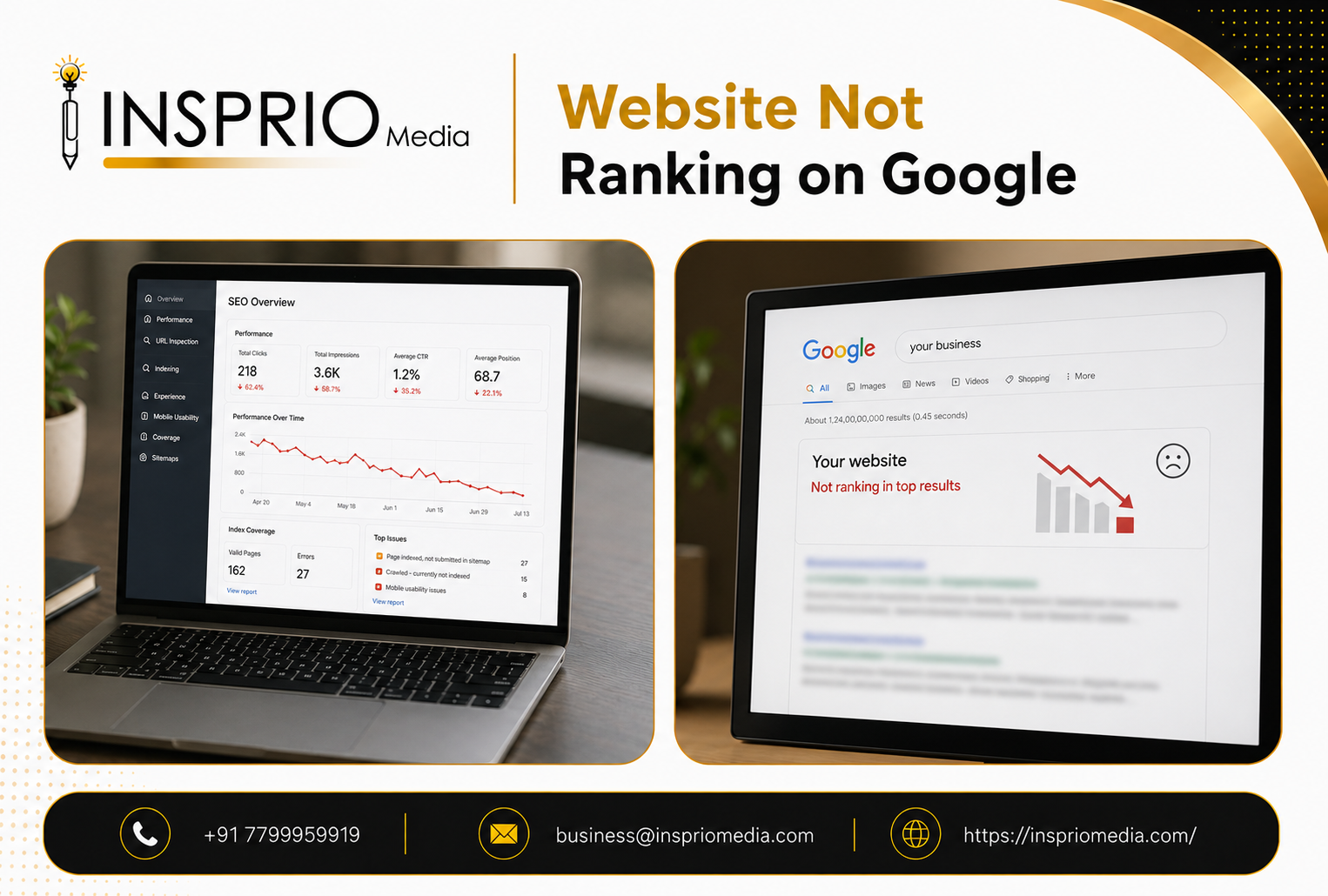
Seeing your competitors appear on page one while your business stays invisible can be frustrating. A Website Not Ranking on Google is usually not caused by one single issue. Search visibility depends on technical SEO, content quality, backlinks, user experience, local signals, indexing, authority, and how well your pages satisfy search intent.
When a Website Not Ranking on Google continues for weeks or months, the right approach is to diagnose the site methodically instead of making random changes. Google evaluates hundreds of signals, but most ranking problems can be traced to a smaller set of recurring SEO weaknesses.
1. Google Has Not Properly Crawled or Indexed Your Website
One of the first reasons for a Website Not Ranking on Google is that important pages are not indexed. A page cannot rank if Google has not discovered, crawled, or accepted it into its index. Incorrect robots.txt rules, accidental noindex tags, poor internal linking, server errors, or a missing XML sitemap can all create indexing problems.
Use Google Search Console to inspect URLs, review indexing reports, and submit your sitemap. If your Website Not Ranking on Google because key pages are excluded, fix the technical reason before investing heavily in content or link building.
2. Your Content Does Not Match Search Intent
A common Website Not Ranking on Google issue occurs when content targets a keyword without answering what users actually want. Someone searching for an SEO agency, for example, may want service details, proof, local expertise, case studies, pricing guidance, and a clear way to contact the business. A thin generic page may not satisfy that intent.
To resolve a Website Not Ranking on Google situation, review the top-ranking results for your target keyword and identify what type of page Google prefers. Improve topical depth, add practical examples, answer related questions, and make every page genuinely more useful.
3. Your Website Has Thin, Duplicate or Low-Value Content
If a Website Not Ranking on Google contains many short pages with nearly identical text, Google may struggle to identify which page deserves visibility. Duplicate location pages, copied product descriptions, repeated service paragraphs, and generic filler content can reduce the usefulness of a website.
Google recommends creating helpful, people-first content. Its helpful content guidance is useful when evaluating a Website Not Ranking on Google. Add first-hand expertise, original insights, real examples, FAQs, clear authorship, useful visuals, and information visitors cannot easily find elsewhere.
4. On-Page SEO Is Weak or Inconsistent
A Website Not Ranking on Google may have excellent services but poorly optimized page titles, headings, URLs, image alt text, internal links, and meta descriptions. On-page SEO helps search engines understand the purpose and context of each page.
For every important page, use one clear H1, descriptive H2 and H3 headings, a relevant title tag, readable URLs, contextual keyword usage, optimized images, and internal links to related services. Fixing these elements can make a Website Not Ranking on Google easier for both visitors and search engines to understand.
Explore Related Insprio Media Resources
If your Website Not Ranking on Google, SEO should work together with web development, branding, local search and digital marketing. Explore these useful resources:
Learn how Performance Marketing drives business growth and ROI.
Discover why Social Media Management is essential for business growth.
Improve local visibility with GMB SEO Services for Google Maps and local search.
Understand how Website SEO Services support higher Google rankings.
Explore professional 3D Design Services and Graphic Design Services.
Build stronger brand visibility through Offline Marketing Services and professional Branding Services.
A technically strong website starts with SEO-friendly Web Development Services.
You can also explore Digital Marketing Services for growing your business online.
5. Your Website Is Slow or Offers Poor User Experience
Speed can contribute to a Website Not Ranking on Google problem, especially when visitors experience slow loading, unexpected layout shifts, intrusive popups, or poor mobile usability. Website performance also influences whether visitors stay, interact, or immediately leave.
Check Google PageSpeed Insights and review Core Web Vitals. Compress images, use reliable hosting, reduce unnecessary scripts, enable caching, and improve mobile responsiveness. These improvements can help a Website Not Ranking on Google become faster, easier to use and more competitive.
6. Your Website Lacks Authority and Quality Backlinks
Another reason for a Website Not Ranking on Google is weak authority compared with established competitors. Relevant backlinks from trustworthy websites can help search engines understand that a website, company, or piece of content is recognized within its industry.
Do not solve a Website Not Ranking on Google issue by purchasing hundreds of irrelevant links. Instead, earn links through original research, useful guides, digital PR, industry partnerships, local citations, guest contributions, and content worth referencing. Review Google's official spam policies before starting aggressive link-building campaigns.
7. Your Local SEO Signals Are Incomplete
For businesses serving particular locations, a Website Not Ranking on Google may also mean poor visibility in Google Maps and local search. An incomplete Google Business Profile, inconsistent contact information, weak reviews, inappropriate categories, or insufficient local content can affect visibility.
Keep your business name, address, and phone details consistent across reputable directories. Build useful location-specific service pages and optimize your Google Business Profile. Google's official local ranking guidance discusses relevance, distance, and prominence. These factors are important when diagnosing a Website Not Ranking on Google for geographically targeted searches.
8. Technical SEO Problems Are Holding the Website Back
A Website Not Ranking on Google can be affected by redirect chains, incorrect canonical tags, duplicate URLs, structured-data errors, broken pages, JavaScript rendering problems, poor site architecture, or pages that have no internal links pointing to them.
A detailed technical audit should examine crawlability, indexability, canonicalization, HTTPS, mobile usability, structured data, internal links, page depth, XML sitemap quality, redirects, and HTTP status codes. When a Website Not Ranking on Google has a stronger technical foundation, content and authority-building efforts have a better opportunity to produce results.
9. You Are Targeting Keywords That Are Too Competitive
Businesses sometimes choose highly competitive search terms before building enough topical authority. A new company targeting broad national keywords may compete against businesses that have invested in SEO for many years.
Instead of focusing entirely on highly competitive phrases, start with commercially relevant long-tail keywords, local keywords, question-based searches, and specific service queries. Building rankings across these smaller opportunities can gradually strengthen the overall authority of your website.
10. Your SEO Strategy Is Too New or Inconsistent
Sometimes a Website Not Ranking on Google simply needs more time and consistent SEO execution. New websites normally have less authority, fewer backlinks, fewer indexed pages, and a smaller content footprint than established competitors.
SEO should therefore be treated as an ongoing business-growth process. Publish useful content, improve existing pages, monitor Search Console, strengthen internal linking, build trustworthy backlinks, and measure conversions. A Website Not Ranking on Google will rarely achieve sustainable growth through a single optimization campaign.
How Insprio Media Can Help Improve Your Rankings
Insprio Media can investigate the complete reason behind a Website Not Ranking on Google, including technical SEO, keyword targeting, content quality, website performance, backlinks, Google Business Profile optimization, web development, and digital marketing.
A professional SEO strategy should prioritize problems according to their potential business impact. Fixing a serious indexing issue, for example, is more urgent than rewriting a meta description on a page Google cannot crawl.
Visit Insprio Media to explore SEO, digital marketing, web development and branding solutions. If your Website Not Ranking on Google, a detailed SEO audit can identify which improvements should be completed first.
Frequently Asked Questions
1. Why is my website not appearing on Google at all?
If your Website Not Ranking on Google at all, begin by checking Google Search Console, robots.txt, noindex directives, sitemap submission, server accessibility, and page indexing. The website cannot obtain organic rankings until Google can properly discover and index its important pages.
2. How long does a new website take to rank?
There is no guaranteed ranking timeline. A Website Not Ranking on Google may require several weeks or months of improvement depending on competition, authority, website quality, content depth, backlinks, technical health, and the keywords being targeted.
3. Can slow website speed affect SEO?
Yes. Slow pages can create poor user experiences, especially on mobile devices. Improve image sizes, caching, hosting performance, JavaScript execution, CSS delivery, and Core Web Vitals wherever possible.
4. Do backlinks still matter for SEO?
Quality backlinks can strengthen website authority when they come from relevant and reputable sources. For a site with poor rankings, concentrate on earning trustworthy references rather than purchasing large quantities of low-quality links.
5. Can duplicate content prevent rankings?
Duplicate and near-duplicate pages can make it more difficult for search engines to determine which URL should appear in results. Consolidate overlapping content, use appropriate canonical tags, and ensure important pages provide distinctive value.
6. Should I hire an SEO agency when my website rankings are low?
If you cannot determine why rankings remain low, an experienced SEO team can perform technical, content, keyword, backlink, competitor, local SEO, and conversion audits to identify the most important actions.
7. Does changing website content improve Google rankings?
Updating content can help when those updates make the page more accurate, useful, relevant, comprehensive, and aligned with user search intent. Simply changing words without adding value is unlikely to create meaningful improvement.
Final Thoughts
A Website Not Ranking on Google is not a reason to panic, but it is an important signal that your SEO strategy requires diagnosis. Begin with indexing and technical health, then improve search intent, content quality, internal linking, local relevance, website authority, performance, and user experience.
The most effective way to fix a Website Not Ranking on Google is to combine data from Google Search Console, analytics, keyword research, competitor analysis, local SEO reviews, and detailed technical audits. Consistent improvements create stronger long-term results than shortcuts or temporary ranking tactics.
Contact Us :
Contact Insprio Media for professional SEO, digital marketing, web development, branding, and online growth solutions.
Phone: +91 7799959919
Email: business@inspriomedia.com
Website: https://inspriomedia.com/