Business Card Design That Creates a Powerful First Impression
Discover how a professionally designed card can introduce your brand, communicate credibility and help potential customers remember your business.
In a digital-first business environment, personal interaction still matters. Whether you are attending a networking event, meeting a potential customer, visiting an exhibition or presenting your services to a local company, a professionally designed business card gives people a tangible reminder of your brand. At Insprio Media, we combine branding, typography, layout and visual strategy to create cards that look polished, communicate clearly and support your wider marketing goals.
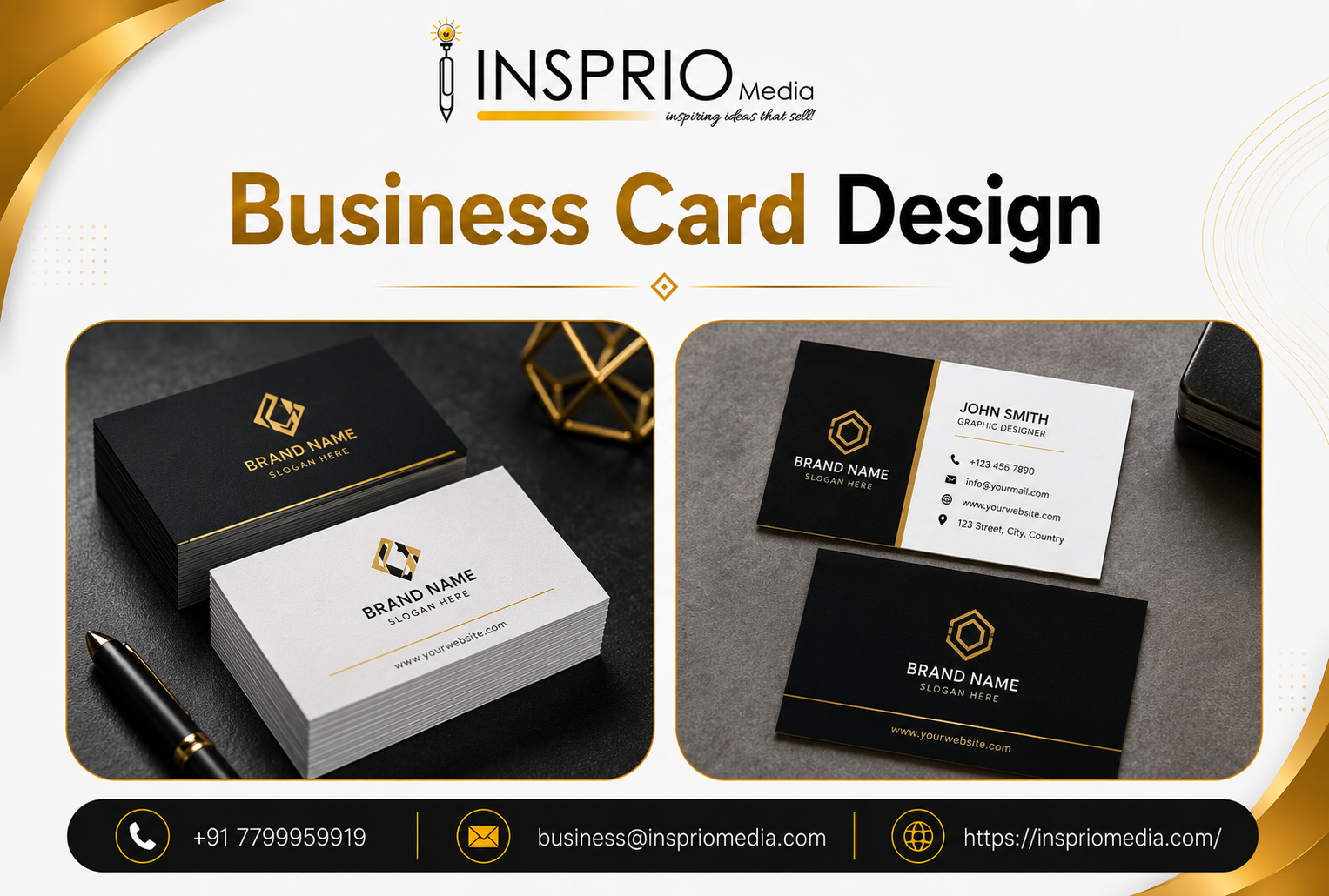
Effective Business Card Design is not simply about placing a name, phone number and logo on a small rectangle. It requires careful planning so that every visual element has a purpose. The colours should match your brand, the typeface should remain readable, the spacing should feel balanced and the most important contact information should be immediately visible. When these elements work together, even a small printed card can communicate confidence, quality and professionalism.
Why a Professional Business Card Still Matters
Online profiles, websites and social media pages are essential, but they do not always replace the value of a direct personal exchange. A printed card can be shared instantly without requiring an internet connection, app or search. It also gives the recipient a physical object connected to the conversation they had with you.
Good Business Card Design strengthens this interaction by ensuring that your card looks intentional rather than generic. A card with clear hierarchy, high-quality graphics and consistent branding can make a small business appear more established. It can also help employees, consultants, sales representatives and founders present the same professional identity during every customer meeting.
What Makes a Card Memorable?
Clear visual hierarchy
The viewer should immediately know where to look first. In most cases, the name or company identity receives primary attention, followed by the role, phone number, email address, website and other useful contact details. Proper hierarchy prevents the layout from appearing crowded.
Consistent brand colours
Colours influence recognition and perception. A luxury company may benefit from refined neutral shades, while a creative agency may use more energetic combinations. The important factor is consistency. Random colours can make the card feel disconnected from the rest of the company’s identity.
Readable typography
Stylish fonts can improve visual appeal, but readability must always remain the priority. Contact details should be easy to read under normal lighting. The designer must also consider font size, line spacing, contrast and how the final typography will appear after printing.
Balanced use of space
Empty space is an active part of the composition. It helps separate information, improves readability and gives important elements room to stand out. Filling every available area with text, icons and effects can reduce the premium quality of the finished card.
A practical call to action
Depending on the business, the card may encourage the recipient to visit a website, scan a QR code, book an appointment, request a quotation or follow a social media page. The call to action should be short and relevant rather than promotional or distracting.
Information to Include on Your Card
Every card should include only the information that helps a recipient identify and contact the business. Common elements include:
- Company logo and brand name
- Employee or business owner’s name
- Professional designation or department
- Primary phone number
- Professional email address
- Company website
- Office address when relevant
- QR code connected to a useful landing page
- Selected social media handles
Strategic Business Card Design removes unnecessary information instead of trying to include everything. For example, a business serving customers online may not need a full postal address, while a local showroom, restaurant or clinic may consider its location essential. The final content should reflect how customers normally interact with the company.
Our Creative Process at Insprio Media
Brand discovery
We understand your business category, customers, brand positioning, preferred style and practical card requirements.
Content planning
We organise names, titles and contact information according to their importance before beginning the visual composition.
Concept development
We explore layouts, colours, typography and graphic treatments that suit the personality of your company.
Design refinement
We improve alignment, spacing, contrast and detail to create a professional front-and-back card composition.
Review and corrections
Contact information and spelling are checked carefully, and approved revisions are incorporated into the final artwork.
Print-ready delivery
Final files can be prepared with appropriate dimensions, bleed, colour settings and resolution for professional printing.
Our Business Card Design process balances creativity with practical print requirements. The objective is not only to produce an attractive preview on a screen but also to ensure that the approved artwork can be reproduced clearly on the selected card stock and finishing method.
Popular Card Styles for Different Businesses
Minimal corporate cards
These designs use strong typography, controlled colours and generous spacing. They are suitable for consultants, technology companies, construction firms, legal professionals, financial services and corporate teams.
Premium luxury cards
Luxury cards often use dark backgrounds, metallic accents, embossing, foil effects or textured stock. They can work well for premium real estate, jewellery, beauty, hospitality, fashion and high-value professional services.
Creative agency cards
Creative businesses may use bold compositions, unusual typography, illustrations or distinctive colour combinations. Even when the design is expressive, the contact information should remain easy to understand.
Service and appointment cards
Salons, clinics, repair businesses and home-service providers may combine contact information with an appointment section, emergency number, QR code or short service list. The layout should remain practical for repeated use.
Personal branding cards
Freelancers, speakers, trainers, artists and consultants may place greater emphasis on their personal name, photograph, specialty or portfolio link. These cards should still connect visually with the individual’s website and online profiles.
Choosing the Right Size, Paper and Finish
The final result depends on both artwork and production. Standard sizes are convenient because they fit in wallets and card holders. Custom shapes may attract attention, but they should be selected only when they support the brand and remain easy to carry.
Paper thickness also influences perception. A heavier stock can feel more substantial, while textured or recycled stock may support a handcrafted or environmentally conscious brand image. Matte lamination offers a refined, low-glare appearance, while gloss can make photographs and strong colours appear more vibrant.
Premium effects such as foil stamping, embossing, debossing, spot UV and edge colouring can enhance Business Card Design when used carefully. Applying every available finish can make a card look excessive and increase production costs. A single well-chosen feature often creates a more sophisticated impression.
Common Design Mistakes to Avoid
- Using very small text: Contact details may become difficult to read after printing.
- Adding too much information: Excessive content makes the card crowded and weakens visual hierarchy.
- Using low-resolution logos: Pixelated graphics reduce the professional quality of printed material.
- Ignoring print margins: Important content placed too close to the edge may be trimmed.
- Choosing weak contrast: Light text on a light background or dark text on a dark background may become unreadable.
- Using inconsistent branding: A card that looks different from the website and other marketing material can confuse customers.
- Failing to proofread: Incorrect phone numbers, email addresses or spelling errors can make the printed cards unusable.
Connecting Print Design with Digital Marketing
A business card can act as a bridge between an offline introduction and an online customer journey. A QR code may lead to a portfolio, product page, contact form, digital profile or location map. The linked destination should be mobile-friendly and directly relevant to the recipient.
For example, a sales representative can use a QR code that opens a product catalogue, while a consultant may connect it to an appointment-booking page. A restaurant may link to its menu, and a property professional may direct prospects to current listings. This makes Business Card Design part of a larger conversion strategy rather than an isolated print task.
Explore Related Insprio Media Services
A strong card becomes more effective when it is supported by consistent branding, an optimised website and a coordinated marketing strategy. Explore these related resources from Insprio Media:
- Performance marketing for measurable business growth
- Why social media management matters for modern companies
- GMB SEO services for stronger local visibility
- Website SEO services for sustainable online growth
- Professional 3D design and visualisation services
- Graphic design services for a powerful brand identity
- Offline marketing solutions for local brand visibility
- Branding services for a consistent business identity
- Fast, secure and SEO-friendly web development
- Digital marketing services for online business growth
Authoritative Design and Marketing Resources
Business owners and marketing professionals can also explore the following trusted resources for guidance on branding, accessibility, digital visibility and print preparation:
Frequently Asked Questions
1. What information should I provide before the design begins?
You should provide your logo, brand colours, name, designation, phone number, email address, website, office address and any QR code or social media information you want to include.
2. Can you create a card when my business does not have a logo?
Yes. Logo and brand identity development can be completed before the card layout so that all visual materials share a consistent identity.
3. Should the front and back have different content?
Usually, yes. One side can focus on the logo and brand message, while the other side displays the name, role and contact information. The best arrangement depends on the amount of content and preferred style.
4. Can a QR code be added?
Yes. A QR code can link to your website, portfolio, contact page, map, digital profile, catalogue or booking page. It should be tested before printing and given enough clear space for reliable scanning.
5. What files are normally needed for printing?
Most professional printers accept print-ready PDF files. Depending on the production process, editable source files or high-resolution image files may also be required.
6. How can I make my card look premium?
Premium results usually come from strong typography, balanced spacing, quality card stock and one carefully selected finish, such as foil, embossing, spot UV or matte lamination.
7. Can one design be adapted for an entire team?
Yes. A master template can be created and then updated with each employee’s name, designation, direct phone number and email address while keeping the company branding consistent.
8. Why should I hire a professional instead of using a basic template?
Professional Business Card Design is created around your specific brand, audience and business goals. It also considers typography, print margins, colour preparation, information hierarchy and consistency with your wider marketing materials.
Build a Consistent and Credible Brand
Your card may be one of the smallest marketing assets you use, but it can have a meaningful effect on how people perceive your company. A thoughtful layout communicates that the business pays attention to detail, values its identity and is prepared to present itself professionally.
At Insprio Media, we approach Business Card Design as part of a connected branding system. By coordinating your card with your logo, website, digital marketing and offline promotional materials, we help create a recognisable experience across every customer touchpoint.
Ready to Create a Professional Card?
Partner with Insprio Media for a polished card that reflects your brand identity, communicates your contact details clearly and supports meaningful business connections.
Visit https://inspriomedia.com/ to explore our creative and marketing solutions.
Contact Us :
Phone: +91 7799959919
Email: business@inspriomedia.com
Website: https://inspriomedia.com/