Industrial 3D Design: Transforming Product Ideas into Precise Digital Experiences
Modern manufacturers cannot afford to rely only on sketches, physical samples, and lengthy trial-and-error processes. They need accurate digital models that help teams understand a product before production begins. Industrial 3D Design enables companies to visualize concepts, review proportions, present products professionally, identify design concerns, and communicate technical ideas more effectively.
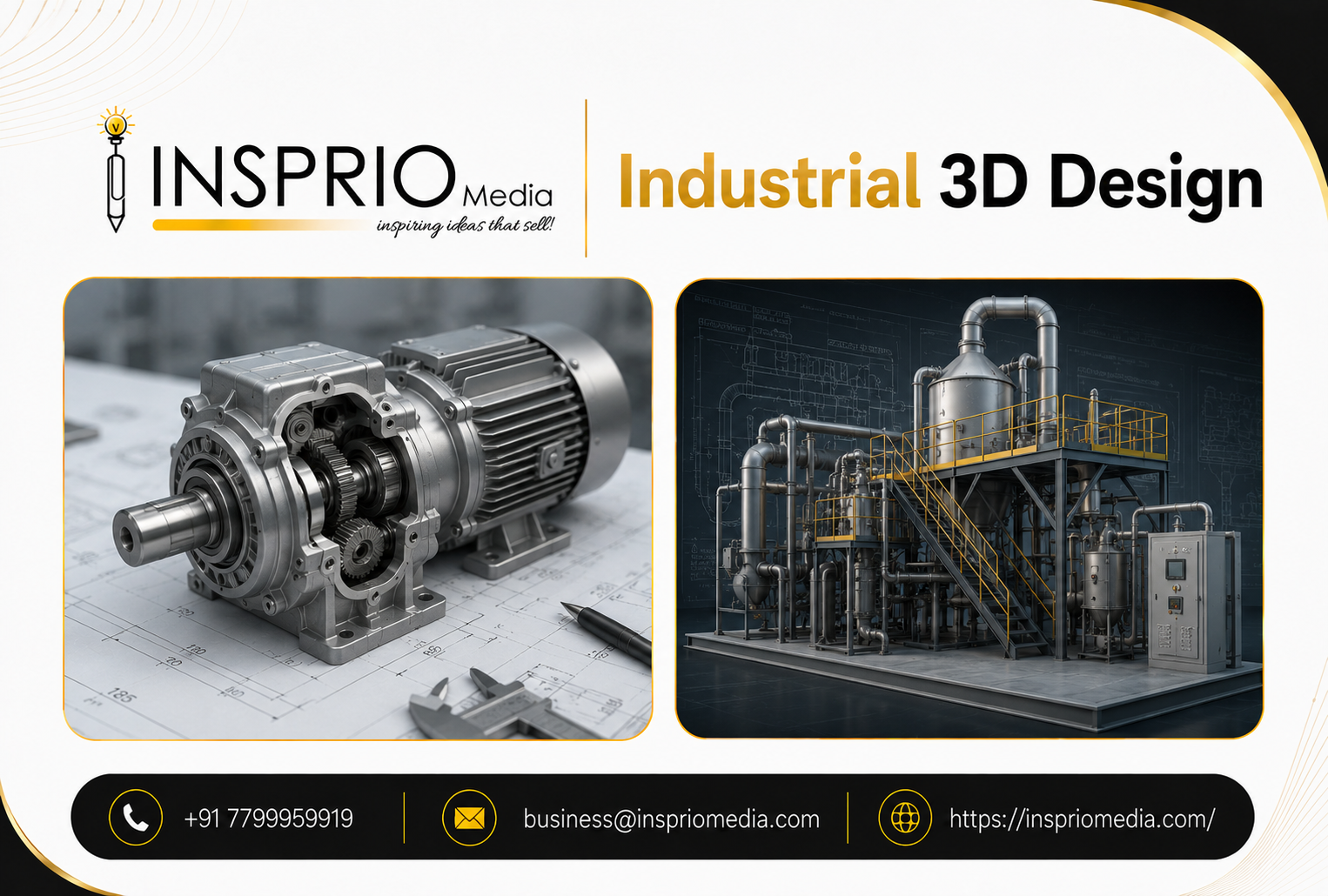
From machinery components and consumer products to packaging, equipment, furniture, electronics, and architectural elements, three-dimensional visualization supports almost every stage of product communication. Businesses can use it to explain complex structures, demonstrate functions, attract investors, train teams, improve sales presentations, and produce realistic promotional material.
At Insprio Media, we combine creativity, technical understanding, visual storytelling, and marketing expertise to turn early-stage product ideas into clear and compelling digital assets. Our process is designed to help brands communicate not only how a product looks, but also how it works, where it fits, and why customers should choose it.
What Is Industrial Product 3D Visualization?
Industrial product visualization is the process of creating a detailed digital representation of a physical product, machine, component, environment, or manufacturing concept. The model may be developed using measurements, CAD references, sketches, engineering drawings, photographs, or written descriptions.
Once the basic model is developed, designers can apply materials, textures, colours, lighting, shadows, environmental effects, and camera angles. This process transforms a technical shape into a realistic or stylized presentation that can be used across websites, brochures, advertisements, exhibition displays, catalogues, presentations, and social media.
Unlike ordinary product photography, Industrial 3D Design can present products that have not yet been manufactured. It can also reveal internal mechanisms, demonstrate exploded views, show multiple finishes, or place large machinery in a realistic environment without organizing an expensive physical photoshoot.
Why Modern Businesses Need 3D Product Design
Visualize a Product Before Manufacturing
A realistic digital model makes it easier for decision-makers to understand a product before investing in tooling, fabrication, packaging, transportation, or photography. Teams can review the overall appearance, proportions, finishes, and presentation early in the project.
Improve Communication Between Teams
Product development often involves engineers, designers, marketers, sales teams, manufacturers, clients, and investors. Each stakeholder may interpret a flat drawing differently. A clear three-dimensional model creates a shared visual reference and reduces misunderstandings.
Create Marketing Material Before Product Launch
Companies can begin building product pages, brochures, advertisements, presentations, social media campaigns, and dealer material before the final product is physically available. This helps marketing teams prepare campaigns in advance and create stronger momentum around a launch.
Present Complex Products Clearly
Machinery and technical equipment may contain internal parts that cannot be photographed clearly. Cutaway views, transparent views, exploded diagrams, and animated sequences can explain assembly, movement, installation, maintenance, and product advantages.
Reduce Dependence on Repeated Photoshoots
A physical photoshoot may need to be repeated whenever a product colour, finish, background, accessory, or angle changes. With Industrial 3D Design, an approved model can be adapted to generate multiple visual variations without rebuilding or transporting the physical product.
Industrial 3D Services Offered by Insprio Media
3D Product Modelling
We create accurate digital product models using available dimensions, drawings, photographs, reference files, sketches, and design instructions.
Photorealistic Product Rendering
Realistic materials, reflections, lighting, shadows, backgrounds, and camera perspectives are used to produce presentation-ready product images.
Exploded and Cutaway Views
Components can be separated or internal sections revealed to explain assembly, construction, servicing, engineering, and product functions.
Product Animation
Animated sequences can show movement, assembly, installation, operating procedures, material flow, and other processes that static images cannot fully communicate.
Material and Colour Variations
The same approved model can be displayed in multiple colours, finishes, textures, materials, and branded variations.
3D Marketing Visuals
We transform technical models into visually engaging content for landing pages, advertisements, presentations, brochures, catalogues, and social media campaigns.
Industries That Benefit from 3D Visualization
The flexibility of Industrial 3D Design makes it valuable for businesses across numerous sectors. It can support both technically complex engineering projects and visually focused consumer products.
- Manufacturing: Machinery, industrial equipment, tools, production systems, and replacement components.
- Automotive: Vehicle components, accessories, interiors, mechanical parts, and concept presentations.
- Architecture and construction: Structural systems, equipment layouts, building products, fixtures, and installation concepts.
- Furniture: Tables, chairs, storage systems, office furniture, modular products, and material variations.
- Electronics: Devices, enclosures, switches, panels, appliances, and product launch visuals.
- Packaging: Bottles, containers, cartons, labels, product boxes, and retail presentation concepts.
- Healthcare equipment: Medical devices, diagnostic equipment, product demonstrations, and training visuals.
- Energy and infrastructure: Equipment, technical systems, process illustrations, and installation presentations.
How the Insprio Media 3D Design Process Works
1. Requirement and Reference Collection
The project begins with a discussion about the product, target audience, intended use, preferred visual style, output dimensions, required angles, and delivery formats. Clients may provide CAD files, sketches, measurements, photographs, product samples, branding references, or existing marketing material.
2. Digital Model Development
Our team develops the primary three-dimensional structure based on the supplied references. During this stage, attention is given to proportions, visible components, surface form, assembly, and other details that affect the product’s appearance.
3. Materials and Textures
Materials such as metal, glass, plastic, rubber, wood, fabric, stone, paint, and polished surfaces are recreated digitally. This stage determines how the product responds to light and how realistic the final image appears.
4. Lighting and Composition
Lighting is designed according to the purpose of the visual. A technical presentation may require a clean, neutral studio setup, while an advertising image may use dramatic lighting, branded backgrounds, or a contextual environment.
5. Rendering and Refinement
Draft renders are generated for review. After feedback, details such as camera position, material finish, colours, shadows, product placement, background, and visual balance are refined.
6. Final Output Delivery
The approved visuals are exported in suitable formats and dimensions for websites, advertisements, brochures, print campaigns, presentations, marketplaces, social media, or other communication channels.
3D Rendering Compared with Traditional Product Photography
| Requirement | 3D Product Rendering | Traditional Photography |
|---|---|---|
| Physical product required | Not always required | Normally required |
| Colour variations | Can be generated digitally | May require separate samples |
| Internal component views | Possible through cutaway and exploded views | Difficult or impossible without disassembly |
| Future design changes | Model can often be updated | May require a new photoshoot |
| Large industrial equipment | Can be visualized in a digital environment | Requires location planning and equipment access |
| Pre-launch marketing | Visuals can be prepared before manufacturing | Usually depends on a completed sample |
Photography remains valuable when authentic lifestyle imagery or real-world documentation is required. However, Industrial 3D Design provides greater control when products are unfinished, difficult to transport, highly technical, configurable, or available in multiple versions.
Using 3D Visuals in Digital Marketing
High-quality visualization becomes more valuable when it is integrated into a wider digital strategy. A technically accurate render should also be optimized for the platform, campaign objective, and audience that will view it.
Businesses can combine product visualization with performance marketing campaigns to create focused advertisements and measurable lead-generation funnels. Product renders can also strengthen social media management by providing consistent, professional content for product launches, demonstrations, and educational posts.
For local manufacturers and service providers, strong visuals can support Google Business Profile SEO. They can also improve landing pages developed through website SEO services by making technical content easier to understand and more engaging for visitors.
Companies seeking broader visualization solutions can explore our guide to professional 3D design services. The resulting assets can then be incorporated into graphic design campaigns, product catalogues, exhibition displays, sales presentations, and branded communication.
Building a Consistent Brand Around Technical Products
A technically accurate model should still feel connected to the company’s identity. Colours, typography, backgrounds, lighting style, product placement, iconography, and messaging must work together to create a consistent brand experience.
Our branding services help businesses build a recognizable identity around their products. These visuals can also be extended into offline marketing material such as brochures, catalogues, exhibition panels, dealer kits, posters, and product packaging.
For digital implementation, our web development services help present products through fast, responsive, and user-friendly websites. Businesses can further connect these assets with integrated digital marketing services to improve visibility, audience engagement, enquiries, and conversions.
Benefits of Choosing Insprio Media
- Creative visuals developed around your product and business objectives.
- Ability to work with sketches, measurements, photographs, CAD references, and conceptual ideas.
- Realistic materials, lighting, backgrounds, and product presentation.
- Multiple output sizes for websites, advertisements, social media, print, and presentations.
- Integration with branding, web development, graphic design, SEO, and performance marketing.
- Clear review stages and structured feedback implementation.
- Solutions for both technical communication and customer-facing marketing.
How to Prepare for a 3D Product Design Project
Better references usually lead to faster and more accurate results. Before beginning an Industrial 3D Design project, businesses should collect all available product information.
- Product measurements and proportions.
- Front, side, top, rear, and detail photographs.
- CAD files or engineering drawings, when available.
- Material and finish references.
- Brand colours and logo files.
- Required camera angles and product variations.
- Examples of the preferred visual style.
- Final usage requirements, dimensions, and formats.
- Information about internal parts that must be displayed.
- Deadlines connected to product launches or presentations.
Authoritative Resources for 3D Design and Manufacturing
Businesses and product teams interested in learning more about digital modelling, design, manufacturing, and visualization can refer to the following authoritative resources:
- Autodesk 3D Modelling Resources
- SOLIDWORKS Product Design and Engineering
- Siemens Industrial Software Solutions
- International Organization for Standardization
- NIST Manufacturing Resources
- Blender 3D Creation Platform
Frequently Asked Questions
1. What information is required to begin a 3D product project?
You can provide CAD files, product photographs, sketches, measurements, material references, branding guidelines, or written instructions. The exact requirements depend on the complexity and intended use of the final visual.
2. Can a 3D model be created without a physical product?
Yes. A model can often be created from accurate drawings, measurements, CAD references, sketches, photographs, or detailed product descriptions. More complete references generally improve accuracy.
3. Can you create different product colours and finishes?
Yes. Once the primary model is prepared, multiple colour, material, label, texture, and finish variations can usually be generated from the same base model.
4. Is Industrial 3D Design suitable for large machinery?
Yes. It is particularly useful for large or difficult-to-transport equipment because the product can be presented digitally without arranging a complex location photoshoot.
5. Can 3D visuals be used on websites and social media?
Yes. Renders can be exported in platform-specific sizes for websites, landing pages, social media posts, advertisements, online catalogues, presentations, and marketplaces.
6. Can internal product components be displayed?
Yes. Exploded views, transparent views, cutaway illustrations, and animations can reveal internal components, assembly sequences, movement, and product construction.
7. How long does a 3D visualization project take?
The timeline depends on product complexity, reference quality, number of views, level of realism, revision requirements, animation length, and final output specifications.
8. Can the model be updated when the product changes?
In many cases, yes. Components, materials, colours, labels, proportions, and details can be modified, although the amount of work depends on the scale of the change.
9. What file formats can be supplied?
Final images can commonly be delivered in formats such as JPG, PNG, TIFF, or WebP. Video and animation formats can be discussed based on the publishing platform and project requirements.
10. Why should businesses choose Insprio Media?
Insprio Media combines visualization with branding, graphic design, website development, SEO, social media, and paid advertising expertise. This helps businesses turn technical product assets into coordinated marketing communication.
Conclusion
Product communication has evolved beyond flat sketches and basic photographs. Customers, investors, dealers, and internal teams expect clear, professional, and engaging visual information. A carefully developed three-dimensional model makes technical ideas easier to review, explain, market, and present.
With Industrial 3D Design, businesses can visualize products before production, create multiple configurations, explain internal mechanisms, strengthen sales presentations, and prepare promotional content for product launches. When combined with branding, website development, SEO, social media, and performance marketing, these visuals can become an important part of long-term business growth.
Insprio Media helps manufacturers, product companies, service providers, architects, engineers, and growing brands transform concepts into polished digital experiences. Whether you need a single product render, a collection of marketing visuals, an exploded technical presentation, or a complete digital campaign, our team can develop a solution based on your goals.
Contact Us :
Phone: +91 7799959919
Email: business@inspriomedia.com
Website: https://inspriomedia.com/
Request a Project Consultation