
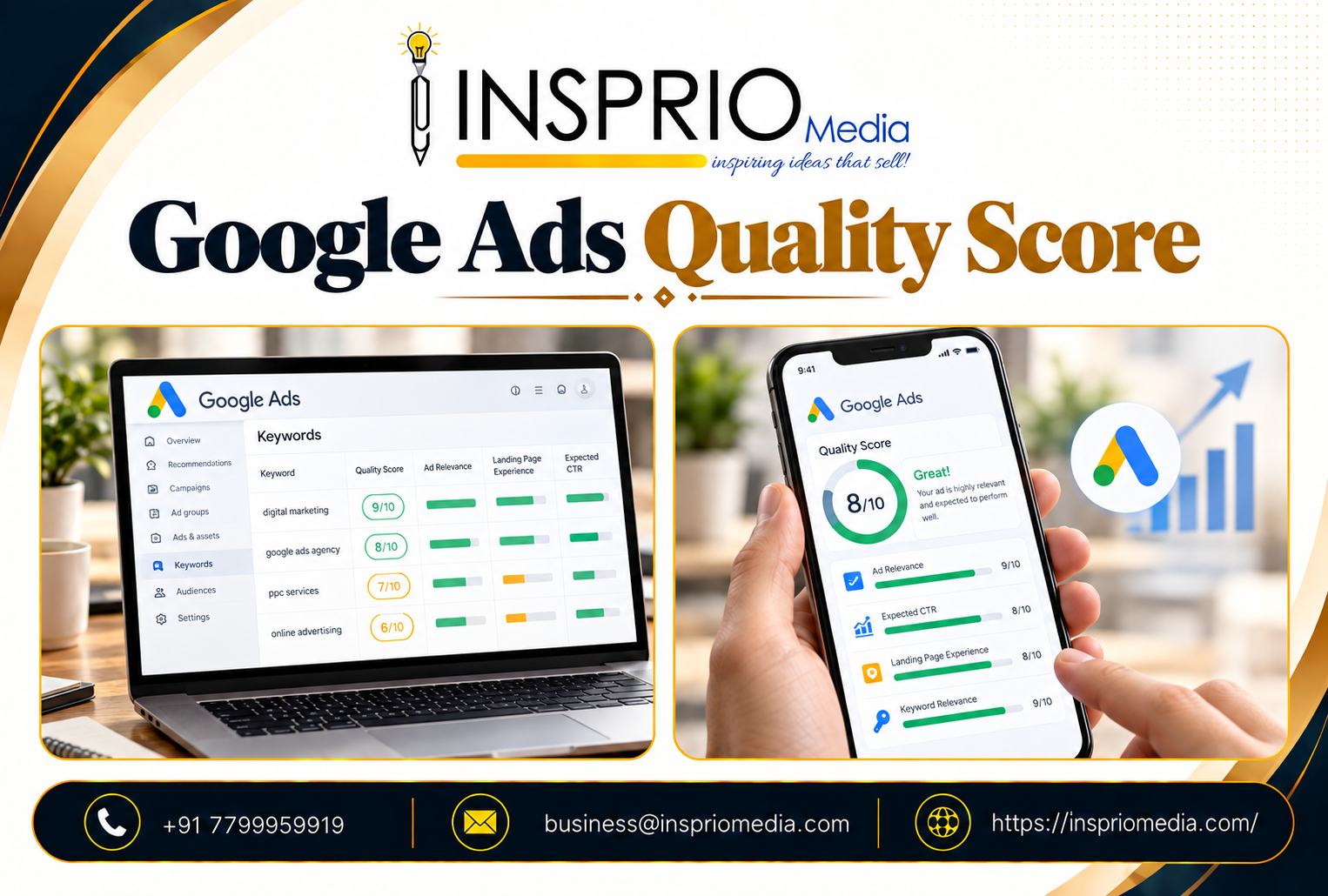
Google Ads Quality Score is a diagnostic rating from 1 to 10 shown next to each keyword in your account. It estimates how your ad quality compares with other advertisers on three things: expected click-through rate, ad relevance and landing page experience. It is a guide for you, not a number Google plugs directly into the auction.
That distinction matters. Many business owners chase a 10 out of 10 and waste weeks on it. The better use of Quality Score is as a smoke alarm: a low score on a keyword you care about usually points to a real mismatch between the search, your ad and your page.
What is Quality Score, exactly?
Quality Score is reported at keyword level, inside the Keywords table of a Search campaign. Google gives each keyword a score from 1 to 10 and a rating of Below average, Average or Above average for each of the three components. The score is an estimate based on past performance and comparisons with other advertisers on similar searches.
Three points are often misunderstood:
- It is a summary for advertisers. The actual auction uses real-time quality signals that are calculated for every single search, which is why two searches for the same keyword can behave differently.
- It does not appear for every keyword. New keywords or those with very little traffic may show a dash instead of a score.
- It is not a business KPI. Nobody pays you for a high Quality Score. What pays you is enquiries, calls and sales at a sensible cost.
The three components and what they really tell you
Expected click-through rate
This is Google's estimate of how likely your ad is to be clicked when it appears for that keyword, with factors like ad position stripped out. A below average rating usually means your ad does not look like the answer to the search. A clinic bidding on dental implants with an ad that talks about general family dentistry is a typical example.
Ad relevance
This measures how closely your ad copy matches what the person searched for. It is the easiest component to diagnose, because you can read the search terms and read your own ad side by side. If they feel unrelated, the rating will usually say so.
Landing page experience
This looks at how useful and relevant your page is to people who click. Content that matches the ad promise, clear navigation, and a page that loads properly on a mobile phone all count. A page that opens slowly on an average 4G connection in a Tier 2 city will struggle however good your ad is.
Of the three, landing page experience is the one most often ignored, and it is usually the slowest to fix because it needs a developer or designer, not just a change in the ad account.
Is Quality Score the same as Ad Rank?
No. Ad Rank decides whether your ad shows and in which position. It combines your bid, the quality of your ads and landing page, minimum thresholds, the context of the search and the expected effect of your ad assets. Quality Score is a simplified view of the quality part only. For a fuller breakdown, read our guide to Google Ads Ad Rank.
In practice, higher quality can let you win a good position at a lower cost than a competitor with weaker ads and a larger bid. That is the commercial reason to care, and it is also why a bigger bid alone cannot fix a poor-quality keyword.
A simple example
Take two advertisers selling the same product in Hyderabad, such as a real estate developer promoting apartments in a particular locality.
- Advertiser A groups tightly related keywords, writes ads that mention the locality and the property type, and sends clicks to a page about exactly that project.
- Advertiser B puts many unrelated keywords in one group, uses a generic ad about luxury living, and sends everyone to the home page.
Advertiser A is likely to see better component ratings and a lower cost for the same position. Advertiser B can still appear, but will usually pay more per click and get less relevant traffic. Neither outcome is guaranteed, but the direction is consistent.
How to check Quality Score and the signals around it
In the Keywords view you can add columns for Quality Score and for the three components. Do this and then look for patterns rather than single numbers.
- Look at keywords that spend the most money first. A poor score on a keyword that gets ten clicks a month is not a priority.
- Look at which component is weak. If most keywords are below average on landing page experience, the problem is your page, not your keywords.
- Read the search terms report next to the keyword list. Irrelevant searches drag expected CTR down.
The score is a hint, so compare it with your real results: cost per lead, conversion rate and lead quality. A keyword with a modest score that brings qualified enquiries is doing its job.
What actually improves it
You do not need a secret trick. Quality Score tends to improve when the basics are consistent from search to sale.
- Keep themes tight. Group keywords that mean the same thing so each ad can speak directly to the search.
- Write for the searcher. Mention the service, the place and a clear reason to click, rather than a general brand slogan. Our article on how to improve Google Ads CTR covers ad copy in more detail.
- Match the page to the promise. If the ad says free consultation, the page should show it clearly, not hide it three scrolls down.
- Fix speed and mobile use. Most Indian search traffic is on phones. A heavy page or tiny buttons will cost you.
- Block irrelevant searches. A regular habit of adding negative keywords keeps your click-through rate honest.
Myths worth dropping
Does a higher bid improve Quality Score?
No. Bids affect where you rank and how often you show, not the diagnostic score. Raising a bid on a poor keyword usually just makes a weak result more expensive.
Do conversions raise Quality Score directly?
Not directly. Conversions are not one of the three components. However, a page that converts well is normally one that is relevant and easy to use, so the same improvements tend to help both.
Do you need a 10?
No. A 10 is not a goal in itself, and some branded keywords reach it easily while others never will. A broad, high-intent commercial keyword with a score of 5 or 6 can still be profitable. Fix low scores that cost real money, then move on.
Can a low score still make sales?
Yes. Competitive or ambiguous keywords may score low because the search intent is mixed, yet still convert. Judge by outcomes first and treat the score as a prompt to investigate.
Quality Score for different types of business
- Local services and clinics: place names and service names in the ad, plus a page with address, phone number and a clear call button, tend to help.
- Ecommerce: product-specific pages beat category dumps. Sending a search for a particular product to a general shop page will often get a weak landing page rating.
- B2B manufacturers and service firms: search terms are long and specific. Ads and pages that speak to a particular application or industry usually do better than a general company introduction.
If your landing pages are the weak link, a purpose-built landing page for each campaign theme is often the fastest structural fix.
How Insprio Media can help
We have run Google Ads and programmatic campaigns for large global brands and for local businesses, and we treat Quality Score as one of several signals, not a target. If you want an honest read on whether poor scores are costing you money, our Google Ads management team can audit your account and tell you what is worth fixing and what to leave alone.


















