
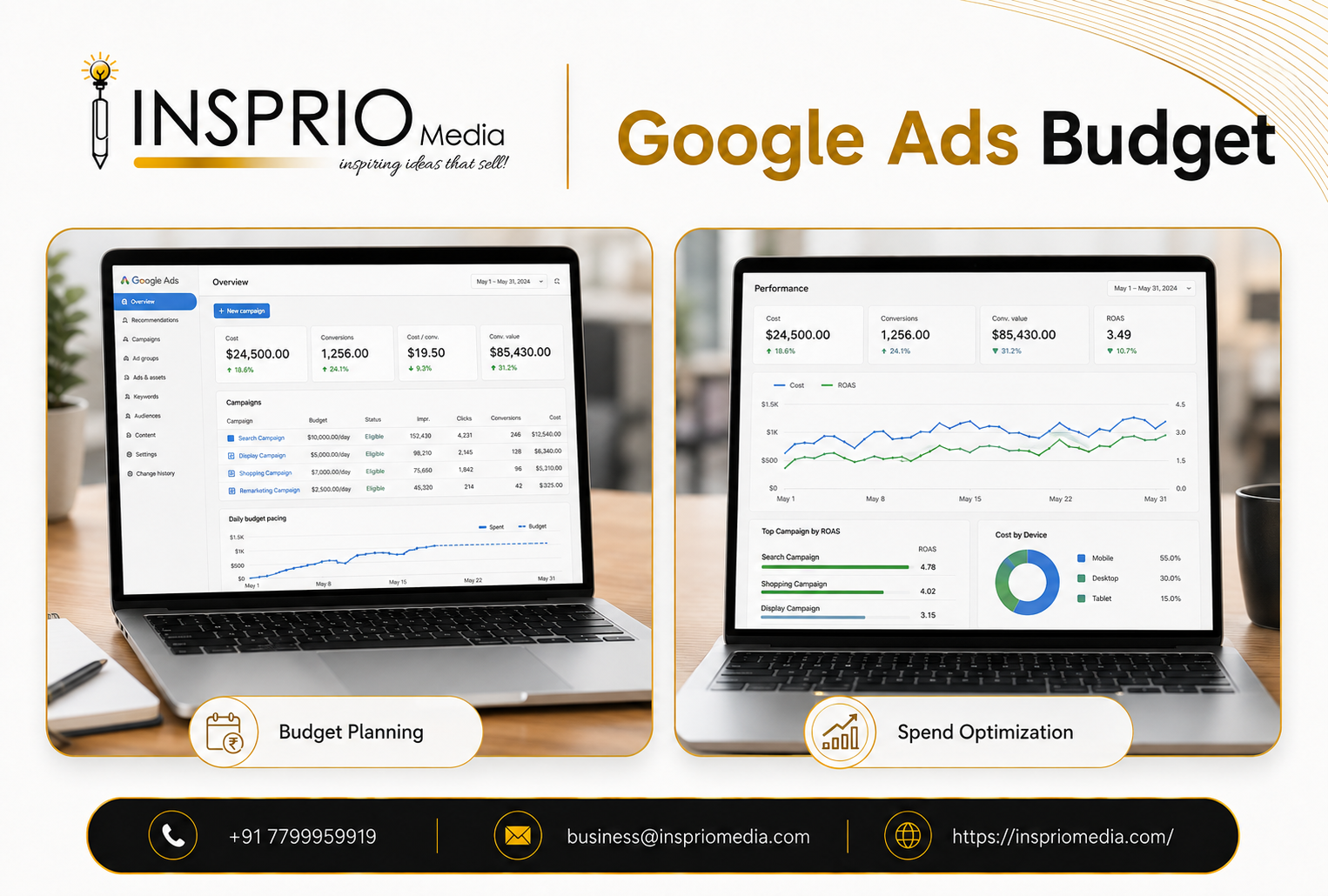
How much you should spend on Google Ads depends on how many customers you want, what a click costs in your market and how many clicks turn into enquiries. There is no universal figure. The right budget is the one big enough to collect meaningful data and win the searches that matter, and small enough that you can afford to learn.
A budget that is too small is a common way to conclude that Google Ads does not work, when the real issue was that the campaign never got enough clicks to judge.
Start from your goal, not a monthly figure
Work backwards. This takes ten minutes and gives you a defensible number.
- Decide how many new customers you want a month.
- Estimate how many enquiries it takes to win one customer. A clinic might close a fair share of booked appointments, while a B2B manufacturer may need many enquiries for one order.
- Estimate what share of website visitors become enquiries. If you do not know, use a cautious guess and replace it with real data after a few weeks.
- Find out what a click costs for your keywords, using the Keyword Planner in a Google Ads account as a rough guide.
Multiply it through, and you have the number of clicks, and therefore the spend, needed to reach the goal. If the number is higher than you can afford, that tells you something useful: either reduce the goal, narrow the targeting, or improve the conversion rate before spending more.
What affects your cost?
Click prices vary a great deal by industry, location, competition and time of year. Legal, finance, education, real estate and healthcare searches tend to cost more than local retail or simple services. Competition in Hyderabad for property or hospital keywords is not the same as for a niche industrial supplier in a smaller market.
Costs also depend on the quality of your campaign. Better ads and pages can lower what you pay for the same position, as we explain in our guide to Google Ads Ad Rank. That means two businesses with the same budget can get very different numbers of clicks.
Daily budget vs monthly spend
Google Ads uses a daily budget. On a given day Google may spend up to twice your daily budget, but over a month it should not exceed your daily budget multiplied by the average number of days in a month. Think in monthly terms and divide, but expect daily variation.
If your budget runs out early in the day, you may miss searches in the afternoon and evening, when your customers might be most active. Sometimes it is better to narrow the targeting, by location, hours or keywords, than to spread a small budget thinly across everything.
How much is enough to learn?
The honest answer is: enough to gather a pattern. A campaign that receives a few dozen clicks in a month cannot tell you much about conversion rate or lead quality. A few hundred well-targeted clicks begins to show a pattern.
This matters even more for automated bidding. Smart Bidding needs conversions to learn from, and a tiny budget produces too few. If you can only afford a small budget, choose a smaller target: one service, one city, one campaign, tightly focused. Do not try to cover ten services with the money for one. See our guide to Google Ads bidding strategies for how data volume affects the choice.
Budget by type of business
Local service businesses
Clinics, coaching centres, repair services and restaurants can often begin with a focused budget around one location and a few high-intent services. Measure calls and bookings, and grow as results prove out. Our article on Google Ads for small business goes further.
Ecommerce brands
The budget should reflect your margins. If your profit per order is small, you cannot afford a high cost per sale. Work out the maximum you can pay to win a customer, then check whether the market allows it.
B2B companies
Volumes are low and each lead is valuable, so budgets are often judged by cost per qualified lead rather than clicks. See Google Ads for B2B lead generation for details.
How to know if your budget is wrong
Signs it is too small:
- Your campaigns are limited by budget for most of the day.
- You get very few clicks and cannot draw conclusions.
- Impression share is low even for your most important keywords.
Signs it is too large for the current setup:
- Cost per lead rises as spend rises, with no gain in quality.
- Search terms are drifting into irrelevant areas.
- Your team cannot answer all the enquiries in good time.
In that case, fix the account before adding money.
Do not forget the cost around the ads
The ad spend is not the only cost. Include management fees if you use an agency, landing page and tracking setup, creative, and the time of whoever follows up on leads. A good campaign with a slow, unprepared sales process wastes the spend. Our overview of digital marketing cost in Hyderabad shows how these pieces add up.
A worked example with no currency attached
Suppose a dental clinic in Hyderabad wants twelve new treatment enquiries a month. From experience, one in three enquiries books an appointment, and the clinic believes about one in twenty website visitors from Google Ads will call or fill the form. Twelve enquiries at one in twenty means about two hundred and forty clicks. Multiply that by the average cost per click for the clinic's keywords and you have a monthly working figure.
Now check it against reality. If the clinic earns well from a patient who completes treatment, the number may be comfortable. If margins are thin, the clinic should narrow the service list to the highest value treatments, or improve the page so more visitors act. Notice that the budget came from the goal, not from guessing what other clinics spend.
Revisit the maths after the first month. Your real click cost and real enquiry rate will almost certainly differ from your starting assumptions, and that is useful. It is the reason to start with a controlled test and not a large commitment.
A sensible way to scale
Start with a budget you can sustain for at least two to three months. Check results against your goal. If cost per lead or sale is acceptable, raise the budget in steps rather than doubling overnight, and watch what happens to quality. If results are weak, find the cause before adding money: tracking, targeting, ads, page, offer and follow-up. More money rarely fixes a broken funnel.
Keep a reserve for testing
Set aside a small part of your budget, perhaps a tenth to a fifth, for testing new keywords, ads or pages. Without it, an account tends to repeat what already works and slowly stagnate. With it, you find the next improvement while the core campaigns keep delivering. Keep tests clearly labelled so you can judge them separately.
How Insprio Media can help
We help businesses in Hyderabad, across India and abroad set budgets from their own numbers, not a generic rule. If you would like a realistic estimate based on your market and goals, our Google Ads management team can walk through it with you, or you can contact us to discuss it.


















