
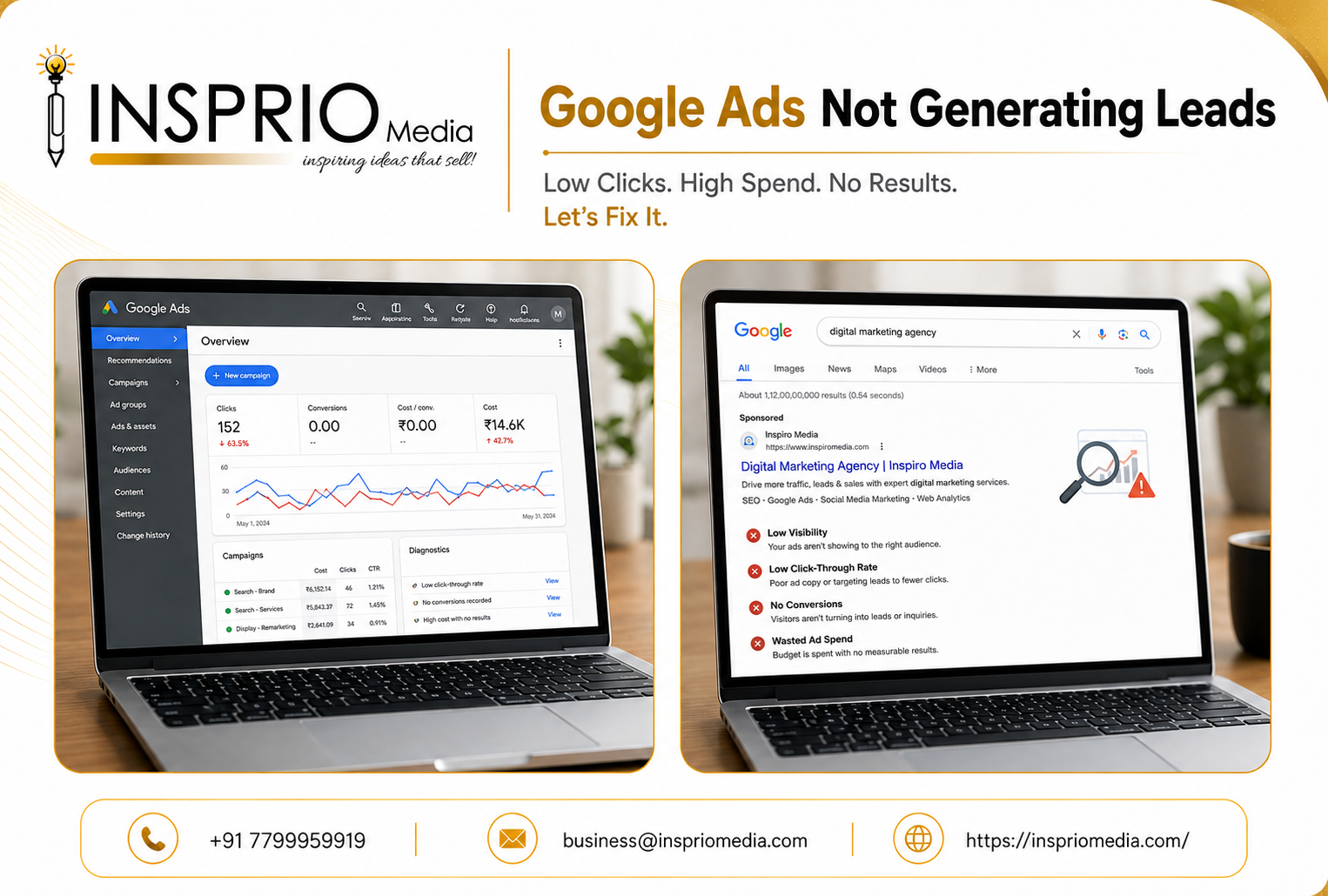
When Google Ads is not generating leads, the cause is almost always one of four things: the campaign is reaching the wrong searches, the landing page does not convince, the conversion tracking is wrong, or the leads arrive but nobody follows up properly. Raising the budget fixes none of these.
The useful first step is to find out which of the four you have. This guide shows how to tell them apart, and what a healthy account looks like so you know what to ask your agency or in-house team.
First, are you getting no clicks, or clicks with no leads?
These are different problems and need different fixes.
- Few impressions and clicks: the budget is too low for your market, bids are too low, approvals are blocked, or your targeting is so narrow that almost nobody qualifies.
- Plenty of clicks, no enquiries: the traffic is wrong, or the page and offer fail to convert it.
- Enquiries in Google Ads, but nothing useful in sales: a quality and follow-up problem, not an advertising problem.
Look at the Campaigns view for the last 30 days before changing anything. A clinic in Hyderabad that gets 400 clicks and zero calls has a very different problem from one that gets 12 clicks in a month.
The seven usual causes
Cause 1: You are paying for the wrong searches
This is the most common cause. Open the search terms report and read the actual phrases that triggered your ads. Many accounts show a mix of job seekers, students, DIY researchers, competitors and people looking for something you do not offer.
A real estate developer bidding on a broad phrase like "flats" will pay for people browsing rentals, builder jobs and price comparisons. A B2B manufacturer may attract buyers who want a single piece, not a bulk order. Every irrelevant click is budget gone with no chance of a lead.
Two things control this: your match types and your exclusions. Broad match combined with automated bidding can work, but only when the conversion data feeding it is clean. Without that, it tends to drift into loose, low-intent queries. Building a solid negative keyword list is a regular job, not a one-time setup.
Cause 2: The conversion tracking is broken or measures the wrong thing
Sometimes leads are coming in and the account does not know. Sometimes the account counts things that are not leads at all, such as page views or button clicks that happen on every visit. Either way, Google's bidding system is learning from bad information.
Check these basics:
- Does a real form submission, call or WhatsApp click register as a conversion, and only one conversion per enquiry?
- Are phone calls from the ad itself and from the website both counted?
- Do the numbers in Google Ads roughly match the enquiries your team actually received?
If the answers are unclear, fix conversion tracking before touching anything else. Optimising a campaign on faulty data makes it worse each week.
Cause 3: The landing page does not convert
Paid clicks cost money every time. If the page they land on is slow, confusing or generic, you lose most of them in seconds. Typical problems on Indian business sites:
- Ads pointing to the homepage instead of a page about the exact service searched.
- A form with too many fields, or a contact number that is hard to tap on mobile.
- Slow loading on a 4G connection, which matters because most local searches happen on phones.
- No proof: no reviews, no photos of real work, no clear statement of who the service is for.
- An offer that is vague. "Contact us" gives no reason to act today; a free site visit, a consultation slot or a quotation within a day does.
Our guide to Google Ads landing pages goes deeper. If your site is the weak link, a dedicated landing page built for one campaign often beats sending paid traffic to a general website.
Cause 4: Your budget and bidding do not fit the market
A budget that is too small spreads thin across too many keywords, so no ad group gets enough data to learn. Automated bidding strategies such as Maximise Conversions or Target CPA need a steady flow of conversions to work. If you get only a handful of conversions a month, an aggressive target can starve the campaign of impressions altogether.
Equally, too many campaigns on a small budget is a common pattern. It is usually better to run one or two tightly focused campaigns that can actually spend, than five that each get a few clicks a day.
Cause 5: The ad promises something the page does not deliver
Ad copy that is vague attracts curious clicks. Ad copy that is specific attracts buyers. "Interior designers" is vague. "Modular kitchen design for 2 and 3 BHK flats in Hyderabad" filters for people who have a real need.
Message match matters too. If the ad mentions a free consultation, the landing page should lead with it. A mismatch between ad and page raises bounce and lowers the quality of the click, which in turn can hurt your Quality Score and make each click cost more.
Cause 6: Leads arrive, but follow-up kills them
This one is not visible in Google Ads at all. A person who fills a form at 11 am and is called back at 6 pm has usually already spoken to two competitors. For high-value services such as healthcare, admissions or property, speed of response decides who wins the enquiry.
Ask honestly:
- How quickly is each lead contacted?
- Is there a clear owner for every enquiry?
- Are missed calls from ads being tracked and returned?
Simple automation, such as an instant WhatsApp acknowledgement and a CRM that logs every lead, closes much of this gap. It is also the only way to learn which campaigns produce customers, not just form fills.
Cause 7: The offer or the market is the problem
Sometimes the advertising is competent and the result is still weak. The price may be out of line, the service area too wide, or the product genuinely not searched for. In that case Google Search may be the wrong first channel, and testing demand through Meta ads or local visibility work may serve you better. A frank audit should be willing to say this.
A sensible order for diagnosing the problem
- Confirm tracking is accurate so the numbers can be trusted.
- Read the search terms and remove irrelevant traffic.
- Check that each ad group sends people to a matching, fast, mobile-friendly page.
- Review budget and bidding against how many conversions you really get.
- Audit lead handling after the form is submitted.
Resist the urge to change everything at once. If you change keywords, bids, ads and the page together, you will never know which change helped. For a wider list of avoidable errors, see our overview of common Google Ads mistakes.
How long should you wait before judging the campaign?
There is no fixed number, but a new account usually needs a few weeks of steady spend before patterns are meaningful, and longer if your sales cycle is long. Judging a B2B campaign after four days is as unfair as keeping a clearly broken campaign running for four months. Watch the trend in cost per qualified lead, not single-day swings.
How Insprio Media can help
We run Google Ads for businesses in Hyderabad, across India and abroad, and the team has managed large-brand search and programmatic campaigns. If your account is spending without producing enquiries, we can audit tracking, search terms, pages and follow-up and tell you plainly where the leak is. Start with our Google Ads management service or get in touch.


















