
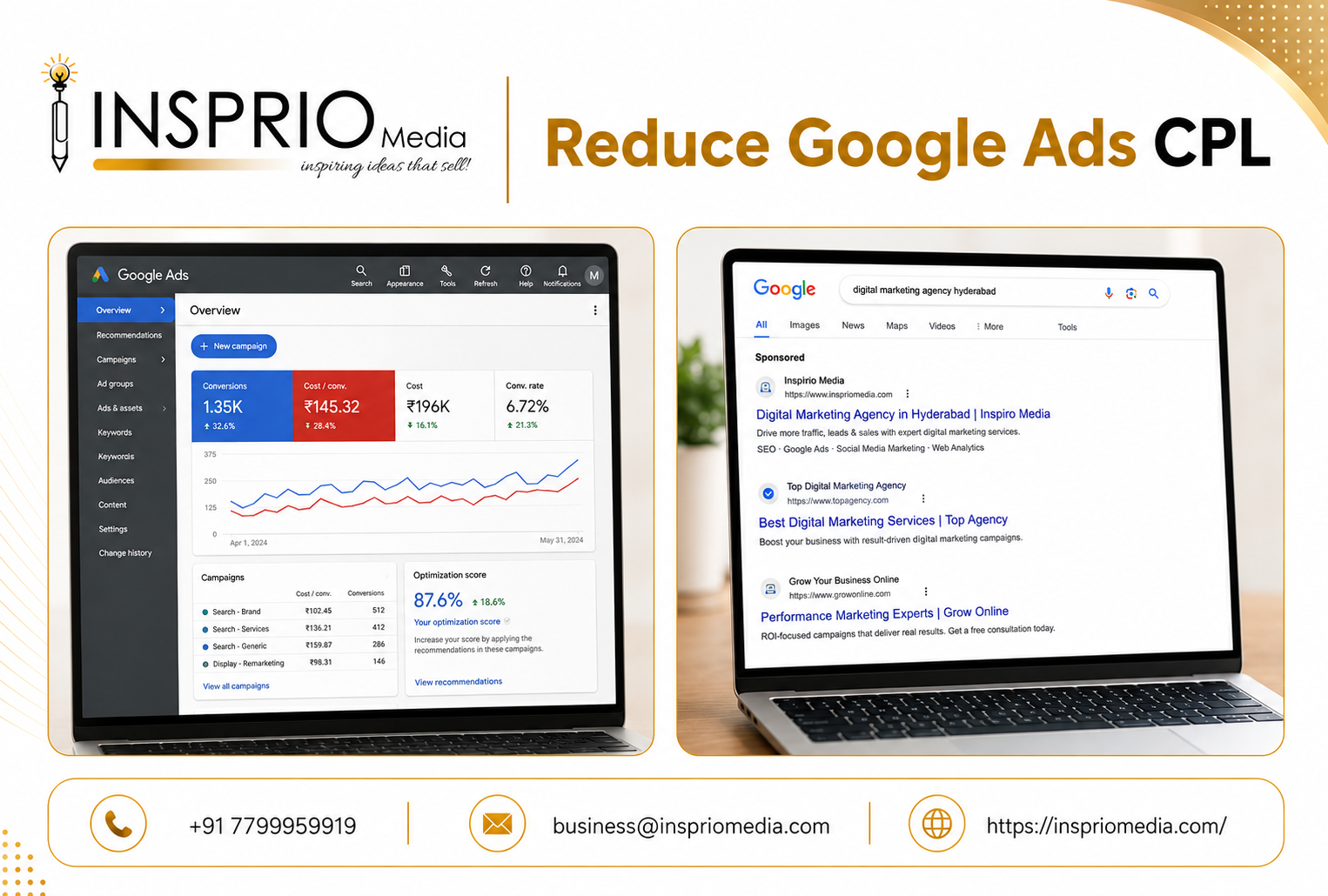
To reduce cost per lead in Google Ads, work on three things in this order: stop paying for searches that never convert, convert more of the clicks you already get, and feed Google accurate conversion data so bidding improves. Lower bids alone usually just reduce the number of leads.
Cost per lead (CPL) is your spend divided by the number of leads. It looks simple, but it hides the real question: what does each qualified customer cost? A cheaper lead that never buys is more expensive than a pricey one that does.
First, decide what a lead is worth
Before cutting anything, know your limit. Work backwards from what a customer is worth to you. If a Hyderabad interior design firm earns a healthy profit on one project and closes one in every few qualified enquiries, it can afford a far higher CPL than a coaching class selling a low-fee course. Without this, you will chase a lower number with no idea whether it is good.
Break your lead types apart as well. A phone call from a decision maker and a form fill from a student downloading a brochure are not the same lead. Our explainer on CPL, CPA and ROAS shows how these measures relate.
Why is your CPL high?
CPL equals cost per click divided by the share of clicks that become leads. So only two things can be wrong: clicks are too expensive, or too few of them convert. It helps to know which.
- High cost per click, normal conversion: a competitive keyword set, low relevance, or poor Quality Score.
- Normal cost per click, low conversion: poor traffic quality, a weak page or an unattractive offer.
- Both: start with traffic quality, because it affects everything else.
Remove wasted spend
The fastest savings usually come from cutting clicks that had no chance. Read your search terms report and look for irrelevant queries, such as jobs, free, DIY, or services you do not provide. Add them as negative keywords.
Then check where else money leaks:
- Locations you cannot serve.
- Devices or hours with clicks but no leads.
- Broad keywords that attract casual browsers, when specific phrases would capture buyers.
- Display or partner network placements switched on by default in search campaigns.
Be careful with pausing on thin data. A keyword with five clicks and no lead is not proof of failure; one with fifty clicks and nothing probably is.
Convert more clicks and give Google better data
Once the traffic is cleaner, the next gain is conversion. A small improvement in conversion rate cuts CPL without touching the auction. If a page converts one visitor in twenty and you lift it to one in fifteen, your CPL falls by a quarter with no extra ad spend.
What usually helps:
- One clear action per page, with the phone number and form visible without scrolling on mobile.
- Fast loading, since many Indian users browse on average phones and mobile data.
- A short form. Ask only what you need to qualify and call back.
- Real proof: reviews, work samples, certifications you truly hold.
- A page for each service rather than one page for everything.
Read more on Google Ads landing pages. If your current site is the bottleneck, a purpose-built landing page is often the cheapest improvement available.
Improve tracking and bidding together
Smart bidding strategies learn from your conversion data. If the account counts low-value actions, such as scrolling or page loads, as conversions, it will pursue cheap but useless ones, and CPL will look good while sales suffer. Count only real leads, ideally weighted by quality if you can pass back information from your CRM.
When conversions are accurate and steady, bidding strategies such as target CPA can help hold cost steady. Set the target realistically. A target far below what your market allows starves the campaign of traffic rather than lowering cost.
Raise Quality Score the honest way
Ad relevance, expected click-through rate and landing page experience affect how much you pay for a position. Tightly themed ad groups, specific ad copy and pages that match the query reduce cost per click over time. There is no trick here, but the gains compound. See our guide to Quality Score for what each part means.
Do not forget lead quality and follow-up
The lowest CPL in the account often comes from the worst leads: contests, freebies, vague offers. Track what happens after the form: contacted, qualified, visited, sold. If one campaign has a higher CPL but closes twice as often, it is the cheaper campaign.
Speed matters as well. Leads called back within minutes convert far better than those called the next day, and a missed call from an ad is a paid click wasted. A simple WhatsApp reply and a tracked CRM can improve results without changing the ads at all.
A simple way to think about it
Imagine a dental clinic in Hyderabad paying a certain amount per click, with one in every twenty visitors calling. If the page changes so that one in fifteen call, the cost per lead falls without any change in bidding. If the clinic also removes searches for dental jobs and cheap home remedies, fewer clicks are wasted and the same budget reaches more patients.
Now suppose a second campaign has a higher CPL but its callers book appointments far more often. The clinic should shift budget towards it. This is why CPL should always be read alongside what happens after the call.
Questions to ask your agency or team
- What is our cost per qualified lead, not just per lead?
- Which search terms brought leads that became customers?
- What portion of spend goes to searches we would not choose to pay for?
- What does the landing page convert at, and what has been tried to improve it?
- How quickly is every lead contacted?
Good answers are specific. If the reply is mostly about clicks and impressions, the account is probably not being managed on the number that matters.
Seasonality deserves a mention too. Admissions, wedding, festival and tax-season demand all push cost per click up for a few weeks. Compare like periods with like, and do not panic-edit a campaign during a spike that will pass by itself.
One more habit helps: keep a simple log of every change you make and the date. When CPL moves, you can then check whether it followed a change, a season or a competitor, instead of guessing after the fact.
Finally, set expectations with whoever signs off the budget. CPL will move up and down week to week, so judge it over a meaningful window and against your allowable cost, not against last week.
What not to do
- Slash bids across the board. You lose position and volume together.
- Cut budget on the campaign that brings customers because its CPL looks high.
- Change many settings at once and lose track of the cause.
- Compare CPL across channels without comparing quality and cost per customer.
- Accept any report that does not show leads reaching sales.
How Insprio Media can help
We review Google Ads accounts for businesses in Hyderabad, across India and abroad, and show where spend is wasted and where leads are lost after the click. Our Google Ads management works from cost per qualified lead, not clicks. You are welcome to contact us for an account review.


















