
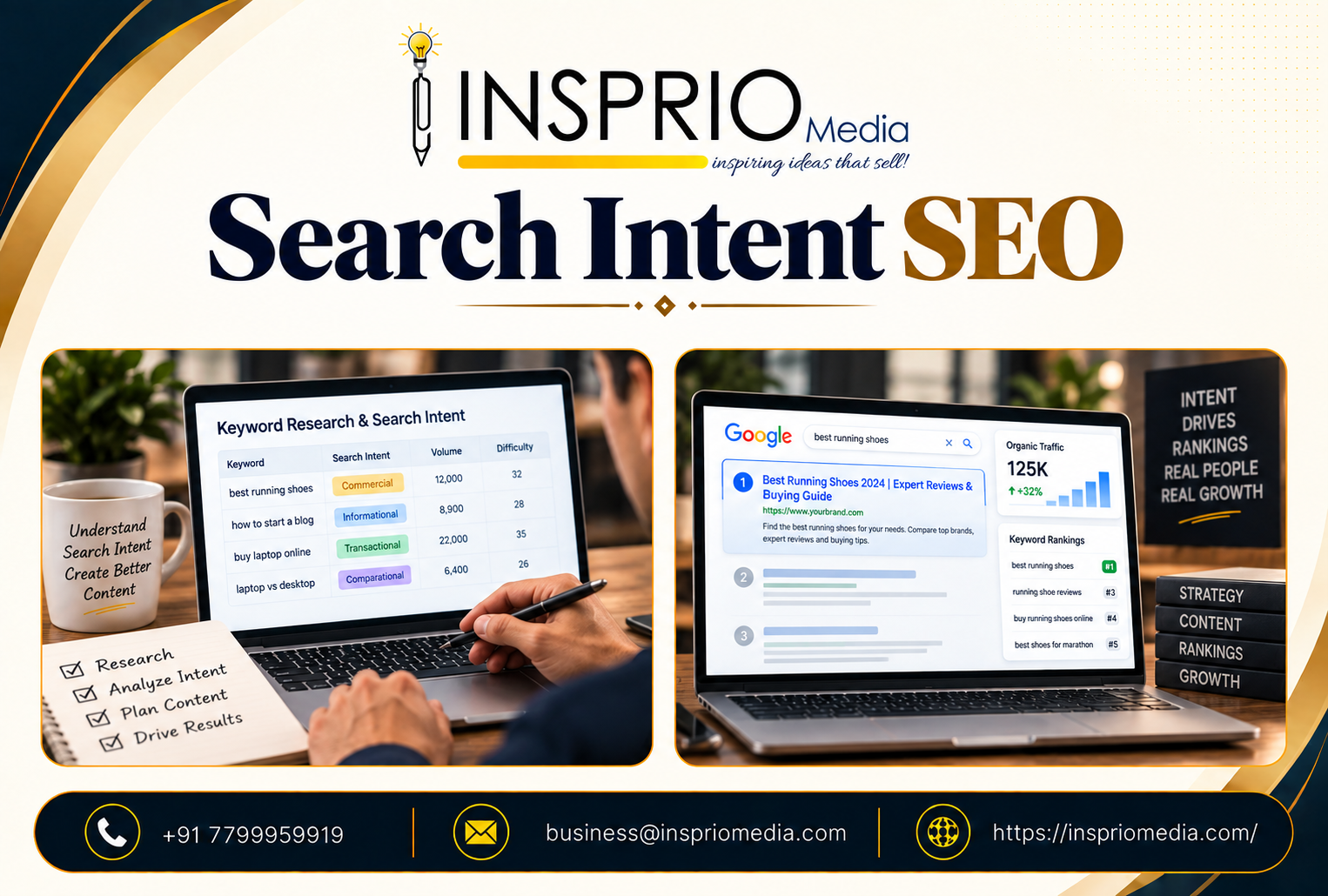
Search intent is the reason behind a search: what the person wants to know, find, compare or buy. Search intent SEO means building the type of page that satisfies that reason, instead of only repeating the keyword on a page.
It matters because Google's job is to show results people find useful. If your page is a sales pitch and the results are all how-to guides, the page will struggle however well it is written. Getting intent right is often the difference between a page that ranks and a page that never moves.
The four main types of search intent
Most searches fall into one of four groups. Real queries can mix them, but the groups are a useful starting point.
- Informational: the person wants to learn. 'What is a GST return', 'how to choose a school for a toddler'.
- Navigational: the person wants a specific site or place. 'Insprio Media contact', 'Apollo Hospitals Jubilee Hills'.
- Commercial investigation: the person is comparing options before deciding. 'Best CRM for small business', 'Shopify vs WooCommerce'.
- Transactional: the person is ready to act. 'Book dental implant consultation', 'buy cotton kurta online'.
A local intent layer sits across these. A search like 'physiotherapy near me' or 'interior designer Hyderabad' tells Google the person wants nearby businesses, which changes the results towards maps and local pages.
Why two similar keywords can need two different pages
'What is technical SEO' and 'technical SEO agency' share words but not purpose. The first wants an explanation. The second wants a provider to hire. Putting both on one page leaves both groups unsatisfied.
This is a common reason businesses publish a blog post for a keyword and then wonder why their service page, which they actually wanted ranking, does not move. The search wanted a service page, and the blog post answered something else. Matching the type of page to the query matters more than cleverly placing the phrase.
How to check intent in a few minutes
You do not need a paid tool to see what Google thinks a query means. Search it yourself, ideally in a private window, and read the first page of results as a customer would.
- What types of pages rank? Guides, product pages, category pages, local listings, videos?
- What format do they share? Lists, comparisons, step instructions, pricing tables?
- What features appear around them? Map pack, shopping results, 'People also ask', video carousels?
- Which angle do the top pages take? Beginner explanation, expert deep dive, cost breakdown?
The pattern you see is the intent Google has learned from user behaviour. Your page should fit that pattern and then be better at it. If you wish to stand out by doing something different, do it inside the format, not against it.
Watch for mixed intent
Some queries return a blend: a couple of guides, a few service pages and a map. That means Google is unsure, or that people want different things. In this case choose the angle that best fits what your business can deliver, and consider whether a second page is justified for the other intent.
Choose the page type before writing
Once you know the intent, decide what the page must contain. This sounds obvious, but many pages are written first and matched to a keyword later.
- Informational: a direct answer near the top, then depth, examples and next steps. An internal link to the relevant service is fine, but a hard sell is not.
- Commercial investigation: fair comparisons, clear criteria, honest trade-offs, and evidence. Readers can tell when a comparison is rigged.
- Transactional: what you offer, who it is for, proof, process, and a clear way to act. Remove distractions.
- Local: address, service area, hours, reviews, photos and a map, supported by a well-kept Google Business Profile.
The structure follows the job. A page that tries to teach, compare and sell all at once usually does none of them well.
A worked example: one topic, three intents
Take a Hyderabad school group. Parents search for 'best CBSE schools in Hyderabad', 'CBSE vs ICSE which is better' and 'admission process for Class 1 in Kondapur'. The first is a comparison, the second is informational, and the third is close to transactional with a local flavour. Three different pages are needed: a comparison of what to look for, an explainer on the boards, and an admissions page with dates, documents, contact details and a clear enquiry route.
If the school publishes one general page titled 'Best School in Hyderabad' and hopes it covers all three, it will rank for none of them convincingly. The fix is not more words. It is more clarity about what each page is for.
Intent for ecommerce and B2B
Ecommerce searches often split between category intent, such as 'running shoes for men', and product intent, such as a specific model. Category pages should help people browse and compare, with filters, short guidance and clear links. Product pages should settle the decision with specifications, images, reviews and delivery details. B2B searches often start as problem searches, so a manufacturer who only publishes product pages misses the early stage where engineers and buyers shortlist suppliers.
Intent and the buyer journey
Intent is also how you plan content across the customer journey. A parent looking at schools might first search for curriculum comparisons, then for fee structures, then for 'admissions open' and the school name. A buyer of industrial equipment might begin with how a machine works, move to specification comparisons, then request a quotation.
Each stage needs a page that meets the person where they are, and each page should link to the next logical step. Our article on the digital customer journey shows how these stages connect, and the guide to website user journey covers how visitors move once they arrive.
Common intent mistakes
- Targeting high-volume informational terms and expecting leads. Traffic is not demand for your service. Check whether the people searching could plausibly become customers.
- Using a blog post where a service page is expected. Or the reverse, a thin service page for a query that wants a guide.
- Several pages for the same intent. This splits signals and can cause pages to compete with each other. See our guide to keyword cannibalization.
- Ignoring the SERP features. If a map pack leads the results, a website page alone may not get seen.
- Never rechecking. Intent shifts over time. A query dominated by guides a year ago may now favour tools or videos.
Using intent to improve pages that already exist
Intent is just as useful for repairing old content as for planning new content. Take a page that sits on page two for a worthwhile query and compare it with the pages above it. If they are all comparison pages and yours is a general explainer, you may need to restructure, not merely add words. If you are not sure why an important page is stuck, why a website is not ranking on Google covers the wider list of causes.
Also look at what visitors do after landing. If people leave quickly or never click your call to action, the page may be attracting the wrong audience, or promising something the page does not deliver. Both are intent problems, not writing problems.
How Insprio Media can help
When we plan SEO, we start from the pages that should earn enquiries and work out what each search actually wants. That avoids producing content that looks busy but attracts the wrong audience. If you would like a review of how your key pages match their searches, see our SEO services or contact us.


















