
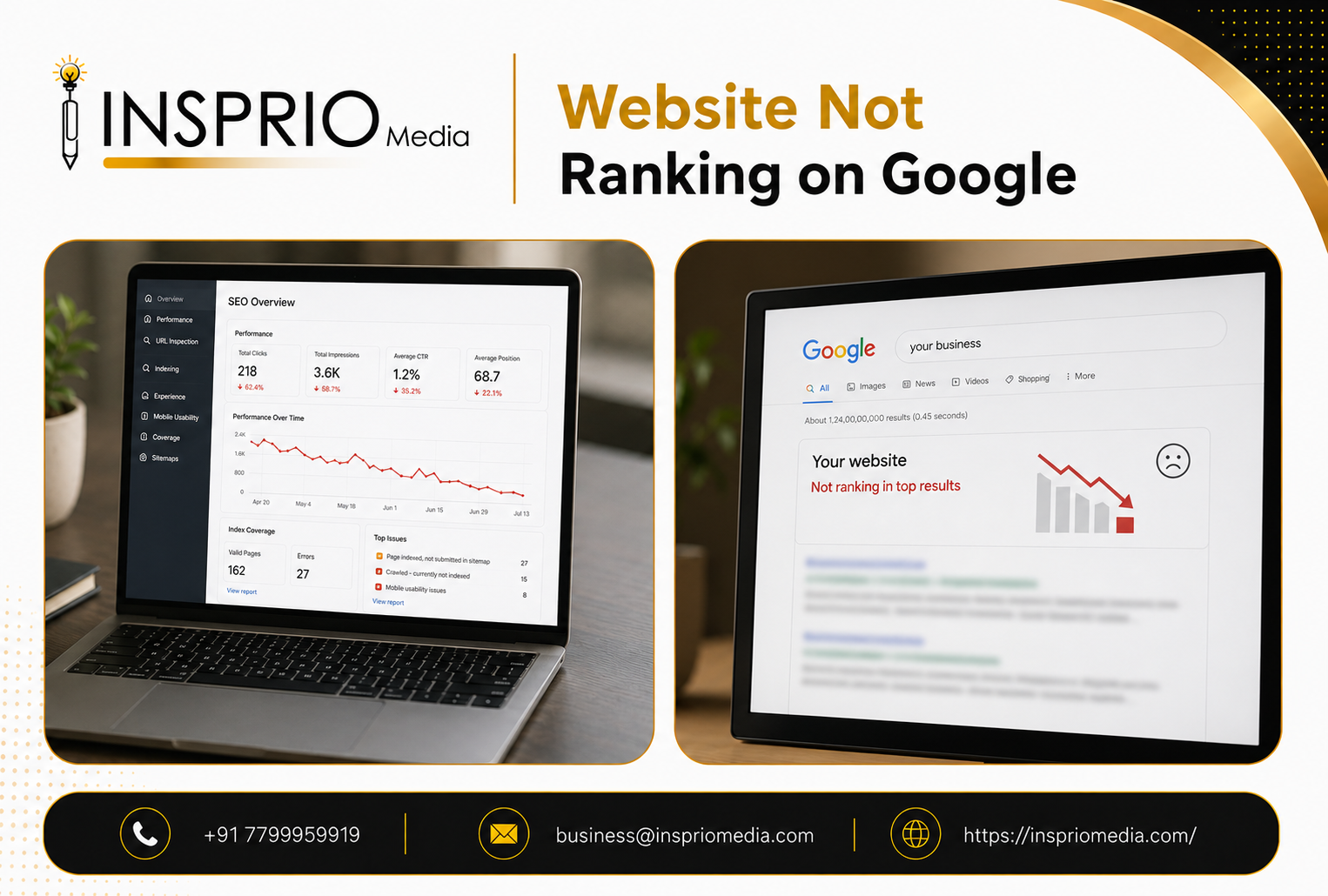
A website usually fails to rank on Google for one of five reasons: the pages are not indexed, the content does not match what searchers want, the content is thin or copied, the site lacks authority compared with competitors, or the technical setup (speed, mobile, structure) holds it back. Often it is a mix of two or three.
The right response is to diagnose before you change anything. Random fixes waste months, while the first check often takes ten minutes.
First, check whether Google can see the page at all
If a page is not in Google's index, nothing else matters. Search for your own business name and for the exact address of a key page. If neither appears, or Google Search Console reports the page as excluded, look at the likely causes:
- A leftover "noindex" setting from when the site was being built. This is surprisingly common after a redesign or a launch from a staging site.
- Crawling blocked by a robots file.
- A site so new that Google has not yet found it, or pages with no links pointing to them.
- Server errors, or pages that load only after complex scripts run.
These are quick to fix and the payoff is immediate. Search Console is free, and every business website should have it set up. Our technical SEO checklist explains the wider set of technical points.
Is the page answering what people actually want?
Ranking is largely a matching exercise. Google looks at what searchers appear to want and shows pages that satisfy it. A common failure is a page that targets a keyword but gives the wrong kind of answer.
Someone searching "dentist in Banjara Hills" wants local clinics, reviews, prices and a way to book. If your page is a general essay on dental health, it will not compete however well written. Someone searching "how to choose a CRM" wants guidance, not a sales page. Look at the pages currently ranking and note what type they are: service pages, comparison lists, guides, product pages. Then check whether yours is the same kind and at least as helpful. Our guide to search intent goes further.
Thin, duplicated or generic content
Sites that hold many short pages with near-identical wording tend to struggle. Typical examples are location pages with only the city name swapped, product descriptions copied from a supplier, and service pages with generic paragraphs that any competitor could have written.
What earns visibility is content that offers something specific: real examples, clear pricing guidance where possible, photos of actual work, local details, answers to the questions customers ask you every week. If your page could be pasted onto a competitor's site without anyone noticing, it is not giving Google a reason to rank it.
Also check for competing pages on your own site that target the same query, which splits relevance. See keyword cannibalization.
Authority: why bigger sites win
Google looks at whether other credible sites and people reference and trust you. A new website or one with few mentions will find it hard to beat established competitors for competitive keywords, even with good content.
This is not a reason for despair. It does mean choosing battles. Newer sites often do better aiming at more specific, lower-competition searches first, such as a particular service in a particular area, and building trust there. Real signals count: reviews, citations in relevant directories, mentions in trade publications, partnerships and genuinely useful content people link to. Avoid buying links or joining link schemes, which can lead to penalties. For approaches that hold up, read about link building strategies.
Technical and experience problems
A weak technical base rarely stops ranking on its own, but it makes everything harder.
- Slow loading, especially on mid-range mobiles on ordinary networks.
- Poor mobile layout, where text is hard to read or buttons are hard to tap.
- Messy structure, with important pages buried several clicks deep.
- Broken pages, redirect chains and unsecured pages.
- Intrusive pop-ups that cover the content.
Check these in Search Console and PageSpeed tools, and by simply using your site on a phone.
Local businesses: check your Google Business Profile
If you are a clinic, restaurant, school or service provider, much of your visibility comes from map results rather than classic website listings. A missing or inconsistent business profile can explain why competitors show up and you do not.
Check that your profile is claimed and verified, categories and services are accurate, your name, address and phone number match across the web, and you are collecting genuine reviews. A Hyderabad business serving particular areas should make sure its service areas and pages reflect those places honestly. See our guide to ranking on Google Maps in Hyderabad.
Is it just too early, or too competitive?
Sometimes nothing is broken. SEO takes time, and results for a new site commonly take several months to appear. Fiercely competitive terms such as "best interior designer in Hyderabad" or "digital marketing agency" may be out of reach for a long time against established brands.
Signs you are on the right path: pages being indexed, impressions rising in Search Console even without many clicks, and rankings for longer, more specific searches. Signs you are not: no growth after a long period, content that never gets impressions, or a strategy that changes every few weeks.
A simple order of diagnosis
Keep notes as you go: what you checked, what you found and what you changed. It stops you repeating work and makes it far easier to brief a developer or agency.
- Is it indexed?
- Does it match the intent of the search?
- Is the content distinct and helpful?
- Is the keyword realistic for your site's strength?
- Are there technical or experience problems?
- For local businesses, is the business profile in order?
Work through this in order, because earlier problems make later fixes pointless.
Mistakes that make things worse
- Rewriting every page at once. You lose the pages that were working and cannot tell what helped.
- Chasing more keywords instead of better pages. Ten average pages rarely beat two excellent ones.
- Buying cheap backlinks. They rarely help and can create a problem you then need to clean up.
- Judging by one search from your own phone. Results are personalised and vary by location, so use Search Console data instead.
- Changing the site constantly. Give each change time before judging its effect.
A realistic example
Consider a Hyderabad physiotherapy clinic whose website has been live for four months with no enquiries from Google. A look in Search Console shows that only the home page is indexed, and the service pages were set to noindex by the developer during the build. Once that is fixed and the pages are linked from the main menu, impressions begin to rise. The clinic then finds that its treatment pages are generic, so it adds local detail, practitioner profiles, real photos and answers to common patient questions, and builds up reviews on its Business Profile. None of this is clever. It is a sequence of ordinary problems, found in the right order.
How Insprio Media can help
We review sites across these areas and tell business owners plainly what is holding them back, rather than promising rankings no one can guarantee. If you would like a second opinion, see our SEO services or contact us.


















