
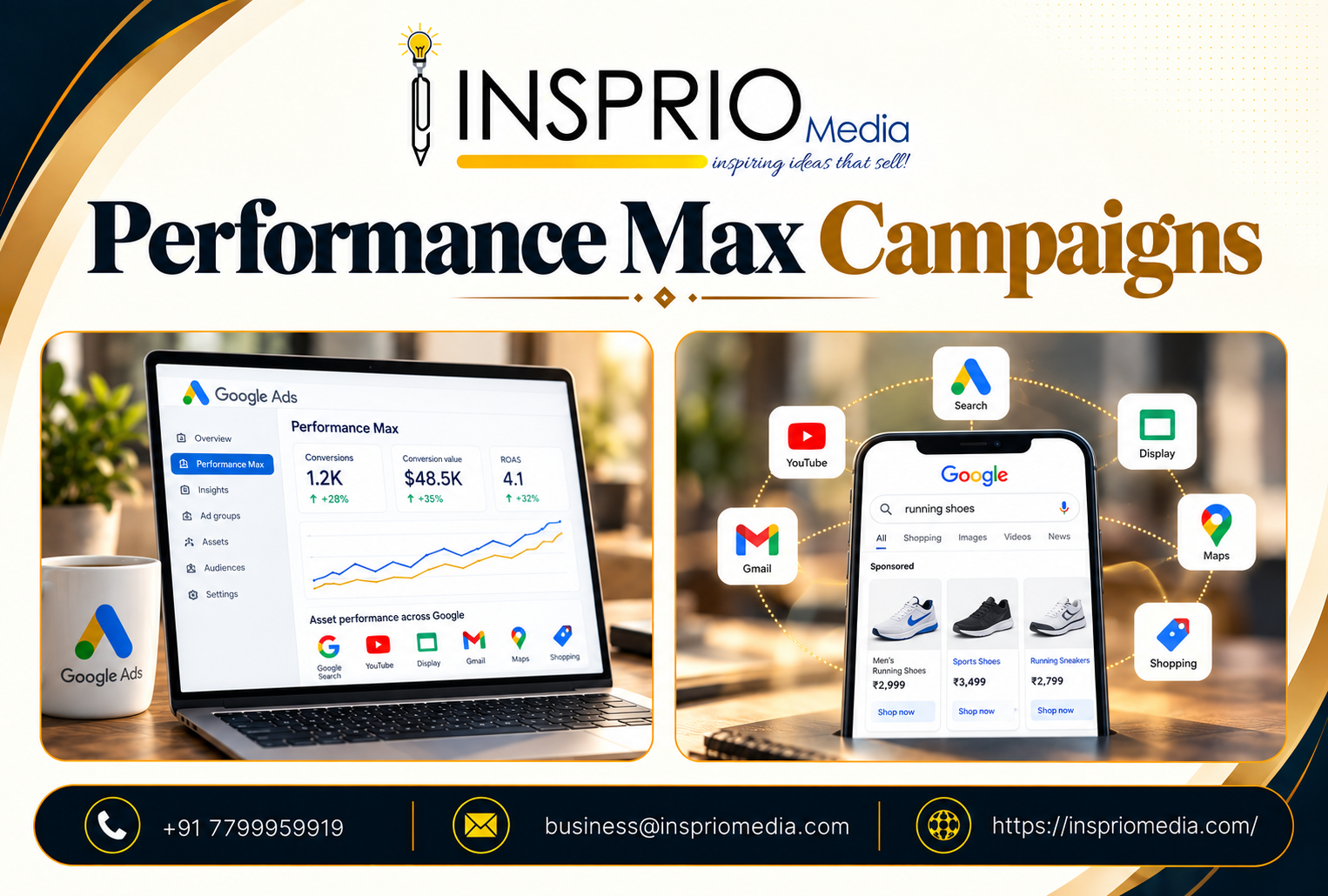
Performance Max is a Google Ads campaign type that runs your ads across all of Google's channels from a single campaign: Search, YouTube, Display, Discover, Gmail and Maps. You provide the goal, creative assets, a budget and optional audience signals. Google's automation decides where each ad appears, to whom, and at what bid.
It can work well for businesses with solid conversion tracking and good creative. It can also quietly waste money when the goal is poorly defined or the lead quality is not monitored. It is a strong tool, but not a default answer.
How Performance Max campaigns work
A traditional Search campaign is built around keywords. Performance Max is built around goals and assets. You supply headlines, descriptions, images, logos and videos, grouped into an asset group. Google then assembles ad combinations and shows them wherever it predicts a conversion is most likely.
Three inputs shape what it does:
- Conversion goals. The system optimises for the actions you tell it matter. Wrong goals mean wrong results.
- Assets. Quality, variety and relevance of your creative decides what the system has to work with.
- Signals. Audience signals and search themes give Google a starting hint about who your best customers are.
Because the system picks placements itself, you get less direct control than in Search. Google has added more reporting and control over time, including channel-level reporting, brand exclusions and account-level negative keywords, but it remains less transparent than a keyword-based campaign.
Performance Max vs Search campaigns
The question is rarely which one to pick, but which one to start with and how they work together.
| Question | Search | Performance Max |
|---|---|---|
| Main input | Keywords and ads | Goals, assets and signals |
| Control over searches | High | Lower |
| Reach | Search results | All Google channels |
| Creative needed | Text | Text, images, often video |
| Best for | High-intent demand capture | Scaling with good data |
For most lead generation businesses, a well-run Search campaign is the safer foundation. Performance Max then adds reach once you know what a good lead costs. For ecommerce, especially with a product feed, Performance Max is often a core part of the account from early on.
Who should use Performance Max?
It tends to suit
- Online stores with a product feed, clean product data and tracked purchases.
- Businesses with steady conversion volume, so the system has something to learn from.
- Brands with decent visual assets, including video, who want visibility beyond Search.
- Local businesses promoting multiple locations, such as a restaurant chain or a hospital group, where Maps and local visibility matter.
It tends to be risky for
- Accounts with unreliable or missing conversion tracking.
- Very low budgets, where there is not enough spend to test across channels.
- B2B companies with long sales cycles and few leads, where automation lacks signals and lead quality is hard to see.
- Businesses that rely on tight control of where their brand appears.
Conversion goals decide everything
This is the most important and most neglected part. Performance Max will chase whatever you count as a conversion. If you count every form fill including spam, it will find more spam. If you count a page view, it will find cheap page views.
For lead generation, aim to measure actions that reflect real interest, such as qualified enquiries or calls of a meaningful length, and where possible feed back offline outcomes like a site visit booked or an order closed. Our article on Google Ads conversion tracking covers why this foundation matters.
Asset groups, audience signals and search themes
Asset groups
Think of an asset group as a themed set of creative for one product or service line. Mixing unrelated services in one group creates muddled ads. A real estate developer, for example, would keep different projects or customer types separate rather than throwing everything together.
Audience signals
Signals are suggestions, not restrictions. Examples include your customer list, website visitors and people with relevant interests. Google may show ads beyond them if it predicts conversions, so do not expect them to limit reach the way targeting does in other platforms.
Search themes
Search themes let you add topics to guide Google toward the kind of searches that matter to you. They are hints, not keywords, so they do not give keyword-level control.
The common ways Performance Max goes wrong
- Counting low-value conversions. The campaign looks cheap and busy while sales stay flat.
- Weak or generic creative. Stock-like images and vague copy lead to poor engagement. Even good automation cannot fix an unclear offer.
- Brand cannibalisation. If branded searches dominate the results, the campaign may take credit for people who would have found you anyway. Use brand exclusions and compare results with your Search campaigns.
- Judging too early. The system needs time to learn. Frequent changes in the first few weeks restart that learning.
- Ignoring lead quality. A cost per lead that looks fine may hide poor-fit enquiries. Check the leads, not just the dashboard.
- Replacing everything at once. Moving all spend into Performance Max without a comparison leaves you unable to tell what worked.
How to judge whether it is working
Look beyond the headline number. Ask whether total business results improved, not just the campaign's own reporting. Compare enquiries and revenue before and after, review the quality of leads with your sales team, and look at channel and search category reports to see where the spend actually went.
Be patient but not passive. Give the campaign a fair learning window, then judge against the cost per lead or return you need. If you use automated bidding, make sure the target matches reality, as covered in our guide to Google Ads bidding strategies.
Performance Max and the rest of your marketing
Performance Max works best as part of a system. Your website must load fast and convert, your Google Business Profile should be accurate for local visibility, and your SEO should cover the organic side of demand. Paid and organic support each other. If you are weighing the two, our comparison of SEO vs PPC explains how they fit together.
What good creative looks like for Performance Max
Because the system mixes and matches your assets, every piece must work on its own and alongside the others. A few principles help:
- Show the real product, space or team. A genuine photograph of your clinic, showroom or dish usually does more than a polished but generic image.
- Provide several angles: price-led, benefit-led, proof-led and location-led messages, so the system has real variety to test.
- Include video. If you do not supply one, Google may generate one automatically from your other assets, and you may not like the result.
- Keep claims honest and specific. Vague lines such as best quality add nothing, while concrete details such as opening hours, delivery area or warranty terms give people a reason to act.
If you need help producing photos or short videos, our reels and video production team makes assets designed to work across several formats. Good creative is often the cheapest improvement available in a Performance Max account, and the one most often skipped.
How Insprio Media can help
We set up and manage Performance Max for ecommerce and lead generation clients, starting with tracking and goals before any creative. If you want to know whether it fits your business, or why your current campaign is not delivering, our Performance Max campaigns service is the place to start.


















