
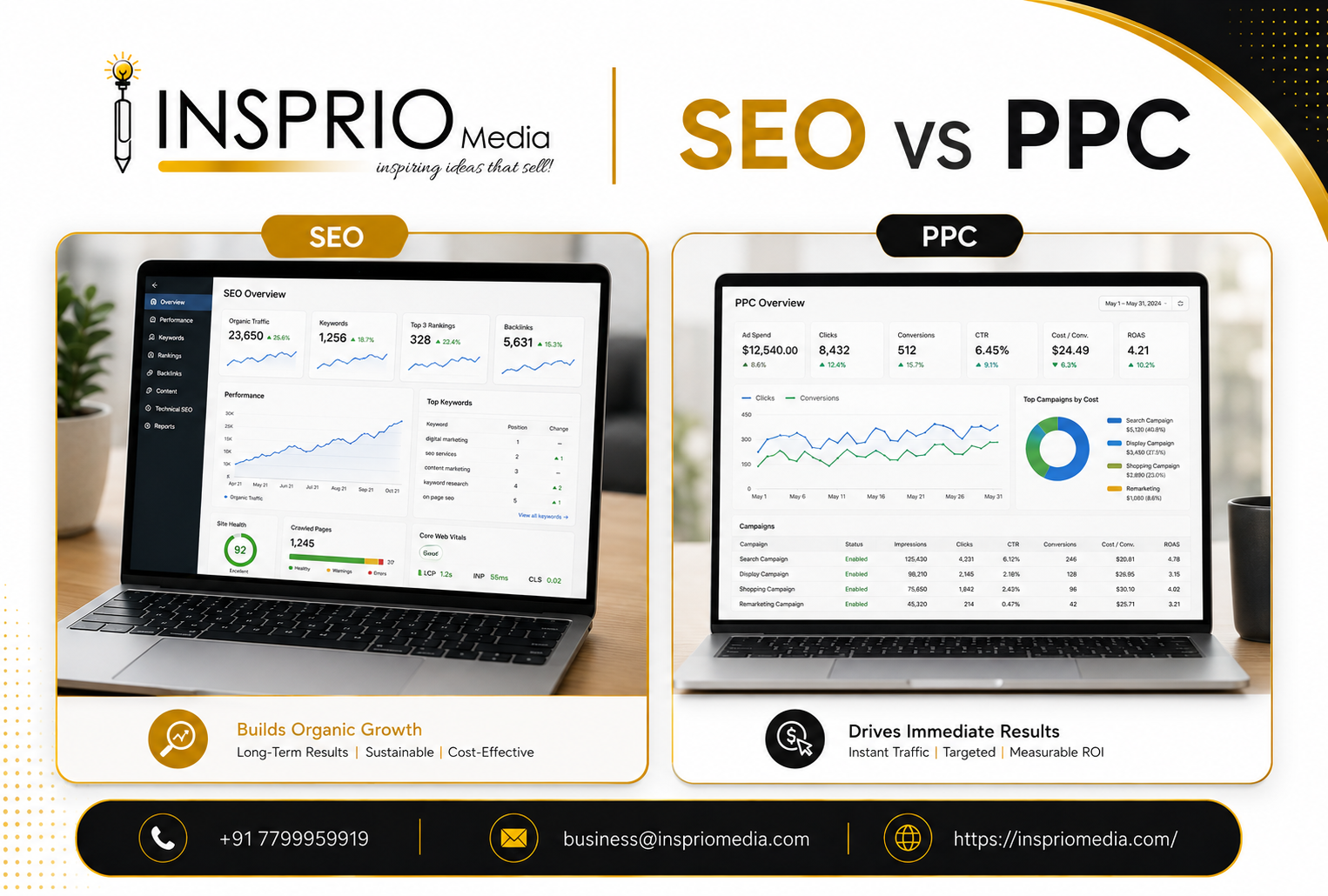
SEO and PPC both put your business in front of people searching on Google, but they behave differently. PPC (pay-per-click ads) can bring enquiries within days and stops the moment you stop paying. SEO takes months to build but keeps bringing visitors without a charge per click.
Neither is better in every case. The right choice depends on how quickly you need customers, how competitive your market is, what a customer is worth, and how much patience your cash flow allows.
How the two actually differ
| Factor | SEO | PPC |
|---|---|---|
| Time to first results | Usually months | Days to a few weeks |
| Cost per visit | No charge per click, but ongoing investment in work | You pay for every click |
| If you stop | Rankings fade slowly, if at all | Traffic stops immediately |
| Control | Limited: Google decides rankings | High: you choose keywords, locations, budget and message |
| Best for | Long-term, steady demand | Fast testing, launches, time-sensitive offers |
One difference matters more than the table suggests. With PPC you buy visits, so cost rises with competition. With SEO you build an asset, so each new page and each earned review makes the next one easier. That asset can also be lost, as Google updates and competitors keep changing the picture.
When PPC is the better first move
Choose PPC first when you need leads soon, or when you want to learn what works before committing to long-term work.
- New business or new location: you have no rankings and no reviews yet, and need enquiries now.
- Time-bound offers: an admissions season for a school, a festival sale for a retailer, a property launch.
- High-value customers: a B2B manufacturer or a specialist clinic can afford to pay more for each click because one customer is worth a great deal.
- Testing demand: ads show you which searches lead to enquiries, which also informs your SEO later.
PPC works best with tight targeting and a good landing page. Poorly set up, it is also the quickest way to waste money. Our guide on common Google Ads mistakes lists the usual culprits.
When SEO deserves priority
SEO is the better foundation when demand is steady and you can wait. It suits businesses whose customers research before buying, or whose clicks are expensive.
- Expensive keywords: in competitive fields such as real estate, education and legal services, paid clicks can be costly, and strong organic rankings lower the average cost of acquiring a customer over time.
- Local services: clinics, salons and restaurants in Hyderabad benefit hugely from local SEO and a well-managed Google Business Profile, because map results get a large share of attention.
- Content-led trust: buyers of complex products often read several pages before contacting anyone.
The caution: SEO has no guarantees and no fixed timetable. Anyone promising specific rankings by a specific date is not being straight with you. Our guide to choosing an SEO company explains what to look out for.
Which gives better ROI?
It depends on the time frame you measure over. In the first few months PPC almost always looks better, because SEO is still being built and costs money without visible return. Over a year or more, well-executed SEO often delivers customers at a lower average cost, because you are no longer paying for every visit.
But that statement carries conditions. SEO only wins if the work produces rankings for terms that bring buyers, not just traffic. And PPC wins whenever its cost per customer stays comfortably below what a customer is worth. Judge both on cost per customer and profit, not on clicks. See how to improve marketing ROI for how to measure properly.
Why running both usually works best
The two channels help each other:
- PPC data shows which keywords and messages convert, so SEO effort goes where it pays.
- Strong organic results sit alongside your ads, and appearing in both builds trust and takes up more of the results page.
- Ads cover the gap while SEO matures, and can be scaled back as organic traffic grows.
- Remarketing can bring back visitors who first came from organic search.
You do not need equal budgets. A small business might start with a modest ad budget on its most profitable service, while building its local SEO and website in the background. As organic results strengthen, it can shift spend to new areas rather than paying for what it already ranks for.
One caution: do not assume you can cut ads on your brand name without testing. In some cases competitors bid on your name, and removing your ad lets them take the click. Test it carefully and watch actual enquiries.
What each looks like for different businesses
A few typical patterns show how the choice plays out.
- A new dental clinic in Hyderabad: runs search ads for core treatments in nearby areas to fill the diary, while building its Google Business Profile, collecting patient reviews and creating service pages that will eventually rank.
- A D2C brand: uses paid search and shopping ads for products people already search for, and relies on SEO for informational content and category pages that reduce dependence on ads over time.
- A B2B manufacturer: uses paid search for specific, high-intent product searches, and SEO to publish technical pages, specifications and application guides that buyers and engineers look for before sending an enquiry.
- A coaching institute: leans on paid campaigns during admission season, with year-round SEO and local presence to keep enquiries flowing between peaks.
Budget is the other practical question. With PPC, your spend is a dial you control: you can start small, learn which searches pay, and raise it as results justify. With SEO, the cost is mostly in work and time, so the risk is not wasted clicks but paying for months of activity without a clear plan or reporting. Ask any provider what will be done each month and how you will tell it is working. See our guide to how much to spend on Google Ads for a way to size the paid side.
Mistakes that make either channel look bad
Many businesses conclude that SEO or PPC does not work when the real problem is elsewhere.
- Judging SEO after six weeks, before it has had time to work.
- Running ads to a home page with no clear offer or contact route.
- Targeting broad keywords in both channels without checking which ones bring buyers.
- Ignoring calls and WhatsApp enquiries in tracking, so the true results go unseen.
- Stopping ads and SEO together, then wondering where the enquiries went.
Fix these before deciding that a channel is the problem.
How to decide for your business
- How soon do you need customers? If weeks, start with PPC.
- What is a customer worth? Higher value supports more paid spend.
- How crowded is the market? Check what clicks seem to cost before committing.
- Is your website ready? Neither channel works well on a slow or confusing site.
- What can you track? Both need reliable measurement of calls, forms and sales.
If the website is the weak link, fix it first. Our article on SEO for small business covers where a limited budget does the most good.
How Insprio Media can help
We handle both sides: SEO services and Google Ads management, so the advice you get is about your numbers, not about selling one service. If you are unsure which to start with, tell us about your business and we will give you an honest view.


















